She was just seventeen years old. Yet, her voice stopped a raging tide of anger in its tracks.
London: A City Ablaze
In June 1780, London's streets bristled with chaos. The Gordon Riots, ignited by deep-seated religious tensions, transformed the city into a battleground. It began as a protest led by Lord George Gordon against the Papists Act of 1778, which eased restrictions on Catholics. In a city already simmering with economic hardship and distrust, the protest erupted into a violent frenzy. For six days, London was unrecognizable. Prison gates were shattered, distilleries were pillaged, and infamous Newgate Prison reduced to mere cinders. The air was thick with smoke, a harrowing testament to the mob's wrath and the helplessness of the city's defenders. Firelight flickered against the soot-streaked faces of those who hoped only to survive the night.
In this tumultuous environment, the boundary between safety and destruction was razor-thin. Devastation loomed large as furious mobs descended upon homes and businesses, eager to quench their destructive thirst. However, amidst inferno and ire, tales of unexpected valor surfaced, stitched together by the courageous acts of ordinary people. It was in such moments that a young servant girl's daring encounter with a marauding mob became more than just a footnote in history, but a narrative of fearless resilience.
The Encounter at the Doorstep
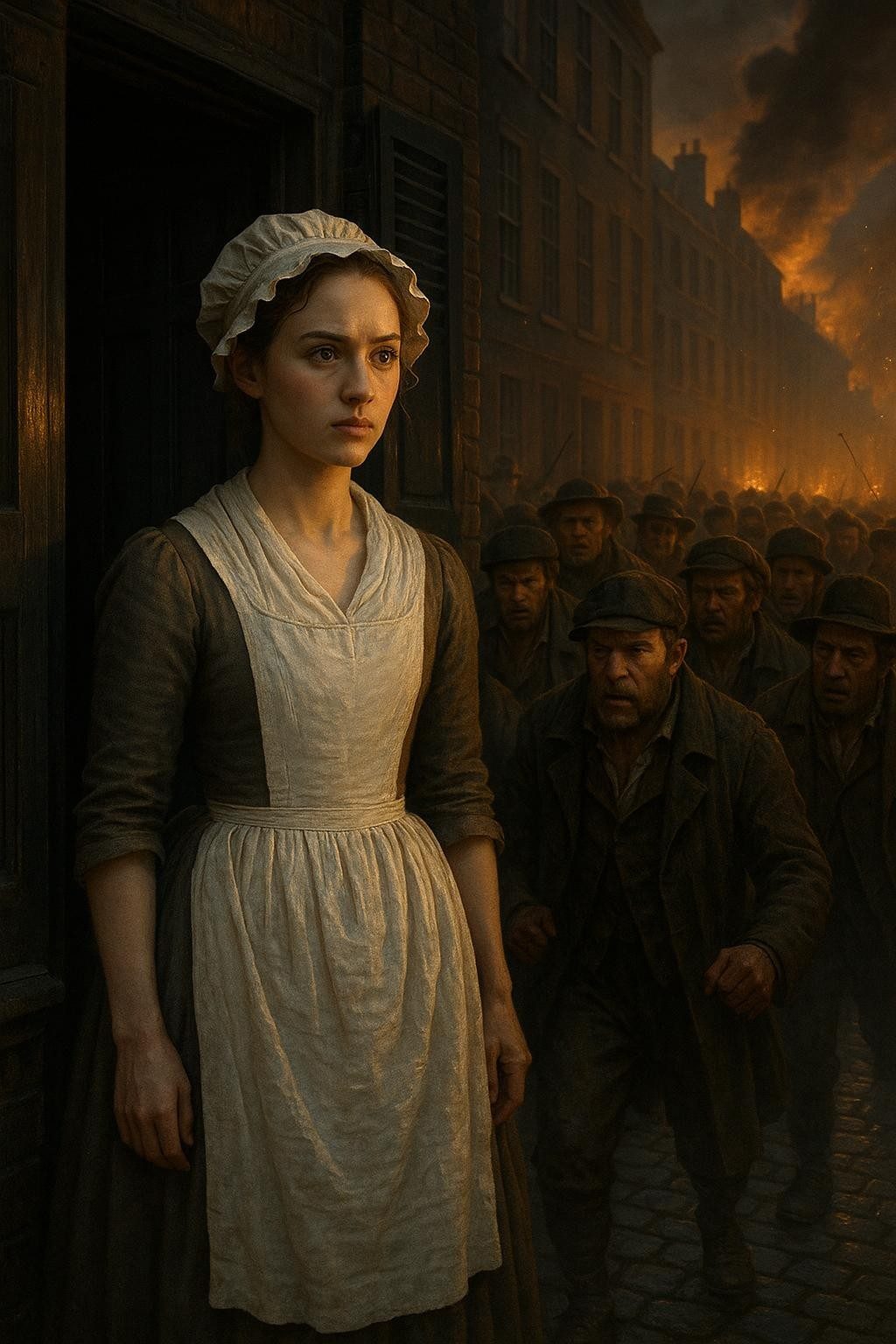
In an unremarkable quarter of the city, a figure stood defiantly before her master's house. A teenage servant, unnamed and largely forgotten by history, appeared in the threshold. The house's occupants no doubt huddled within, their hearts pounding in synchrony with the mob's chants, their breaths shallow with fear. Outside, torches bobbed menacingly in the hands of the mob as intent and purpose melded into a singular vision of destruction.
Read next: The Day a Surgeon Walked Into a Prison and Freed a Madman
What prompted this young girl to step forward when all others sought refuge remains a mystery. Yet, there she stood, framed by the doorway like a sentry guarding a fortress. Her task was monumental. For those few moments, the future of her master’s house—and perhaps her life—hung precariously on the strength of her words.
She faced them unnoticed, invisible yet undeniable. The clamor of the mob lulled beneath the quiet power of her voice. To them, she might have been no more than a servant, a girl of little consequence. But she commanded courage that belied her station. Perhaps it was the raw humanity in her plea, or the surprising boldness of her stance that paused the chaos. One can only imagine her words, laden with a truth that caught them unexpected, words that ruptured the cacophony with a call for sanity. And somehow, against the odds, it worked. The mob retreated, their intent diffused by a solitary figure's quiet courage.
A Forgotten Heroine
The historical stage is seldom kind to those of modest origins. The annals of the 1780 Gordon Riots preserve the tales of destruction and prominent figures like Lord George Gordon himself, while the story of this courageous servant girl stands unclaimed and largely uncelebrated. Her name is lost to time, much like the quiet heroes whose daily bravery shapes history from the shadows. Despite her anonymity, her actions ripple through the ages, illuminating the power of individual courage amid collective madness.
Through the haze of smoke and history, one can visualize her. Perhaps her hair was matted with the soot of burning buildings, her eyes reflecting the inferno consuming her city. Yet her voice, calm and resolute, carried a strength that spoke to something deeper—a universal hope that humanity could triumph over chaos. Her success in averting tragedy speaks volumes about the capacity of silent strength; a lesson as relevant now as it was in her era.
Why Her Story Matters
The tale of the teenage girl who calmed a London mob is a reminder of the extraordinary power of ordinary voices. In a city where power often lay in the hands of the few, her actions remind us that true strength is democratic and often manifests when least expected. Her story, though obscured by the shadows of more infamous accounts, shines through the soot-soiled veil of the Gordon Riots as a beacon of individual agency and heroism.
In today's world, which still grapples with its own tumult and unrest, this unnamed girl's courage serves as a pertinent reflection—an unremembered lesson from the past. It represents a call to action for those who might otherwise consider themselves inconsequential. Her forgotten encounter illustrates that bravery doesn't require recognition or renown, only the will to stand firm in the face of adversity. This teenage girl, though lost to the textbooks and untethered from a name, reminds us of the profound impact a single voice can have in altering the course of history.