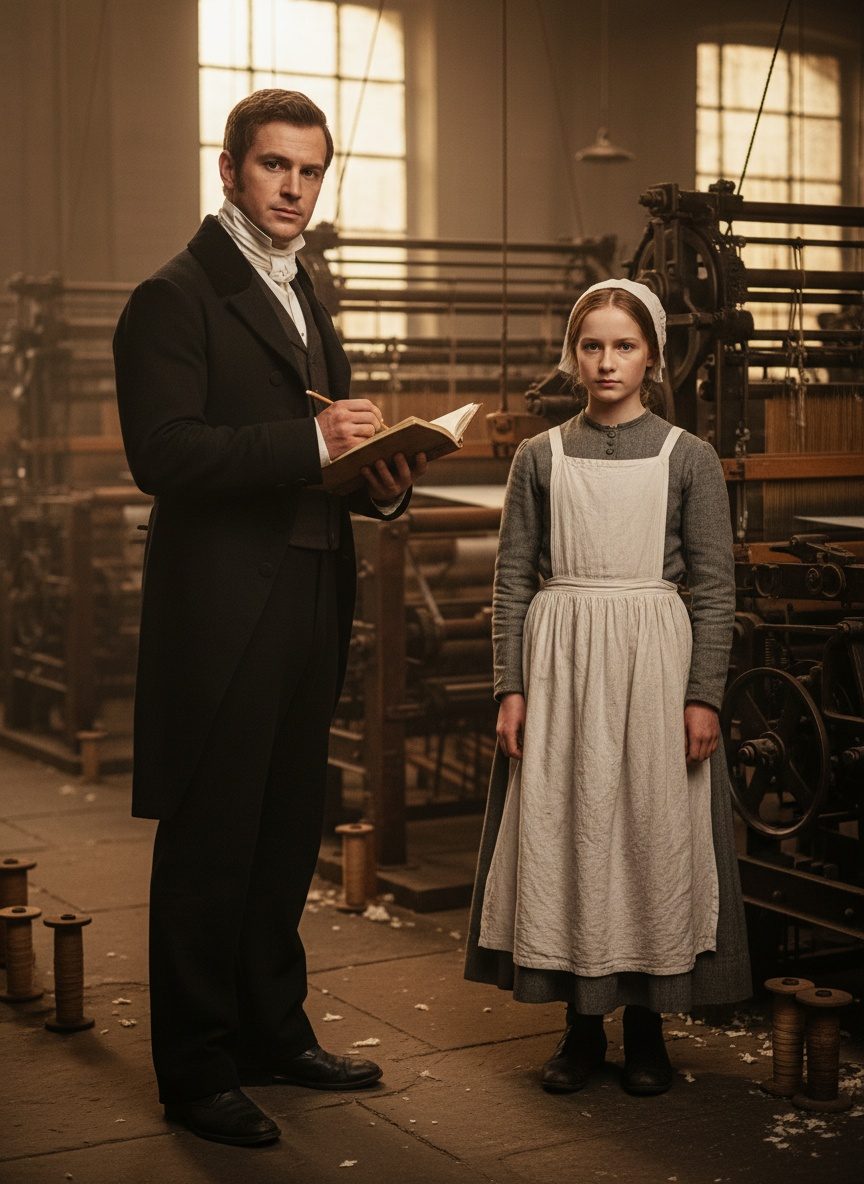
She was ten years old. She was about to stand up to one of the most powerful industries of her time.
The Loom and the Law
In the heart of the Victorian era, amidst the relentless hum and clatter of mill machinery, a hidden drama was unfolding inside the textile factories of Yorkshire. The Industrial Revolution had brought about vast changes, transforming Britain's economic landscape. Yet, every leap in productivity came at the human cost of its workers. Among these workers was Elizabeth Bentley, a small figure with a profound impact. At just ten years of age, Elizabeth had already been laboring for several years in one of Bradford’s textile mills. Her workday was grueling—thirteen hours of labor, six days a week, often in oppressive conditions of noise and dust.
It was in this harsh environment that Elizabeth's chance encounter with a factory inspector occurred, placing her unexpectedly in the spotlight. Tasked with ensuring compliance with labor standards, factory inspectors were a new presence in industrial towns but often met with resistance from mill owners. Despite this, when one inspector visited in 1833, it was Elizabeth's unvarnished account of life inside the mill that became the turning point in a broader push against child labor. Her words were not premeditated or chosen for effect—she simply described her life as she lived it. Yet, her story shook those who heard it, painting a picture stark enough to reach lawmakers and audiences far beyond Yorkshire.
What Elizabeth didn't realize as she spoke was that she was becoming an inadvertent advocate for a new vision of childhood—a protected time, separate from the toils meant for adults. At a time when many in society felt that putting children to work was a necessary evil, required for the financial survival of struggling families, she was providing evidence that would challenge these assumptions.
Read next: The Day a Surgeon's Son Chose Death Over Silence
Testimony of the Innocent
Elizabeth's testimony was more than just a recounting of daily hardship; it was a peek behind the industrial curtain, revealing a reality that much of Britain's upper class had chosen to ignore. Within the dark, confined spaces of the factories, children like her ensured the looms kept turning, but at the cost of their health and future. The very idea that such young children were enlisted in this ceaseless, demanding labor became a moral crisis for the nation upon hearing accounts like hers.
Her description of exhaustion, injury, and unending roar of machinery was raw, depicted with all the innocence of a child who knew no alternate reality. Little bodies were tasked with nimble jobs—crawling under dangerous machines to tie broken threads, cleaning parts while the gears still ground ever onwards. Elizabeth’s story, like many untold ones, laid bare the human elements often glossed over in statistics; it provided a deeply personal context that numbers alone could not.
Elizabeth Bentley didn't set out to change the world, nor perhaps did she understand the weight of what her simple truths would catalyze. As tales of young children crippled by their tasks awakened a collective conscience, British society began to ask itself uncomfortable questions about the price of progress. Her account was pivotal in swaying public opinion and galvanizing support among social reformers, advocates, and some parliamentary members. Within months, debates that would have once seemed fanciful now took center stage—over how Britain could reconcile its industrial ambitions with the welfare of its youngest citizens.
The Factory Act and Beyond
The Factory Act of 1833 emerged as the critical legislation that sought to curtail the exploitation of child labor. While imperfect and limited by modern standards, it was a watershed moment—marking the first significant attempt to regulate child labor in Britain. The act set minimal age limits for working children and restricted their working hours, aiming to bring relief to those who had known none. It authorized regular inspections, a move hastened by firsthand accounts like Elizabeth's, ensuring that future generations might escape the fate she endured.
Read next: The Day a Chimney Sweep's Son Shamed a Whole Parliament
This law, influenced by the experiences of countless children, signaled the beginning of a shift towards balancing industrial progress with human dignity. Although resistance from industrialists persisted, changes were undeniably underway. The narrative of progress now included human cost as a crucial factor, and the factories themselves began to evolve in light of this understanding.
Elizabeth Bentley's quiet act of bravery reveals a larger truth about power, reform, and society's responsibility to its most vulnerable. In an era of rapid industrialization, where children's contributions were weighed solely in terms of output, her story was a catalyst that helped ignite wider debates. It served as an early but essential step towards the broader labor reforms of the late 19th and early 20th centuries.
Today, as we reflect on the legacy of industrial growth and its impact, Elizabeth's story reminds us of the human faces behind legislative progress. Her bravery, though spoken softly in a factory’s shadowy room, echoes decisively through history, challenging each generation to ask whose voices they ignore and what steps they take toward justice and compassion.