He was no stranger to bravery, but he had never been in a battle. The determination of a Welsh schoolmaster-turned-captain transformed history at a remote mission station in 1879.
The Calm Before the Roar
On the evening of 22 January 1879, the British mission station at Rorke’s Drift found itself on the precipice of legend. Positioned near the banks of the Buffalo River in Zululand, the station seemed an unremarkable wooden outpost amidst the vast African plains. But beneath the serene surface, a storm brewed. As dusk settled, rumblings of a Zulu force—almost mythic in its size and intent—crashed into the consciousness of the men stationed there. Commanded by a lieutenant who refused to heed evacuation orders, the garrison of 139 men, many bedridden with illness, knew their fate was entangled with the strength of a soldierly collective that seemed miraculously defiant in the face of certain annihilation.
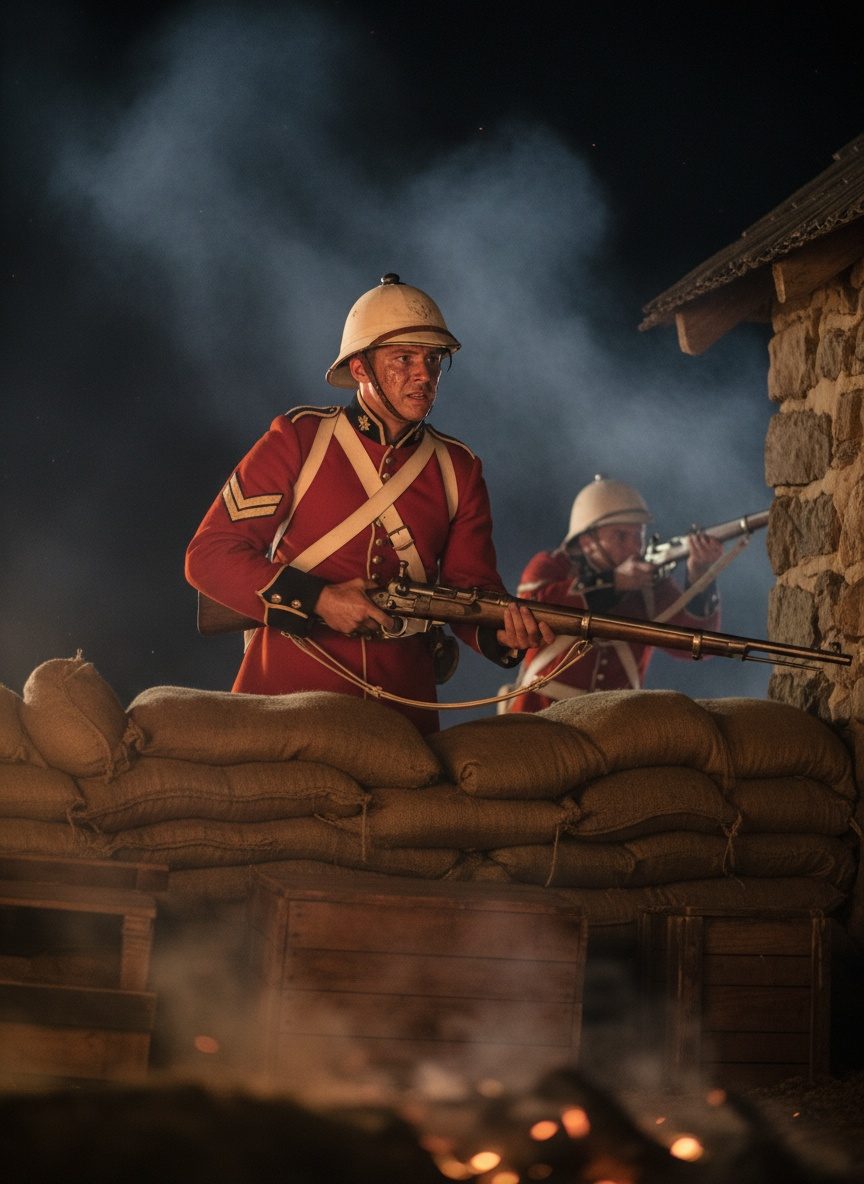
The Zulu warriors, numbering around 10,000, had earlier in the day decimated a larger British contingent at the Battle of Isandlwana. Word of the devastating defeat reached Rorke's Drift, catalyzing anxiety into an acute awareness of impending doom. The cries of Zulu warriors in the distance only accentuated the tension, a cultural clash piercing through the air, as tradition and technology prepared to meet in the darkness. In those early evening hours, Captain John Williams and Lieutenant Gonville Bromhead organized their men within makeshift defenses. Crates, flour sacks, and furniture were stacked hastily to form barriers. Each makeshift bulwark whispered a litany of desperation, echoing the heartbeats of men choosing to stand rather than flee.
Nightfall and the Furnace of Combat
The attack began as twilight surrendered to night, each second folding the defenders into a dance of desperation and valor. Lancers, bathed in the flickering light of the burning hospital, thrust into a wall of humanity—Zulu warriors driven by tradition, hunger, and the promise of honor. Spears clashed against bayonets in a mad symphony, the night air ripped apart by shouts and gunfire. Inside the hospital, patients who had never donned a military uniform in health now found themselves enacting warplays with real stakes. From their beds, they hurled volleys of gunfire and grit, spurred on by the courage of improvised captains setting aside pain for purposes marked in blood and smoke.
The flames consuming the hospital turn walls into embers, walls transfer in a baptism of fire. As each room was engulfed, men evacuated, squeezing into just-defended spaces, nursing both wounds and hopes of survival. Yet amid the chaos, the impromptu barricades held strong. Every burning ember that flew off represented another second wrested from despair. And every Zulu voice that fell silent in the ceaseless onslaught bore testament to human resistance refined in the crucible of circumstance. Remarkably, the defenders did not falter. Each man, whether carrying a rifle or a wound, invoked a courage that became foundational to the mythos of empire.
Read next: The Day a Chimney Sweep's Son Shamed a Whole Parliament
A New Dawn and Lasting Echoes
With the arrival of dawn on 23 January, the sun streamed over a tableaux of valor mixed with loss; the clash that raged through the night had yielded to quietude. The Zulu withdrawal came as silently as it descended, leaving behind a battlefield that whispered repercussions far wider than immediate victory or loss. Eleven Victoria Crosses were awarded for the actions at Rorke’s Drift, drawing the eyes of an empire onto the heroism spun from dire circumstances. The staggering valor displayed shone a light on both the enduring persistence of soldiers at war and the complexity of the colonial tapestry binding Britain’s influence across uncharted lands.
The defenders of Rorke's Drift held fast not merely to sway the outcome of an isolated skirmish but to etch into history a burgeoning example of courage that underscores the turbulence of Victorian imperial ambitions. The legacy of this clash stretches beyond mere numbers and tactics. It serves as an exploration into the nature of collective fortitude—a rippling chronicle of humanity where narratives of empires and transformations are drawn from the line between hope and demise. In a night where every second counted, Rorke's Drift exemplified an ethos of resolute endurance that still echoes across time, a stark reminder of fortitude in its rawest form.