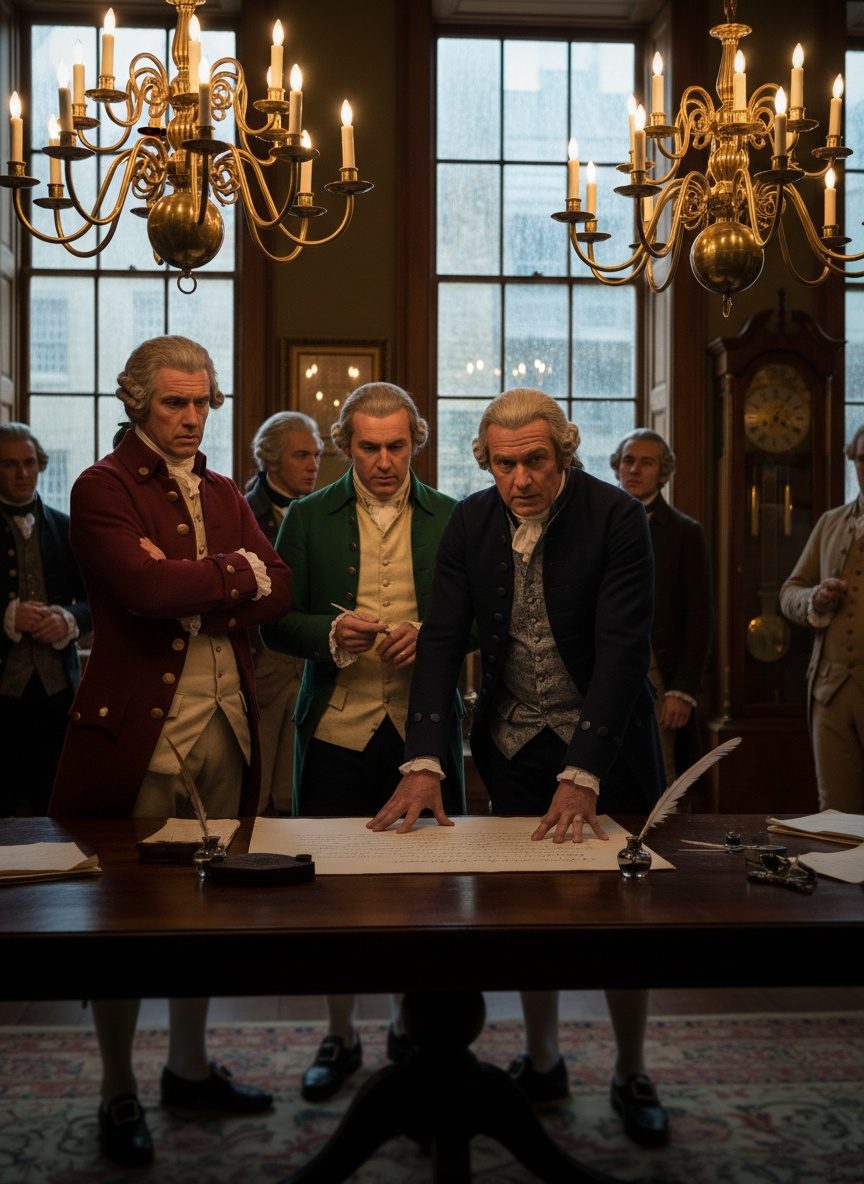
July 4, 1776. The air shimmered with summer heat as Philadelphia bustled with anticipation.
On this day, representatives in the Continental Congress gathered to sign a document that would resonate through the ages: the Declaration of Independence. For Britain, this moment marked not just the loss of its American colonies but, paradoxically, the culmination of the very ideas the British themselves had nurtured. The American authors of the Declaration were merely articulating principles deeply rooted in English political thought. Indeed, the rights of Englishmen had crossed the Atlantic, evolved, and rebounded back, vigorously challenging the authority of their original custodians.
This was an ideological revolution birthed by Britain’s most cherished philosophical exports. It was the world’s largest ironic misadventure. Raised on the Magna Carta's ideals and the vigorous debates of the English Civil War, Americans embraced concepts that had matured through the thoughts of English philosophers like John Locke. They grew from subjects to students—and ultimately, dissenters—to the crown. The Declaration itself articulated principles that were, in essence, British: the idea that government should be based on the consent of the governed, that tyranny should be resisted, and that laws must be applied equally. These were not foreign concepts but had been fostered and ironed into the very fabric of English society over centuries.
Picture the scene in colonial America: settlers who conceived themselves as Britons — or close enough with expectations to match. They were familiar with the significance of being free men under the law, a core tenet of their identity, as enshrined by the English Bill of Rights of 1689. They had not cut their ties to their heritage; rather, they meticulously traced the lineage of their liberties back to their British forefathers. The irony was not lost on these Americans when they found themselves upholding the very framework England intended, against its enforcement by their own actions.
Read next: The Day a Black Sailor Walked Into Court and Freed Himself
The colonial terrain was fertile, prime for cultivating autonomy and self-governance. Yet, Britain, grappling with its geopolitical ambitions, saw the colonies more as cogs within the larger empire machine. The burgeoning population in America demanded more autonomy, fueled by the same Enlightenment zeitgeist sweeping across Europe. These settlers had come to see their destiny as something separate, and perhaps superior, to the land they once called home. In Britain, there was, perhaps, a myopic underestimation of what generations of self-governing settlers could turn into—a force definitively unwilling to relent from ideals they had long owned.
It is thus obscured in our textbooks how the very documents Britain cherished became their colonies' weapons. While John Adams, Thomas Jefferson, and their contemporaries are often heralded as uniquely visionary, they were, to an extent, echoing back to England its own philosophic spirit. Jefferson's pen here crafted not an American doctrine, but rather a profound reassertion of established British philosophies. The Crown’s empire was disarmed with the profoundly English words that the colonists fashioned into an armor of independence.
Read next: The Day a London Clerk Walked Into Court for a Dying Slave
What Britain faced in the 1770s was not an upheaval stemming from foreign barbarism, but a civilization asserting rights Britain taught it to value. The Americans managed to articulate a new political vision, uniting Enlightenment principles and British legal and political thought, to legitimate their independence. Each phrase of the Declaration still spoke the language of the British: beautifully paradoxical, betraying no animosity but an unyielding demand for fairness and dignity. Each grievance aired a distinct echo of the turbulent relationships battled and legally liaised over years in Westminster.
The stirring and perilous transformation from British subjects to independent Americans was, in a sense, a family affair of ideological inheritance. Americans were not ungrateful children but rather the prodigal offspring who learned their lessons a bit too well. Despite the distance in miles, their intellectual closeness bridged the colonies and the crown with burdens harder to sever. By clinging fast to the mutual British past, they carved out a future audaciously independent yet inherently familiar.
Much can be learned today by revisiting this crucial era and its context. When we reflect on modern political struggles about governance, self-determination, and the spreading of liberal rights, we trace much of that ethos back to this pivotal event. The loss of America was not the empire faltering but its philosophy proving too successful. In the relentless drive for self-governance, colonies from North America sowed the seeds that would forever change the understanding of freedom and sovereignty worldwide.
Thus, the day Britain effectively signed away its own crown jewel, we witness not mere geographical estrangement but the compelling pursuit of the ideals it cherished itself. As Americans declared independence, they signaled that principles seeded amongst ancient oak trees of England could, under the right conditions, blaze national entities capable of reshaping the world. It is a profound historical twist that the rhetoric of the Declaration of Independence, with its ideals of democracy and individual rights, continues to inspire not just Americans, but people everywhere, to claim what are even yet acknowledged universally as inherent human rights. And so Britain’s true loss was not territorial nor economic—it was the chimeric promise that others, inspired by its own ideals, could redefine sovereign destinies. That legacy, born from centuries past, still boldly declares itself far beyond the textbook confines.