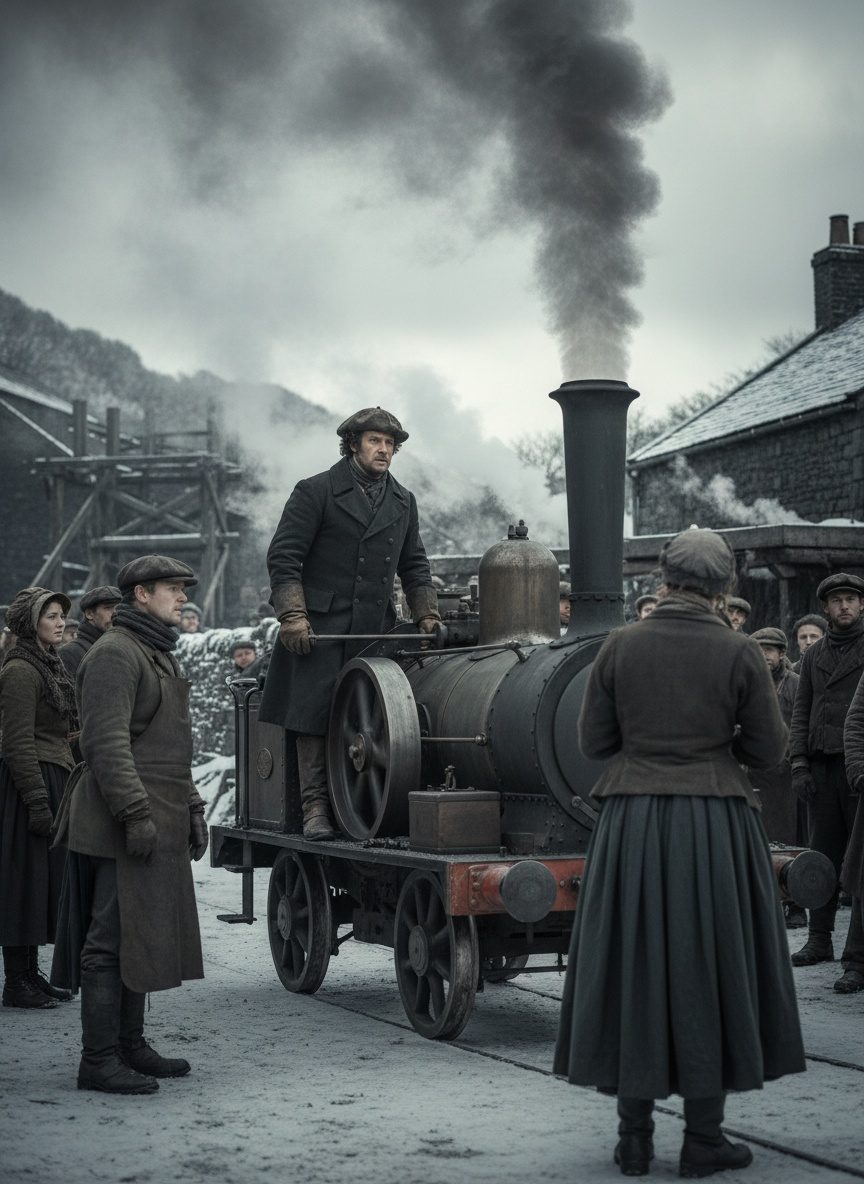
February 1804. Frost clung stubbornly to every surface in Merthyr Tydfil.
The Whisper of Steam and the Promise of Change
On a crisp February morning, the air was electric with anticipation. The industrial heart of South Wales throbbed quietly under a mantle of frost, the landscape marked by stark hills and valleys steeped in coal dust. This was a place where the rhythm of life was dictated by the clatter of picks and the roar of iron. Yet, on this auspicious day, a different kind of roar was set to command attention — a mechanical marvel that would rewrite the almanac of industry across the globe.
A crowd gathered near Penydarren Ironworks, eyes fixed upon a peculiar sight: a machine born from the dreams and determination of a Cornishman. Richard Trevithick, a self-taught engineer, stood beside his creation — an iron behemoth hissing with promise and potential. It was not the first time Trevithick had set his sights on the impossible, but today was special. For those present, this machine was more than a curiosity; it was the harbinger of the future, an odd steel creature that threatened to unshackle them from the ancient demands of muscle and sweat.
The Iron Beast Awakens
As Trevithick stoked the fires of his steam engine, clouds of white vapor billowed into the frigid morning air, dancing to the hum of whispers and speculation. The engine was bulky and rugged, a testament to the industrial age — a paradox of both elegance and might. The machine, ten tonnes of iron tethered in strength, was coupled to five wagons. Each wagon was loaded with iron, the combined weight and mass a considerable burden for any beast.
Read next: The Day a Weaver's Son Lit Britain's First Public Railway
The sight was extraordinary: seventy men stood ready to board this untried contraption, a testimony to shared courage and intrigue. As the engine juddered to life, Trevithick controlled the throttle with the careful precision only a creator could possess. Those present had never seen anything quite like it: a train, a dynamo of metal and steam, making its way down an iron tramway with no horses leading the charge.
The engine groaned and creaked, not unlike the strain of a titan waking to face an unknown world. Slowly, but steadily, it began its journey, moving incrementally faster with each turn of its iron wheels. Nine arduous miles lay ahead — a tract carved from the landscape between Penydarren and Abercynon; it was not merely a test of engineering, but a testament to ingenuity that would ultimately kindle an industrial bonfire.
Witnesses to the Birth of an Era
There was skepticism intertwined with awe among the observers. For those who had grown up with the rhythms of manual labor, seeing this mechanical oddity succeed without a single horse seemed almost sorcerous. Yet magic, in this new age, found its roots in metal and steam. The day’s journey was not without its challenges; the weight of its cargo and the rigors of the track subjected the locomotive to stresses both anticipated and unforeseen.
As the gathering watched in held breath and disbelief, there were audible gasps as the locomotive negotiated inclines and bends. It was the sight and sound of the future — an iron proof of human resilience and innovation. The entire venture was baptism by steam and iron, the Merthyr engine carving its implacable path into history.
Read next: The Day a Mill Owner Walked Into Court and Freed His Rivals' Children
No one understood fully, not then, that they were spectators to a turning point. These were the tentative first steps into an era that would draw distances closer, accelerate commerce, transform societies, and embroider the verdant hillsides of Britain with railways and industry. Trevithick, with his audacious spirit, had moved the marker forward, trailblazing a path through history that others would soon follow.
Reverberations Through Time
In the years that followed, Richard Trevithick’s achievement became a cornerstone upon which the great edifice of the railway age was built. Unlike static machinery or fixed engines, this new contraption challenged the very concepts of mobility and distance. Railways would weave their iron threads through the landscape of Britain, bringing with them prosperity, expansion, and widespread change.
Trevithick’s locomotive was a forerunner, a nascent idea that would evolve, adapt, and sculpt the future. The seeds sown on that February day blossomed into an era that saw the interconnection of towns and cities, spurred economic growth, and lay a foundation for what was to come — a world unfathomably transformed by steam power. Though others refined his invention, it was his daring that sparked a chain reaction of industrial progress.
That frosty day in Merthyr Tydfil bore witness to more than mere machinery; it heralded the dawn of an industrial revolution and an age of steam that forever altered the tapestry of human endeavors. It compels us to reflect on today's innovations and reminds us that at the core of progress is the courage to ignite the fire beneath our own creations, no matter how unlikely their promise might seem.