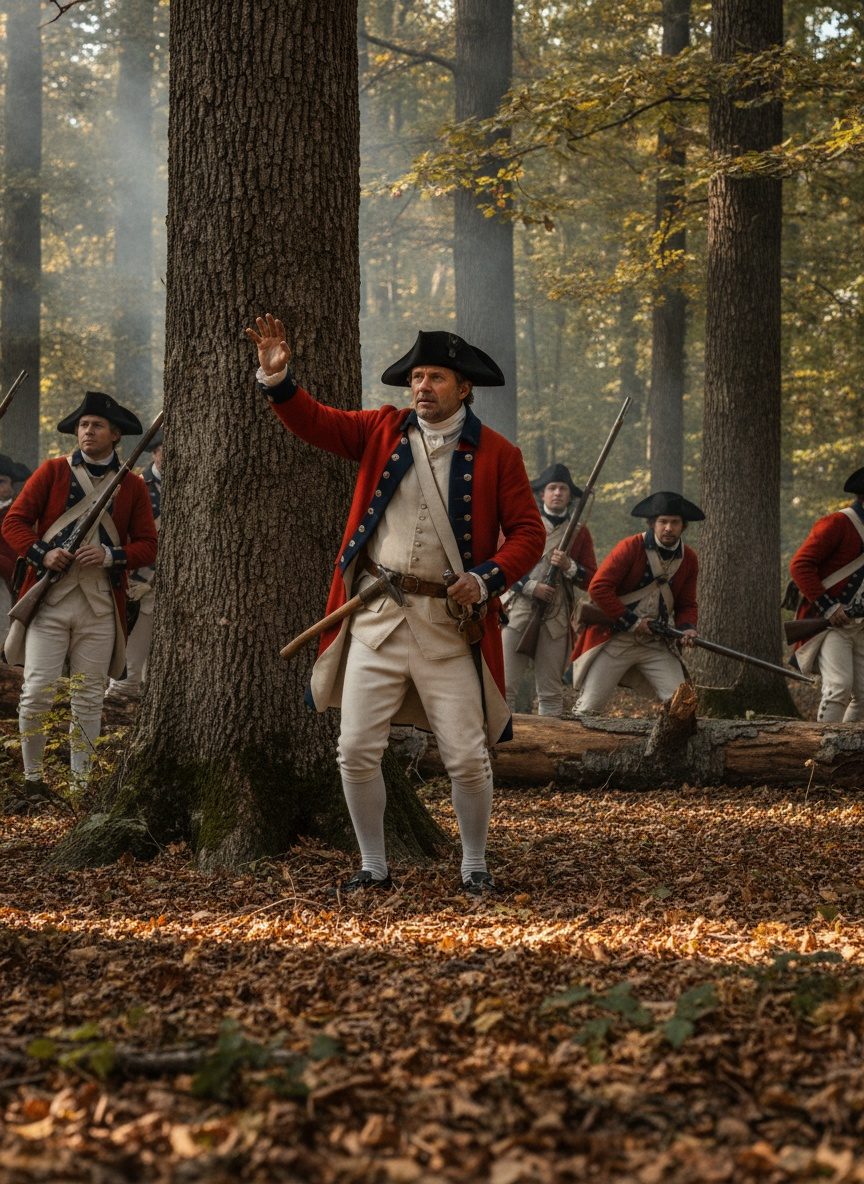
July 9, 1755. The humid air clung to every leaf in the dense Pennsylvania forest.
The Pitfall of Tradition
The morning mist had scarcely lifted when a disciplined column of 1,400 redcoats began their march through the trackless wilderness of North America. Led by the steadfast, if unyielding, Major General Edward Braddock, these British soldiers were accustomed to the grand battles of Europe, where lines met in open fields and victory was decided by volley and bayonet charge. However, the American forests held no stage for such theatrics.
As these soldiers pushed deeper into uncharted territory, their pristine uniforms seemed almost comically out of place against the wild landscape. The ferns and canopy above bore silent witness to a crimson flood, ignorant of the peril that lay invisibly woven into the woods. These trees, teeming with native warriors and their French allies, promised a very different kind of war.
Braddock’s decision to adhere to traditional military formations meant that his men presented easy targets to adversaries skilled in guerrilla tactics. Rather than long lines of battle, it was hit-and-run warfare that would rule the day. The British muskets, primed and pointed, would fire at nothing, for no enemy dared to face them head-on. It was here, in these alien shadows, that the redcoats would first confront their most dire lesson.
Read next: The Day a Surgeon Walked Into a Prison and Freed a Madman
The Ambush's Abrupt Fury
Without warning, the forest erupted into chaos. Bullets whizzed through the air with a deadly whine, striking down men as they puzzled over where the death rain fell from. The British troops, having never faced an opponent they could not see, were thrown into disarray. The din of musket fire, the hoarse cries of wounded men, and the battle cries of unseen foes mingled into a brutal symphony of war.
One officer recorded later that the forest itself seemed to be against them. Flashes of musket fire lit silhouettes among branches and undergrowth, while the British soldiers found themselves firing blindly into a treeline that seemed to swallow bullets without harm. Within mere hours, nearly three-quarters of Braddock’s troops were either dead or injured, skewered on the unyielding spear of an army that fought from the depths of the woods.
It was an unimaginable catastrophe for Braddock, who would fall, mortally wounded, before day’s end. Yet, in the throes of defeat, a quiet observation was made — an opportunity that others might have missed amid the cacophony of collapse.
The Eyes That Looked Forward
Amid the confusion and carnage, a Swiss officer in British service observed what others refused to see. His name, while lost in the broader fabric of history, belonged to a breed of thinker that the age demanded. He knew that warfare’s tides were changing, and that the future of military success lay not in rigid tradition but in adaptability and cunning.
Drawing from his experiences and those of the native allies who had deftly maneuvered through the woods, he began to develop revolutionary tactics — ones that embraced the environment and used it to one's advantage rather than trying to overcome it through sheer might. It was an idea that would resonate through the annals of military strategy, defining the era’s shift away from the ceremonious dogmas of old Europe.
He recognized that soldiers needed to learn the value of concealment, the use of the terrain, and the effectiveness of breaking tighter formations into smaller, more agile units. It was an approach that drew inspiration not only from the rebellious spirits they faced in America but also from a deeper understanding of what a new world demanded of its armies.
The Forging of a New Soldier
As the summer of 1755 turned to autumn, the seeds of these insights began to bear fruit. Training manuals were rewritten, focusing on a new type of soldier: one who could fight in any terrain, under any condition, free from the rigid hierarchy that once chained them in place. British forces, in the years that would follow, transitioned to adopt skirmisher tactics and specialized units — light infantry — who emulated the very finesses of those they once scorned.
The lessons learned from the Pennsylvania woodlands became a cornerstone in the British military doctrine; they redefined the structure and training of the army and lay the groundwork for future engagements where adaptability spelled the difference between triumph and tragedy. Officers began to focus more on unit autonomy, promoting leadership that could make decisions on the fly and react to enemy movements with speed and precision.
Innovations born from that defeat would echo loudly in the decades to come, ringing through future conflicts and solidifying the world’s perception of Britain's military prowess. The Army that emerged was one attuned to the world’s rhythms, prepared not just to meet an enemy, but to adapt and conquer them in their element.
The Unseen Imprint
Marching away from the echoes of musket fire and the shadows of that fateful day, the British Army would never again be the same. At the heart of this evolution was the silent acknowledgment that defeat often seeds its own redemption. While history books may gloss over the specifics of Braddock’s fiasco, the impact it left behind can be traced through military history, an indelible mark that carved a path toward modern warfare.
The true legacy of that event was not one of military shame but rather an indomitable spirit of adaptation and reinvention. In the whispered stories passed between comrades or the pages of a forgotten journal, one finds the underlying truth: in the face of overwhelming odds and bitter defeat, ingenuity plants the seeds for future victory.
This lesson, hard-won and arguably priceless, reminds us that in reflection and reinvention, humanity forges its finest warriors, standing ever vigilant against whatever unforeseen adversaries the future may cast upon them.