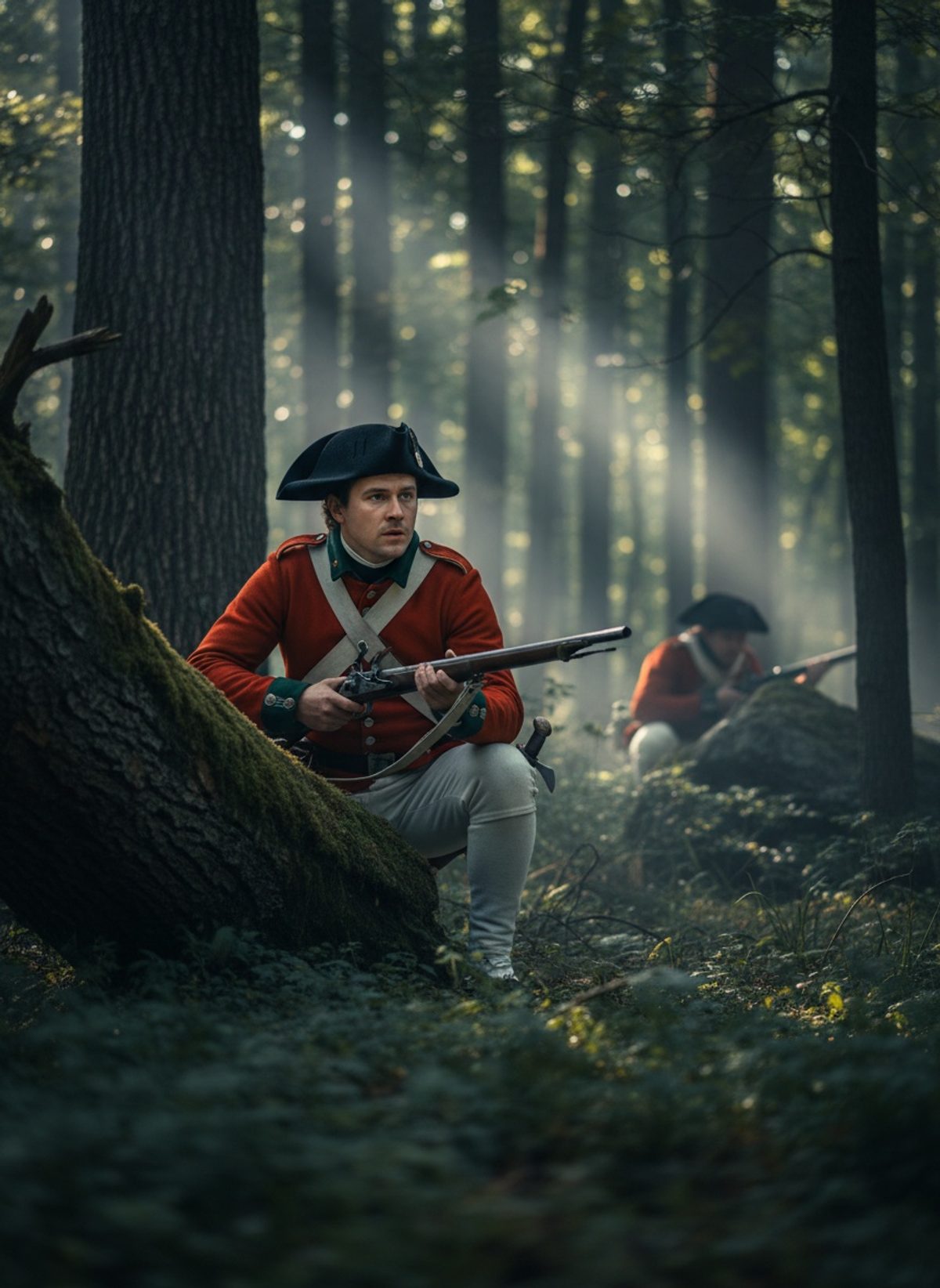
July 9, 1755. A haze hung over the Pennsylvania woods, warping the air as the sun baked the forest floor.
The Column That Fell
On this fateful day, a British column marched into the densely wooded Pennsylvania landscape, a hive of disciplined energy. It was an embodiment of European military precision, a formation perfected on the well-manicured fields of Europe, now sweeping through the primal American wilderness. The scene was dramatic, almost theatrical—a long train of vibrant red coats moving in synchronicity, their bayonets gleaming like rows of sharp teeth. The forest embraced them, a canopy both beautiful and ominous.
But hidden in the murky depths of the woodland was a cunning enemy. French forces and their Native American allies melted into the environment, becoming part of the very shadows and whispers among the leaves. Their rifles spoke from the invisible, bullets slicing through the ranks of an army used to seeing their foes squarely across fields of battles. Panic cut through the columns, confusion rendering soldiers as vulnerable as unarmored knights. In those three hours, nearly 1,000 men were swiftly, brutally cut down. The woods shifted from a stage of might to a scene of tragedy, the cries of the wounded and dying echoing across the trees.
A Shattered Pride
The defeat was not only a loss on the battlefield but a colossal blow to British pride. The army that believed itself invincible found its doctrines torn by the savage efficiency of guerrilla warfare. The surviving troops, led away through the woods by the few unscathed officers, bore the weight of memory—a stark reminder that the old ways were ill-suited to this new world.
Read next: The Day a Freed Slave Lectured Britain's Finest Minds
This engagement affected figures like George Washington, who survived the ordeal and took home invaluable lessons that would shape future military doctrine. To them, it became clear that the tide of war had changed. No longer could the British army march in pomp and pageantry; the forests whispered of an evolved enemy and an unrelenting landscape that demanded adaptation over pride.
Reforging the British Soldier
The retreat from Pennsylvania was not the end, but a rebirth. Britain, in characteristic stubbornness, turned to innovation, pledging to craft soldiers suited to this alien environment of thick forests and hidden threats. The traditional red coat was coupled with an understanding of camouflage. Soldiers now learned to use the environment to their advantage—the very tactic that had undone them was woven into their new manuals of war.
Recruitment practices evolved, drawing men who were not only disciplined but who possessed skills for guerrilla warfare. Hunters, trappers, and outdoor men, men accustomed to the world now essential to survival, joined the ranks. Collaborative tactics between soldiers and Native American guides turned foes into mentors, granting British troops the skills needed to navigate and dominate the North American wilds.
The First Special Forces
This period birthed something remarkable—the creation of an early form of "special forces." These new troops excelled in rapid movements, flexibility, and unpredictability. They learned to engage in skirmishes and ambushes rather than relying solely on formal confrontations. Such small units could move silently and strike decisively, frustrating enemies who expected structured engagements.
Read next: The Winter That Broke Napoleon's Army of Portugal
The adjustments made were harbingers of the modern army yet to be. They spoke of the necessity for versatility and adaptability—principles that would hold true across centuries. To think that such a transformative shift stemmed from one catastrophic defeat is to peer into the unpredictable ways history reshapes and renews itself.
A Legacy of Change
Why does the memory of events in a Pennsylvania forest still matter? It underscores the unrelenting force of adaptation—a notion that an effective military must constantly evolve or risk irrelevance. From the shock of invisible foes to the mastery of guerrilla warfare, the events of 1755 remind us that the seeds of inventive evolution are oftentimes planted in the soil of defeat.
The reshaping of the British Army following that shattering encounter marks not only a transformation in tactics but highlights the perennial dance of warfare—a push and pull of tradition and innovation. In the end, what survives is not the unyielding monument of perfect order, but the fluid improvisation of strategy—the way an army's renewed focus can ripple through history, reshaping conflicts and influencing the soldiers of today and tomorrow.