The sun cast a golden veil over the plains of Salamanca on that fateful summer day in 1812, stretching across the coarse Spanish earth and shimmering upwards like a promise of impending intensity. The breath of the Iberian Peninsula was warm and dry, whispering across the grasses, as both man and beast braced themselves against the sizzle of the midday heat. In this atmospheric stillness, 100,000 men waited, poised, anxious, and burdened by the gravitas of history’s unfolding drama. This was not just another meeting of arms; it was a culminating moment in the long and brutal Peninsular War. Wellington stood ready to turn the tide, shatter Napoleon’s grip, and alter the fate of Spain—and perhaps, the entire continent.
The Endless Standoff
The summer of 1812 thus far had been one of carefully orchestrated tension. For three weeks, the Duke of Wellington and Marshal Marmont had engaged in a masterful dance of military maneuver, each seeking to outflank and outwit the other across the dusty expanses of Castile-León. At stake was not just glory for these commanders but the pivotal control over Spain, fiercely contested territory in the Napoleonic Wars.
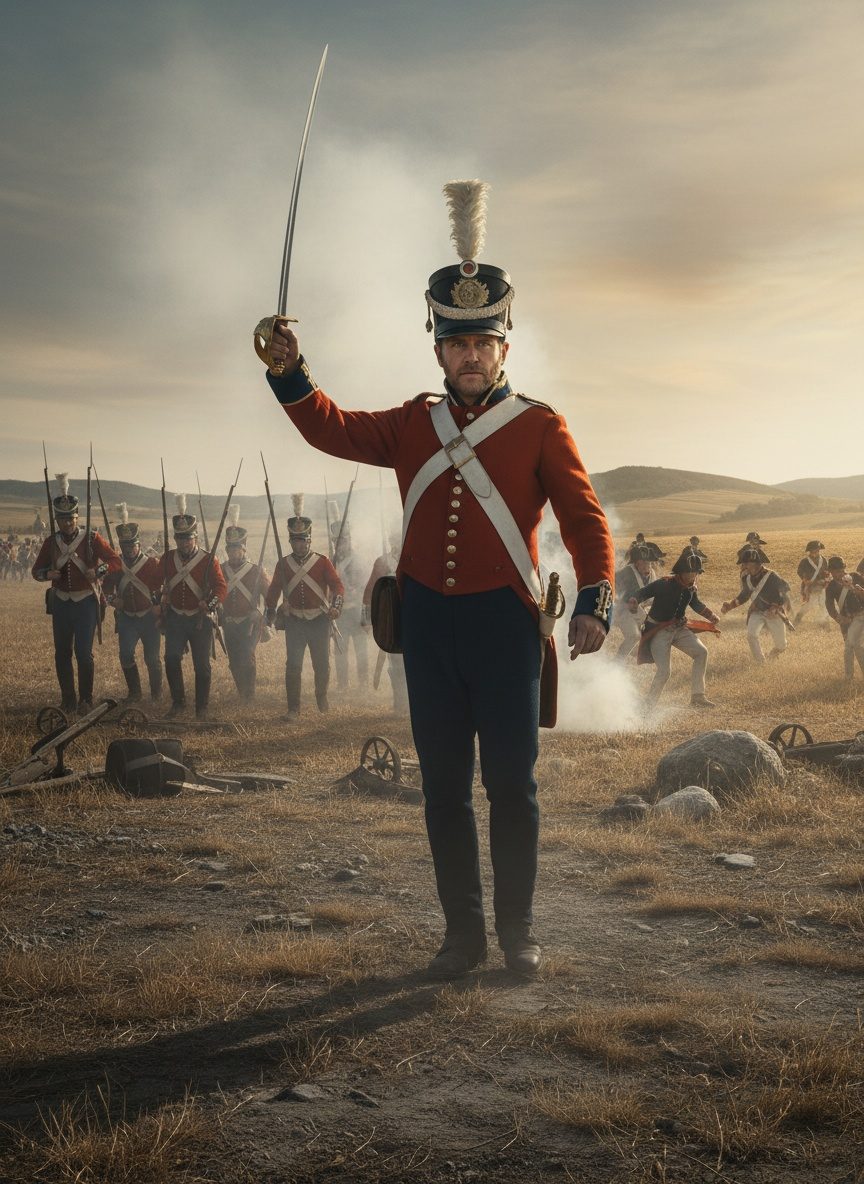
Day by day, the two formidable leaders drew and redrew plans upon the vast canvas of the Spanish plains, neither willing to commit to a full-scale engagement without the certainty of victory. The men under Wellington dressed in the scarlet coats of British might, stood firm, driven by a relentless resolve underpinned by the knowledge that the eyes of both history and their staunchly expectant allies were upon them. Opposite them, the Imperial French forces, seasoned kings of European battlefields, radiated a weary confidence, their belief in their Emperor’s seemingly unshakable dominion hard to wane.
The land itself echoed the tension of this stand-off—a mix of steep hills and deep ravines, perfect for the agile and experienced forces under Wellington’s command. Yet, as each day dragged into the next, the line between patience and recklessness grew ever thinner, the ghost of frustration casting shadows long enough to stretch across an army. Both sides faced the dichotomy of needing to act and yet knowing that one brash move could unravel their painstaking preparations.
Read next: The Day a Surgeon Walked Into a Prison and Freed a Madman
In this deadly chess game, it appeared there would be no sudden checkmate. But then, in an instant, the delicate balance finally tipped.
The Forty Fateful Minutes
The climax came unexpectedly and with dizzying swiftness. As midday waned towards the languid afternoon on July 22nd, a flaw—a critical overstretching—zigzagged like a crack through the French line. Marshal Marmont, ever the opportunist, had overextended his left flank, hoping to envelop Wellington. But what had appeared to be his chance, soon morphed into a devastating vulnerability.
In a remarkable act of perceptiveness and decisiveness, Wellington seized this opportunity quite literally, as legend says, by tossing aside his lunch. His eyes, keen as any hawk, zeroed in on the gap in the French defenses with the sort of clarity that signaled not just tactical brilliance, but historical import. Before the echo of his orders could fade, his troops were in motion, like a tightly coiled spring finally released.
The suddenness of the strike against the French left flank was neither hyperbole nor exaggeration. Within a mere forty minutes, 50,000 French soldiers faced the music of a catastrophe. What followed was a brilliant example of military maneuvering seen seldom on the battlefields of Europe. The disciplined alignment of British, Portuguese, and Spanish forces launched an assault that was swift and unyielding, their advance a choreographed storm that blazed with urgency and might.
The French line buckled and dissolved in the chaos, Marmont himself being wounded and forced from command. Confusion rippled through the ranks like wildfire. What had been a vision of enveloping the enemy became the nightmare of being cut off, surrounded, and scattered. The broken echo of cannon fire and the sharp clatter of musket rounds mingled with the cries of men and the drumming of hooves as if the battlefield itself was giving voice to the drama.
In that condensed, almost mythical span of time, Wellington had achieved what had seemed unattainable throughout the summer—the seismic shift in the control of territory, and by extension, the psychology of war in Spain.
A New Dawn Over Spain
The Plains of Salamanca were forever changed, etched now with the memory of broken power and newfound illumination. What followed the near-obliteration of Marmont’s forces was not just a retreat through historical patinas, but a seismic shift in the Peninsular War. For the French, many of whom had been accustomed to carrying the banner of victory under Napoleon’s eagle, the loss echoed beyond the physical realms, gnawing at the prestige of the Empire.
For Wellington, this victory was more than a mere accumulation of strategic prowess—it was a resounding proof of the growing depth of allied cooperation and belief. The impact of those forty minutes thrust Wellington into a role of legend, not just as a commander revered by his troops but as a pivotal figure reshaping the very course of European history. With the tide of warfare altered, the Spanish populace took renewed heart, emboldened to rise against the occupying forces and stir the embers of nationalism.
Salamanca demonstrated with stark vividness the tensions in the grand designs of Napoleon. What seemed inevitable—a perpetual French dominance—cracked, leaving space for the possibilities of new political futures. As the ripple effects of this battle spread, like shockwaves across European courts and countrysides, it reinforced the understanding that the ambitions of even the greatest of conquerors are constrained by the stark unpredictabilities of war.
In the annals of history, the meeting at Salamanca serves as a powerful reminder—how in moments of crisis, the seemingly minute decisions can unravel the destinies of empires. It speaks directly to the human spirit, rising defiantly against the straitjacket of odds, where intuition meets opportunity, and in such a merger, the course of history is undelibly altered. These plains, still bathed by the same unrelenting sun, hold the echoes of forty minutes where the tide turned, both for a nation and for the broader canvas of history, demanding us to remember and to reflect.