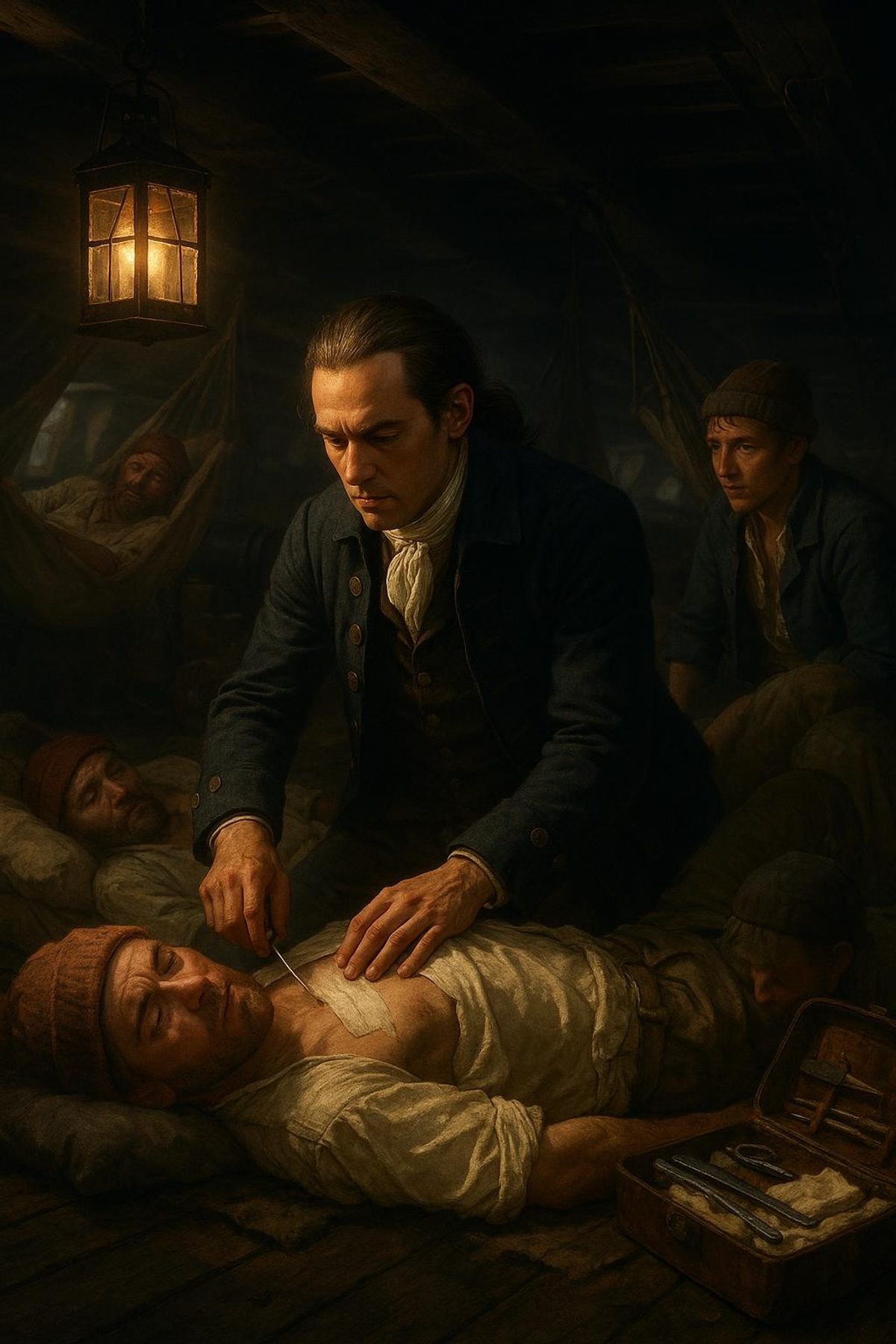
It was just another day at sea for Surgeon Thomas Trotter. Until it wasn't.
Courage Beyond the Call
On the evening of June 1, 1794, the British Navy sailed triumphantly away from one of the fiercest naval skirmishes of the Revolutionary Wars—the Battle of the Glorious First of June. Yet, beneath the echoes of cannon fire and the reluctant victory cheers, lay a terrifying scene that few beyond the decks knew. Aboard one of the charred vessels, a raging fire had taken hold below deck. For most, the image of flames engulfing a ship would be enough to evoke horror, but for Thomas Trotter, a surgeon onboard, it meant an unimaginable reality: 500 wounded men, unable to escape.
The Georgian Era, though marked by grand naval battles and perceived triumphs, was brutal for sailors. Medical care was primitive, at best, for the men who faced relentless battles. Many lay below decks, clutching their wounds and whispering silent prayers, waiting for hope to arrive. When the blaze erupted on Trotter's ship, the above-deck chaos swiftly translated into an abyss of forlorn faces and despairing cries below.
Amidst the inferno, Trotter made a decision that defied both logic and self-preservation. While voices called for the evacuation of those who could walk away, Trotter descended into the heart of the ship, sweat mingling with the scent of smoldering wood. His mission was clear: no man would be left to burn beneath those decks if he had anything to say about it.
Read next: The Day Thirteen Colonies Were Lost — And Britain Barely Blinked
A Stubborn Battlefield Below Deck
Once an apprentice at the Edinburgh Royal Infirmary, Trotter wasn’t accustomed to acceptance of fate; he was a man who challenged the limits of medicine and duty. When faced with this night of peril, his relentless spirit illuminated even the darkest corners of the surgeon’s quarters. Trotter waded into hell with only his medical kit and iron resolve, taking on the searing heat and near-unbearable smoke blind with the single-minded pursuit of life over death.
The usual rigid hierarchy fell away as he worked, invoking the doctrine of “all hands on deck” in a sense never envisioned. Instructing those still standing to assist however they could—tourniquets made from cast-off shirts, pulley systems rigged from spare rope—he orchestrated a concert of care. Sailors who would have earlier scoffed at a surgeon’s gently skilled hands now offered strength where brute force was required, carrying comrades up into the less hostile night air.
Alarm bells, fire crackling, and the constant fear of the ship breaking apart lent urgency. Those four hours tested the mettle of the man and the sailors under his command as they leveraged a raw but determined humanity over certain doom. One by one, over 500 men emerged from the shadowed corridors of the ship, alive, each saved by an unprecedented heroism of one man who refused to step away from the flames.
Revolutionizing Naval Care
The events of June 1st did not merely mark a day where hundreds of lives were saved from a sea blaze. They were a clarion call for change within the British Navy itself. Until then, mortality due to wounds—not merely due to subsequent infections but poor immediate on-board care—had been an unspoken cost of war. Trotter’s ascent as a beacon for change in this fiery crucible pushed old practices under the critical eye of innovation.
His bravery that night wasn't forgotten. Beyond the immediate ripple of gratitude from the 500 sailors and their families, Trotter's actions prompted intense discussions. By November 1794, just months after the incident, the British Navy began implementing significant revisions in the approach to medical treatment onboard. Ships soon carried more comprehensive medical personnel, better surgical equipment, and structured, formal procedures to handle emergencies. Thomas Trotter’s unyielding commitment lit the way for reforms that saw each sailor treated not as expendable pawns of maritime dominance, but men whose lives were worth safeguarding.
The Night that Reshaped Valor
Thomas Trotter’s daring act echoes through the annals of maritime history as proof that heroism comes in varied forms—and he earned his place not by the quickness of his military tactics, but by choosing to stand fast amidst the precarious balance of life and annihilation. His legacy became immortal, painted in the bravery shown by everyone tackling adversity with compassion.
This story isn't merely one of triumph over disaster; it’s a reminder of a crucial turning point in history where the value of a single person's conviction redefined the ethos of military care. While the textbooks might give you strategies and stats, the real worth lies in understanding the humanity that drives such tales. Trotter showed that when courage acquaints itself with compassion, history changes. The unyielding flame of his commitment provides a guiding light for all who choose humanity as their beacon.