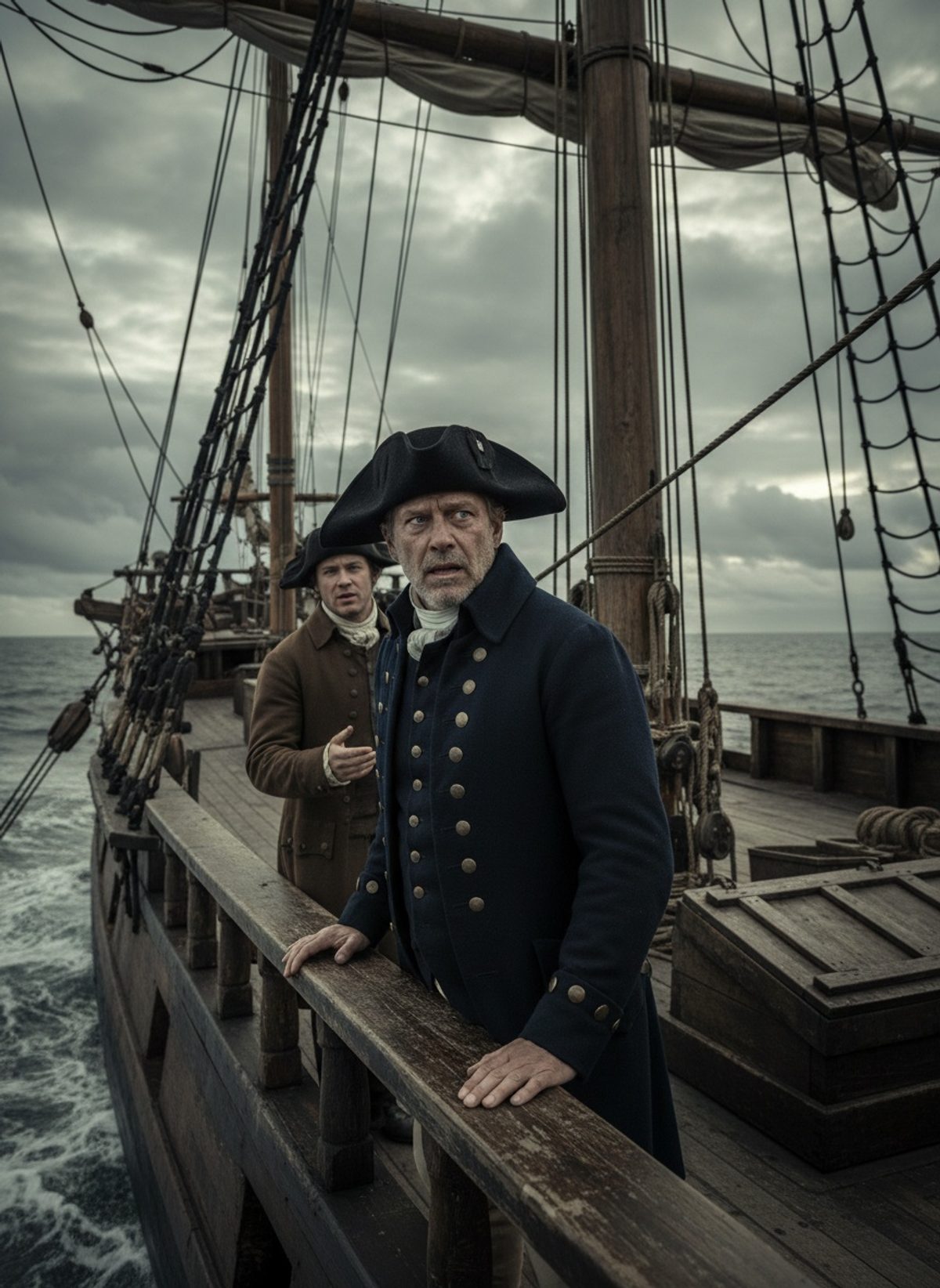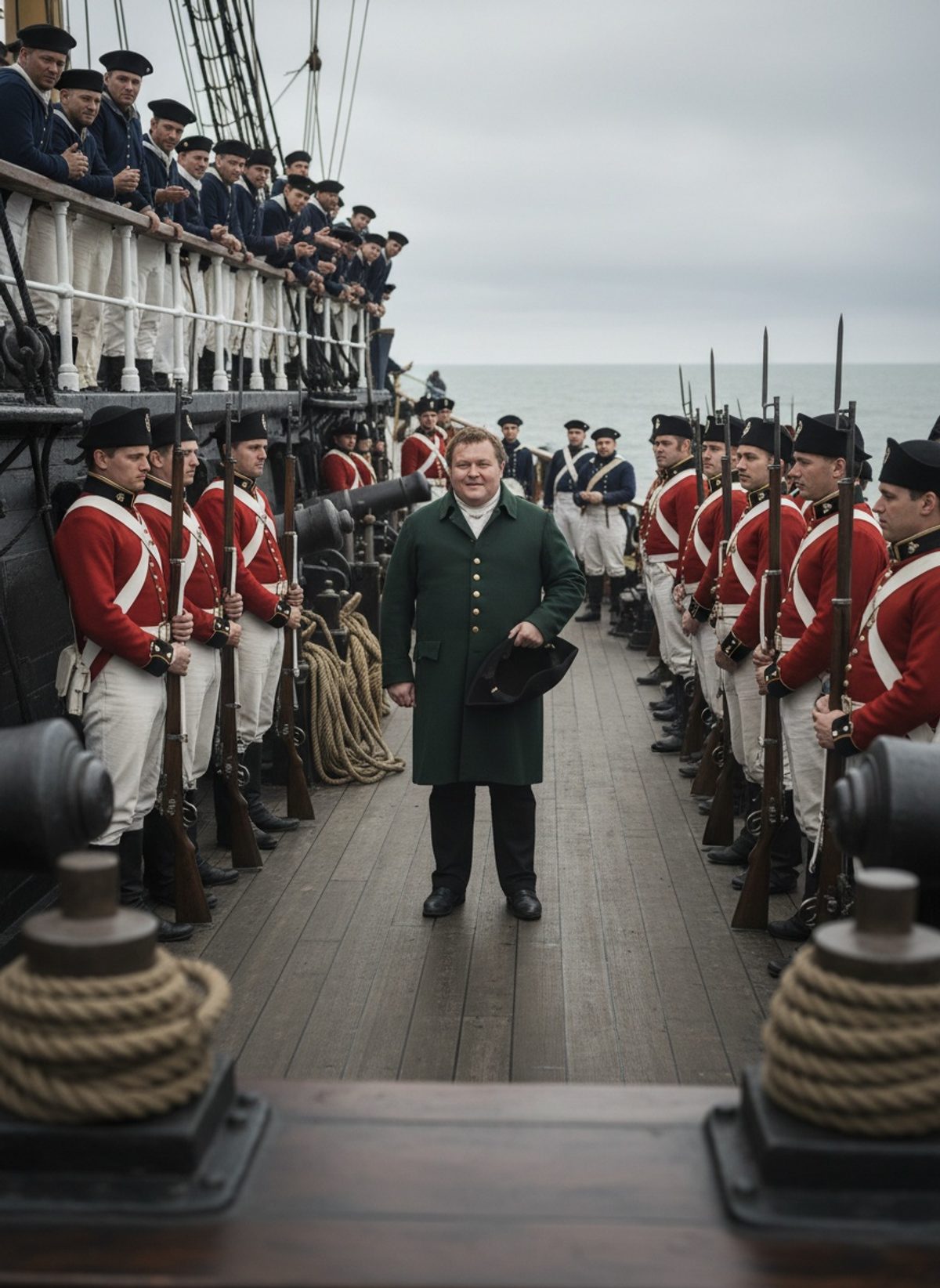
The early morning mist drifted lazily over the seas, casting a ghostly glow upon the deck of HMS Bellerophon. The ship lay anchored off the Devonshire coast, its sails still and silent, as though holding its breath in anticipation of the unfolding drama. The soft lapping of the waves against the great wooden hull was the only sound, a whisper in the vastness of the channel. For the man standing rigidly at the gangway, the stakes could not have been higher. Napoleon Bonaparte, once the most feared and revered man in Europe, now found himself a prisoner of circumstance — his fate hanging in the balance like the morning fog.
Fortune's Irony
The notion of Napoleon Bonaparte stepping across a British man-of-war's gangway was one few could have foretold, yet in July of 1815, this seemingly unthinkable event came to pass. For over two decades, the British Navy had been Napoleon’s relentless adversary, having tirelessly pursued his fleets from the cobalt blue of the Mediterranean to the tumultuous waters off Cape Trafalgar. Now, aboard the HMS Bellerophon, the tables had turned in the most unforeseen of ways.
Napoleon boarded the ship with a belief rooted in British law, hoping for refuge under the guise of asylum. It wasn't a baseless gambit; Britain had long been viewed as a bastion of legal protection and justice. Napoleon, stripped of his imperial titles and now relying solely on the remnants of his charisma and stature, dared to believe that the same consistency of British fairness extended to him even as an enemy. However, the times were as murky as the waters he sailed upon, and his expectations would soon be dashed upon the rocks of political necessity.
The general atmosphere aboard HMS Bellerophon was one of courteous detachment. Captain Frederick Maitland, tasked with the unenviable duty of housing the former Emperor, maintained a respectful air devoid of the enmity that had defined much of their prior relations. For three weeks, Napoleon dined and conversed with British officers, weaving tales of past victories and ambitious visions. These exchanges, while cordial, stood as a poignant microcosm of the complex dance between admiration and animosity that Napoleon inspired across the continent.
Read next: The Day England's First Sea Battle Saved Its Own Crown
The British Conundrum
Even as Napoleon was on board HMS Bellerophon, the British government found itself embroiled in a delicate dilemma, torn between legal precedent and political expediency. Allowing Napoleon to set foot on British soil could invite complications akin to those that had seen Charles I lose his head. The specter of Bonaparte becoming an unexpected rallying point for Republican sentiments was an unwelcome one. Tensions simmered as debates raged in the corridors of power about what to do with such a divisive figure.
The British populace, meanwhile, had their own curiosities piqued. Word of the ship's enigmatic passenger spread like wildfire. Crowds gathered along the south English coast, witnessing the spectacle with a mixture of awe and disbelief, straining for a glimpse of the man who had once seemingly held Europe in the palm of his hand. At times, the Bellerophon was surrounded by numerous small crafts, their occupants eager to catch sight of this living legend. Despite government attempts to shroud Napoleon's presence in secrecy, the public's fascination was insatiable.
Ultimately, the British decision illuminated the iron resolve hidden beneath their genteel surface. Despite potential legal entanglements, there was only one course of action deemed suitable for the vanquished Emperor: exile to a far-flung corner of the world. It was more than just self-preservation; it was a declaration that the era of Napoleon was well and truly over, alike an inscription on a monument to British tenacity.
A Lonely Journey to Oblivion
On board the HMS Bellerophon, the realization of his fate slowly dawned on Napoleon. The British were resolute; he would not remain within their borders to spark political unrest or invite foreign entanglements. Instead, his ultimate destination would be far from the shores he longed to tread. The remote isle of St. Helena, a forlorn outpost in the South Atlantic, was where he would meet the long twilight of his days.
In the quiet moments away from the British officers who had become his reluctant captors, Napoleon gazed longingly out over the English Channel. The waves, relentless and indifferent, paid no heed to human turmoil. It was a stark contrast to the battles for which they were so often a setting — Britannia ruled these waters just as surely as it would dictate the narrative of his own story.
This chapter in history demonstrates a moment where power shifted on an early sunrise's hue, a reminder of how leadership often teeters on the brink of dispossession. For Napoleon, it was a testament to the enduring nature of realpolitik, in which personal hope was subjugated to uncompromising strategy. His brief sojourn aboard HMS Bellerophon symbolized a turning point in the European theater; the definitive conclusion of an epic, with its potential power unseated by logistical and political necessity, leaving the legacy of Napoleon Bonaparte adrift, an emperor without an empire.
As the Bellerophon aged quietly at anchor, her iconic moment became one of history's unwritten secrets. The echoes of Napoleon's footsteps on its decks, the murmur of British officers' polite conversations, and the whispers of the waves still resonate as a powerful reminder of an epoch swaying between the courage of a gamble and the potential cost of that gamble realized. It remains a tale carved not into textbooks but living within the currents of the past, as it quietly envelops the essence of power and its ultimate surrender.