Napoleon Bonaparte was unstoppable. Except when he wasn't.
The Schoolboy Rivalry
Before the cannonade, before the sweeping charges, and before one of history’s greatest military careers unfolded, two boys sat in a classroom, oblivious to their intertwined future. At the military academy in Brienne-le-Château, young Napoleon Bonaparte was, by most accounts, fiercely ambitious and intense, earning both admiration and disdain. Among the few who dared to oppose his sway, Sidney Smith proved himself a rival even then, though in a far more academic arena. Their youthful animosity, rooted in divergent worldviews and personalities, simmered quietly under the surface. Smith was the quintessential British gentleman, brash and confident, while Bonaparte was a Corsican outsider with a chip on his shoulder.
This school-aged rivalry, seemingly trivial at the time, would later explode onto the global stage, embodied in the swirling dust and eruptions of gunfire outside the walls of a forgotten city on the eastern Mediterranean coast. It was here that a long-forgotten fortress became the arena where their clashing destinies would meet headlong.
A Fortress of Defiance
The ancient city of Acre, its walls weathered by centuries of conflict, seemed an unlikely stage for a showdown between the epoch's greatest general and a daring British officer. Yet, in 1799, Acre was where destiny called, the last bastion for those determined to halt Napoleon's eastern conquests. As Napoleon's army—hardened and undefeated—approached, news of a formidable British defiance spread across the city.
Read next: When Monty's Mentor Lost an Army at Tobruk, 1942
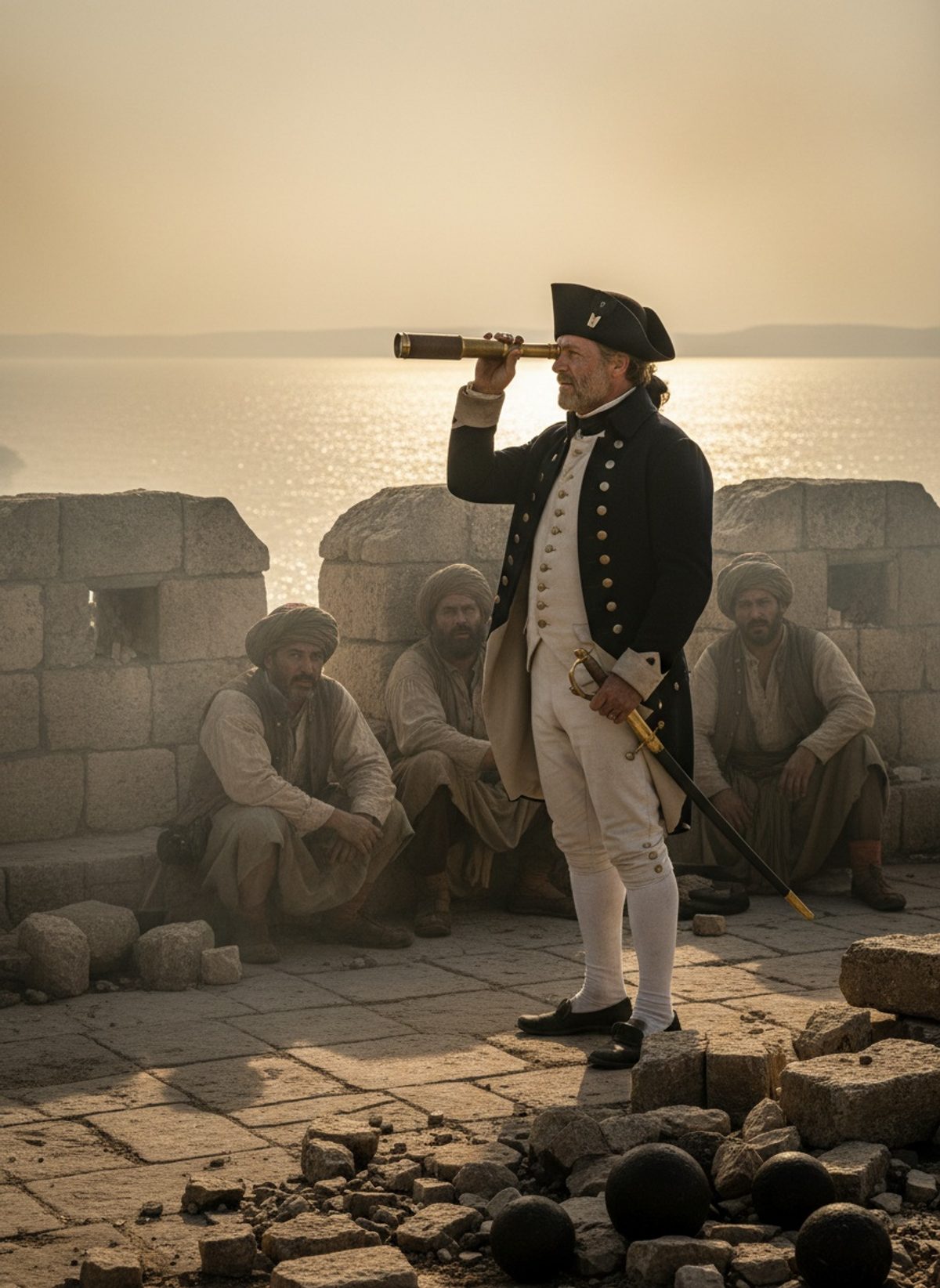
Upon his arrival, Sidney Smith saw opportunity amidst challenge. With a deftness few expected, he smuggled cannon past encircling French lines—single-handedly shifting the balance of power. The city, now armed and emboldened, took on a defiant stance, a mirror reflecting the tenacity of its spirited protector. The audacious legend of Smith stands, not as the hero of a merely stalled advance, but as the architect of a genuine resistance, holding the line at Acre for an arduous sixty-two days.
The Siege That Stopped an Empire
For Napoleon, the siege of Acre was to be a decisive moment—a swift demolition of resistance that would clear the path for a grand empire in the East. Instead, it became a quagmire. Each cannon he positioned and every breach he attempted was met with swift and cunning counterattacks. It was as though the ghosts of every previous defender of this ancient city lent strength to their modern counterparts.
Napoleon himself later admitted that if he had taken Acre, the face of the Middle Eastern world would have changed irrevocably under French rule. However, he encountered walls that seemed to grow taller with each advance, manned by defenders whose resolve hardened with every fallen comrade. Sidney Smith, a knight on a steadfast mission, roamed the battlements, rallying troops with the invigorating spirit of the underdog refusing to surrender.
Napoleon, accustomed to decisive victory, was now bogged down in a costly siege. A malodorous mixture of smoke, sweat, and despair hung over the battlefield. French soldiers who had marched fearless across Europe found themselves repelled by the resolute defenders, their bright uniforms fading with each fruitless charge against Acre’s stone walls.
Read next: When Rick Jolly Ran a Hospital Beside Two Unexploded Bombs, 1982
Aftermath and Echoes Across Time
The retreat from Acre marked a pivotal turn in Napoleon's eastern ambitions. As he pulled back from the coastal city, the indelible scars of those sixty-two days shrouded his dreams of expansion. The pursuit of an eastern empire lay gasping, like the spirits of those exhausted soldiers who had fallen valiantly at their leader's side.
Sidney Smith, though little celebrated in his own time, played a critical role in preserving a precarious balance of power. His command of both strategy and spirit transformed Acre from an ordinary fortress into a powerful symbol of defiance. History forges its legends often with the blunt instruments of war and conquest, but here, it was the astute defensive stand that wrote the lasting legacy.
In the annals of empire, when the beat of a drum signals bold conquest, let us not forget the quiet, determined resistance that holds it back. Acre’s stand reminds us of the power one individual holds against great odds—less celebrated yet equally momentous. It shows us that sometimes, behind every halted empire stands an unsung wall, a forgotten fortress adamant in its mystery.