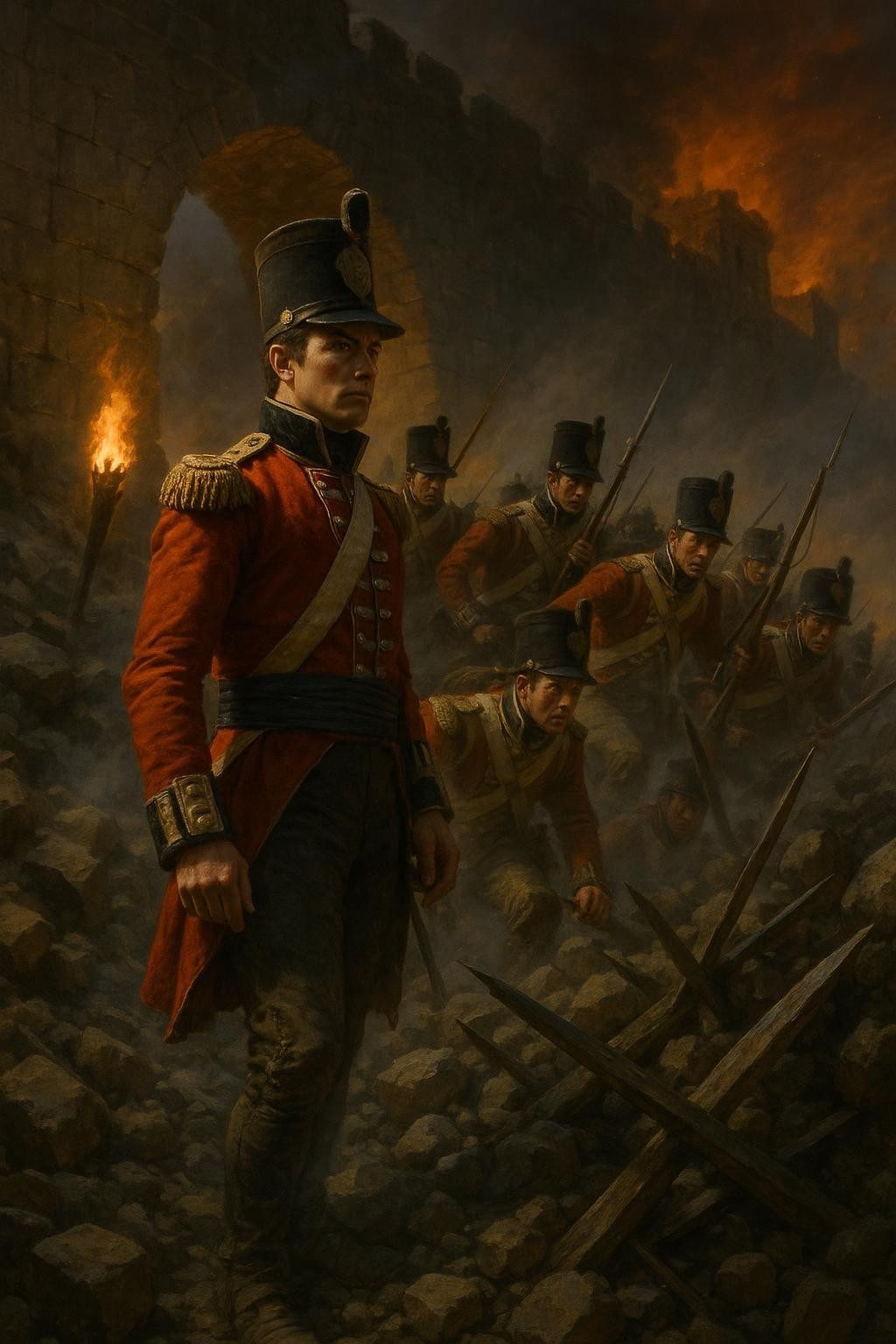
The cacophony of explosions shattered the night air as smoke billowed, swallowing screams and turning soldiers into specters. The siege had reached its peak; the men fought almost blindly, navigating the chaos fuelled by desperation. Suddenly, the brutal clang of metal on stone broke the night—the defenders were finally giving way before the ferocity of Wellington's storming columns at Badajoz. Yet victory carried the taste of ash.
The Breach: A Conflagration of Valor and Chaos
April 6th, 1812. Badajoz, a fortress on the Spanish frontier, had become a crucible of carnage. The British Army, under the steely command of the Duke of Wellington, had set its sights on the city—its bastions crucial for controlling this corner of the Iberian Peninsula during the tempest of the Napoleonic Wars. The assault was to be quick, decisive, a show of their unyielding resolve.
Yet no textbook could adequately capture the horrors unveiled that night. As the dusk deepened, shadows danced across the torn earth beneath the towering walls. The ranks of redcoats hurled themselves into the breaches, making human ladders upon their fallen comrades. Nearly five thousand men fell—lightning-fast saber strokes and cannon-shot tearing through flesh, turning the promise of conquest into a tapestry of human suffering.
Despite the overwhelming bloodshed, the British emerged victorious from the battlefield inferno. At dawn, the city lay open before them, its defenses breached and spirit broken. Victory, however, bore a cost that reached far beyond the gruesome tally of the dead—one that would etch itself into the memory of the Duke and his men for years to come.
Read next: The Day a Surgeon Walked Into a Prison and Freed a Madman
Tears Among the Ashes: Wellington's Agony Unveiled
The morning after the assault offered a vivid tableau of triumph shadowed by despair. Thick smoke still curled from within the breached walls of Badajoz as the first rays of sun pierced through the haze. It was within this ghastly aftermath that Wellington received the casualty returns. As he scanned the scroll of names, each stroke seemed to cut deeper into the fabric of his soul.
Wellington, ever the stoic leader, was not a man given to displays of emotion. Yet, confronted with the staggering loss, the tears came unbidden. He wept, openly, for the men who had been his sword and shield, now lying cold amidst the detritus of battle. It was said that these tears were not simply for those who had perished, but for the realization of what war had wrought on friend and foe alike.
The toll of conquest was more than just human—within the confines of Badajoz, another storm brewed. Unchecked by command, undeterred by decency, some soldiers devolved into plunderers and predators. Fires were set that consumed whole neighborhoods, while looting and violence claimed the streets, sparing neither innocent nor guilty. For three days, lawlessness reigned, binding victory with a fraying cord of shame.
The Embered City: Reflections in the Aftermath
As the fires dwindled and the screams of the violated city quieted, a sobering reality set in. Badajoz, once a vibrant stronghold, now lay in ruins—its sacked corners echoing the forlorn cries of those who survived. The fortress had been a strategic prize, but its capture exposed a raw, reeling humanity grappling with the nature of power and its consequences.
The tragedy at Badajoz expanded far beyond the immediate destruction. It forced introspection among the ranks and riveted Wellington's leadership choices. Leadership in battle was an easy task compared to the indecipherable challenge of managing the aftermath—a revelation that forced the Iron Duke to confront the profound complexities of human nature when stripped bare by the fog of war.
As Wellington’s men departed, leaving behind nearly five thousand brothers-in-arms, there lingered a haunting question: what defines victory? The hollowed streets of Badajoz whispered a lesson older than war itself—that the currency of combat is often not gold, not territory, but the enduring cost of human lives forever altered.
In their silence, the stones of Badajoz remained eternally watchful, witnesses to a history written in blood and fire—an untold legend echoing through time, pressing its undying imprint into the fabric of history, reminding us that in our triumphs, our humanity hangs in a delicate balance.