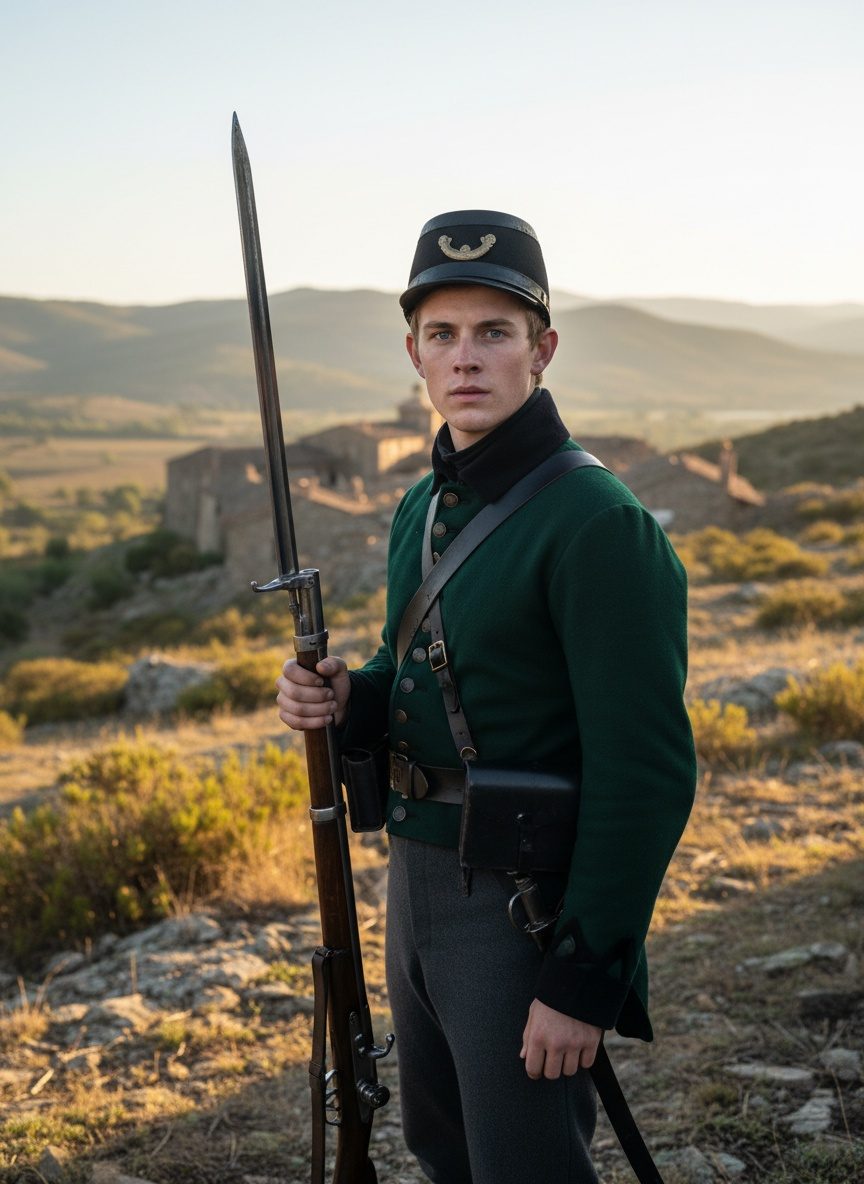
The dawn light broke through the fog, spilling over the dewy English moors to illuminate the morning drills of an unfamiliar band of soldiers. Their uniforms were an unorthodox shade of green, darker than the traditional British redcoats, allowing them to blend seamlessly into the shadowed landscape. The air was alive with the sound of boots muffled by the earth, a subtle contrast to the sharp clang of metal as rifles were shouldered with precision. These were not ordinary soldiers; they were the Rifles, an elite force crafted with the intent to innovate and subvert military norms.
The Forge of Necessity
In 1793, amidst the turmoil of the French Revolutionary Wars, the British Army faced a stark reality: the tactics that had served them for centuries were crumbling under the swift onslaught of modern conflicts. It was a time of great upheaval, with empires teetering on the edge of chasms created by new ideologies and technologies. The need for quick adaptation gave birth to the idea of a new regiment that could explore the uncharted territories of warfare. The Rifles emerged not from tradition, but from necessity — a regiment raised in haste, yet destined to shape the battlefield in unique ways.
Unlike their red-coated compatriots, the men of the Rifles were trained to think on their feet, a trait so radical it set them apart in an army that punished deviations from protocol. They were trained as sharpshooters, experts at navigating terrain and targeting key figures in enemy ranks. Their prowess was not born of adherence to the rigidity of military discipline, but rather their ability to evaluate situations and act with calculated independence.
The Dark Uniforms and Silent Steps
The decision to attire the Rifles in green heralded a tactical shift. Eschewing the traditional red, their dark uniforms allowed these soldiers to slip through the shadows, virtually invisible until they decided to strike. Reducing their visibility was paramount at a time when the battlefield was an open theatre, and traditional lines of engagement made soldiers easy targets. The green jackets of the Rifles symbolized a break from the past and an entry into a new strategic era.
Read next: The Day a Victorian Nurse Walked Into a Fever Ward Alone
Silence was another weapon in the Rifles' arsenal. While the rank-and-file units might rely on the noise of the drum and the trumpet, the Rifles moved in eerie quietness, communicating through subtle gestures and hushed tones. Their very presence was like that of phantoms, felt as much as they were seen — an unsettling force that played on the nerves of friend and foe alike. This silent approach confounded the enemy and often gave the Rifles the element of surprise, a crucial advantage in the chaos of war.
A Bugle Call from the Past
To this day, the Rifles honor their heritage with a bugle call that's remained unchanged since 1808. Each note resonates with the vestiges of countless battles, a solemn reminder of the ears in which these same notes once sang as the call to arms. Tradition states that their officers still dine beneath the colours of Salamanca, a nod to their storied history. This call is more than a signal; it's a living testament to the resilience and continuity of the Rifles across centuries.
Every badge worn by the Rifles is steeped in blood, earned in skirmishes that honed their skills and solidified their fearsome reputation. The bugle call, though a simple melody, carries with it a weight of command, a force that structures the chaos of battle into disciplined action. In the hands of a Rifleman, the bugle is both a clarion of inevitability — the relentless march of their indomitable spirit — and a dirge for their fallen comrades.
The Silent Shores of War
Throughout conflicts from 1793 to 1945, the Rifles played a crucial role in redefining military engagement. In every battle, from the rolling hills of Europe to the scorching deserts of Africa, they refused to let the dead fade into oblivion. Symbolically carrying the spirit of those who fell in their ranks, the Rifles honored each life lost, ensuring their sacrifices echoed in their march forward with valor and tenacity.
Their innovative tactics revolutionized the way Britain conducted warfare. By emphasizing mobility, precision shooting, and tactical independence, the Rifles reshaped the rigid structures of traditional engagement. Their focus on strategic positions and high-value targets often tipped the scales in battles that seemed poised against them. In this manner, the Rifles indelibly left their mark on military history, an enduring symbol of the effectiveness of adaptive tactics.
The Legacy Carried Forward
In an era where warfare was dominated by rigid columns and formal engagements, the Rifles carved a path of unpredictability. They demonstrated that the capacity to adapt, think independently, and engage with precision could dramatically alter the outcome of conflicts. The lessons gleamed from their campaigns continue to inform modern military strategies, proving that the spirit of the Rifles transcends the barriers of time.
It is this relentless drive to honor the past while innovating for the future, a philosophy carried in every note of their timeless bugle call and in the shadows of their dark garments, that keeps the Rifles marching to this day. Their story is one of transformation — from the pages of forgotten battles to the living traditions they uphold, embodying the idea that history, no matter how deeply ingrained in the annals of time, is always present, guiding those wise enough to listen.