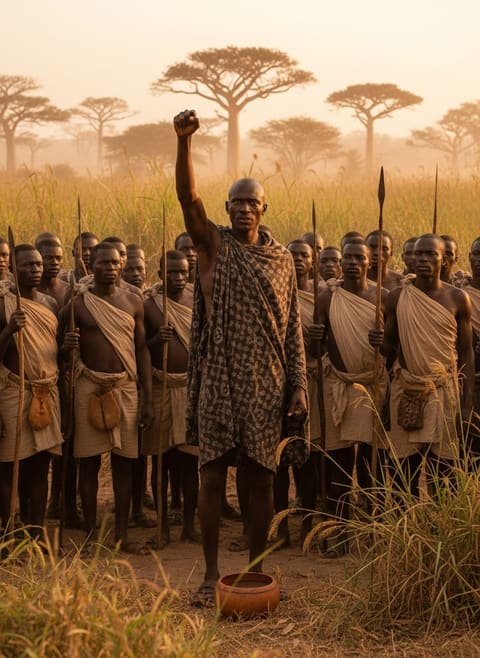
The rustle of leaves underfoot was a subtle whisper against the urgent heartbeat of the forest. Bhambatha moved silently, the dense canopy above forming a green labyrinth through which thin shafts of sunlight barely pierced. In his hand, he clutched his spear, its polished shaft a symbol of defiance. The Nkandla Forest was a sanctuary and a battleground—a place where Zulu traditions collided with the relentless march of empire.
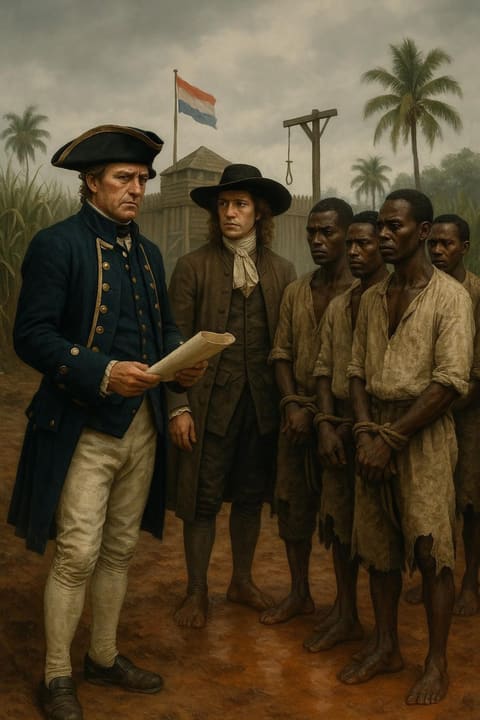
Bhambatha kaMancinza was not a man given to impulsive acts, but the poll tax was a line he could not cross. The colonial government’s decree required every Zulu man to pay a tax for the privilege of existing on their own land—a cold reminder of the subjugation that had cast a long shadow over Natal. To some, it was a nominal fee; to Bhambatha, it was an ensign of oppression, an indignity his forebears could not have envisaged in their most chaotic dreams.
Above the tree line, the sky was a vault of endless blue, indifferent to the human struggles below. The colonial authorities dubbed it a rebellion, but for Bhambatha and his followers, it was a fight for survival. It was here, amidst the thick undergrowth and the calls of distant birds, that the last armed Zulu resistance unfurled its flag against imperial rule. Gathering his impi, warriors whose eyes burned with the same unyielding fire, Bhambatha prepared to challenge a power whose tendrils reached across continents.
The British Empire, at the dawn of the 20th century, exhibited a vast reach, its grasp tightening with every passing year. The tax was conceived in the administrative halls of far-off cities, a product of bureaucracy that cared little for the distinct cultures it strived to control. But in Natal, where history coursed through the veins of the land like an unstoppable river, the Zulu people lived with the heartbeat of their ancestors echoing in their spirits.
Read next: When Wat Tyler Faced the King in Smithfield, 1381
Bhambatha's refusal to collect the tax was not merely an act of defiance; it was an assertion of dignity in the face of imposition. Escaping into the shadows of Nkandla was a strategic retreat—a move that would allow his belief to breathe, gather strength, and strike with precision. It was a place of legend, where the songs of old still lingered, where every tree held stories of valor and sacrifice.
As night fell upon the encampment, the fires flickered like stars fallen to earth. Men gathered around, the gravity of their mission palpable in the air. They were a proud people, taught from birth to endure hardship and celebrate life with unfettered joy. Bhambatha spoke with a voice that rolled like distant thunder: They would defend their right to exist free from the shackles of external rule. His words ignited a flame within his warriors that blazed brighter than the fires around which they sat.
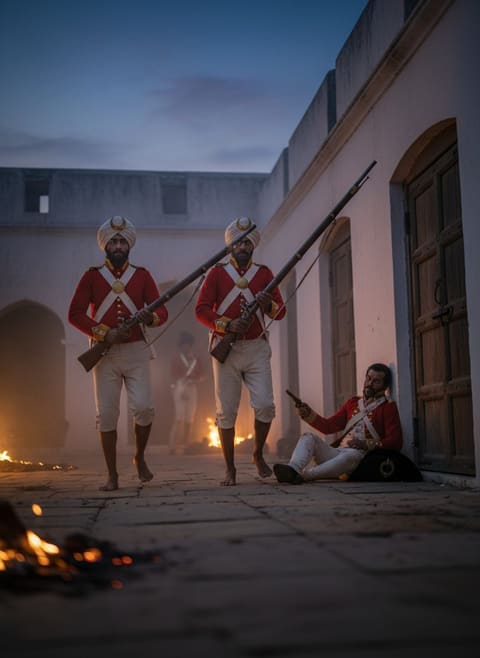
The days that followed were marked by skirmishes—a dance of life and death played out under the vast African sky. The colonial troops, clad in uniforms devoid of the vibrancy of the land they patrolled, marched into the forest with an overconfident stride. War had taught the Zulu to move with agility, to harness the terrain against those who sought to master it. Bhambatha's tactics were elegant and elusive, drawing upon a legacy of military art etched into the marrow of his people.
Read next: When Disguise Carried a Fugitive Through Empire's Heart, 1876
The tragedy lay not in the struggle itself but in the clear imbalance of power. The might of the British machine, driven by technology and unrelenting numbers, clashed against the courage and tenacity of those who fought fiercely but without the same resources. It was a clash of civilizations not unlike the many that had come before, where victory lay not in bloodshed alone but in the stories that would emerge to inspire future generations.
Bhambatha did not seek martyrdom; he sought justice and recognition. His legacy would not be written by those who sat in judgment from afar, but by the voices of the land that sustained him. The Nkandla Forest, with its timeless echoes, knew tales older than any empire, and its silence was a canvas painted with the whispers of resistance.
When the dust settled, and the Zulu hopes were momentarily quelled, an uncomfortable truth lingered. The poll tax, a detail in the grand design of empire, had ignited a flame that would never wholly be extinguished. Bhambatha had raised his spear, not just against a tax, but against an idea—that people could be reduced to numbers, their worth computed in a ledger far from the reality of their lives.
The story matters because it reminds us of the complex tapestry of human resistance and resilience. History is often shaped by the conqueror’s pen, yet it is the tales of those who resist which breathe life into pages long written. Bhambatha's legacy, like the forests he once called his home, endures. His stand was more than a moment; it was a testament to the enduring spirit of those who refuse to forget their roots nor surrender their identity to the annals of conquest.