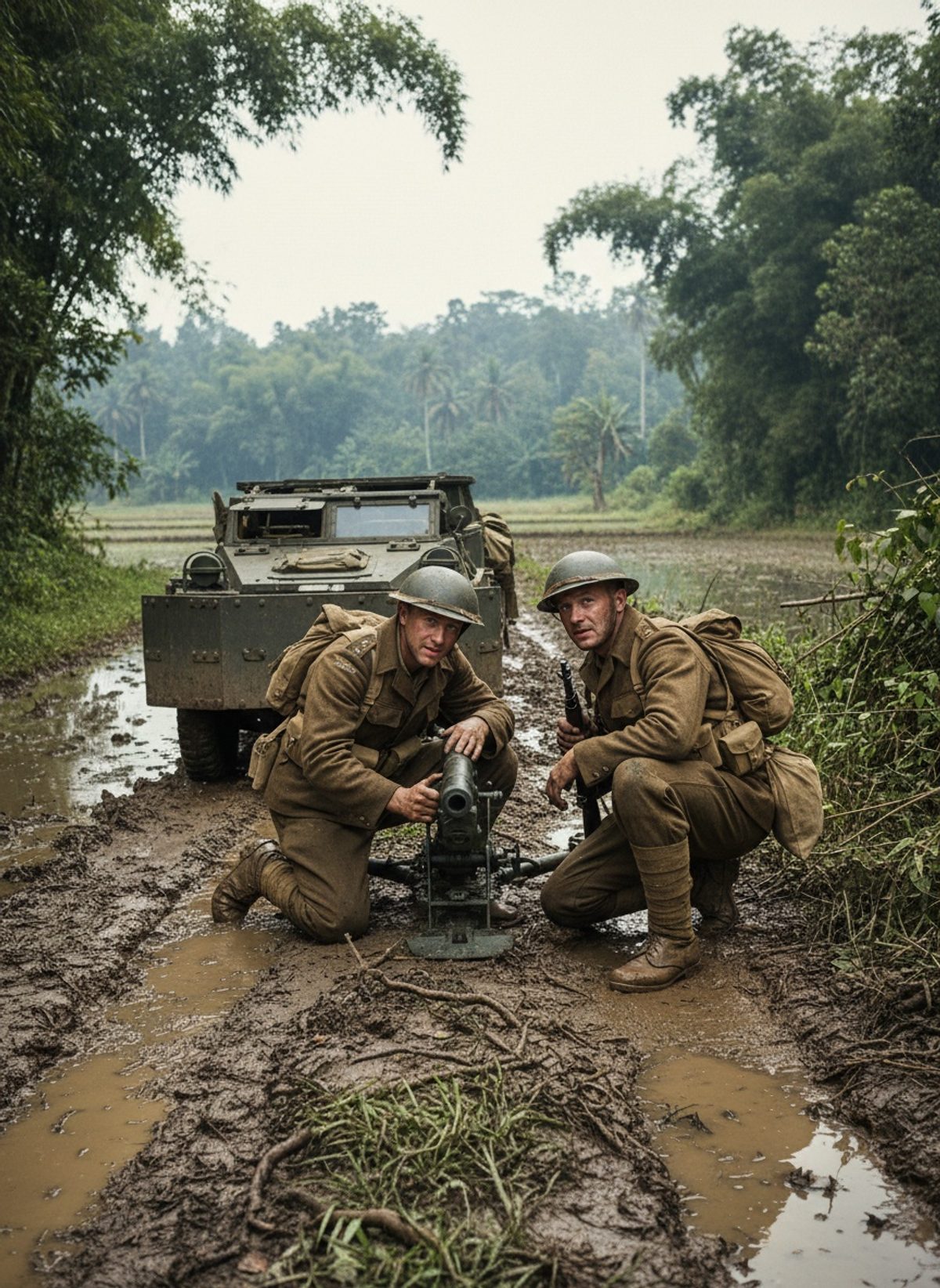
The clang of metal against metal was nearly drowned out by the roar of churning engines as the lead Bren carrier plunged into the murky expanse of the Irrawaddy. Water surged up the wading screens like an aggressor seeking entry, only to be thwarted by innovation. For a moment that hung on the precipice of eternity, the carrier seemed lost beneath the turbid embrace, until it emerged, dripping, behemoth-like, and resolute towards the opposite shore.
The Great Crossing
Here, in the depths of Burma’s January 1945 chill, the 14th Army demonstrated a defiant ingenuity. The landscape of Burma had always served as a formidable ally to the Japanese forces. With its treacherous rivers, dense jungles, and capricious monsoons, it seemed inconceivable for the British armoured vehicles to traverse certain areas, much less advance as they did now. The Japanese, entrenched and familiar with the terrain, could hardly fathom the sight that met them—a parade of iron beasts wading through waters thought uncrossable.
At the heart of this impossible feat were the deep wading screens affixed to the versatile Bren carriers. These screens, despite their simplistic appearance, were anything but mundane. Constructed to stand bravely against the onslaught of river and mud, they elevated the carrier's capabilities from mere land traversal to a theatre of daring amphibious operations. Each carrier seemed a microcosmic Ark, prepared to deliver soldiers not just across the water, but onto a world previously unreachable.
The Japanese had fortified their positions with the assurance of natural defences bolstered by the harsh climate and geography. The British, driven by the indomitable spirit of the 14th Army and a strain of necessity that births innovation, executed a manoeuvre that transcended conventional military logic. Soldiers sitting within the rumbling carriers could feel the nervous anticipation meld into unyielding determination. The air was thick not only with the humid ambient mist but with the charge of dawning triumph.
Read next: He Was 58, Dying, and He Still Led the Charge
Into the Depths
Watching from afar, one might suspect madness in this foray into the depths of an aquatic battlefield. But within, the soldiers were steadfast. Engines growled in a cacophony of relentless energy, hydraulic and human. The sound seemed to rival the very river it sought to tame. The men inside, many of whom had no prior experience with water crossings of this magnitude, found unity in shared glances and the rhythmic clattering of tracks over submerged obstacles.
Those moments in the belly of the carrier were long, with time thickening the air almost as palpably as the water pressing in from all sides. Eyes strained into the dim interior, only to flick to the narrow slits offering views of frothing chaos outside. An occasional cascade over the sides sent adrenaline spiking, teetering on the knife-edge between routine and catastrophe. Yet, the cold metal walls offered an assurance. Their faith was not in the veneer of invulnerability but in the hard proof that innovation could transform impassable realms into corridors of opportunity.
As they emerged on drier ground, guns at ready, and hearts steady, the true extent of their accomplishment came into view. They had defied not only the expectations of their adversaries but, at times, their own skepticism. The carriers, clinging to them like shells of modern crustaceans, stood as testament to the fact that where wheels falter and human persistence abides, there is a path—often forged by the resolute wielding of innovation over intimidation.
Read next: He Stepped Forward in Lucknow and Offered His Life
The Unseen Warrior
It was 1945, and the world was yet to fully witness the echoes of burrowing machines snaking through nightmares of combat. Yet, within the tangled heart of Burma, a story unfolded almost farcical in its seeming simplicity—machines slithering from banks into water, then ferociously onto opposing shores. The British innovation knew no bounds, and neither did their tactical scope. More than metal and mechanics, these carriers became harbingers of a new tactical era.
The Japanese, caught in the web of their own static confidence in natural obstacles, found themselves circumvented by opponents who redefined the canvas they were painting their defence upon. This exchange of gritty, mechanical artistry and raw martial prowess wove a new thread in the tapestry of warfare—a reminder that even during grandiose confrontations, minutiae and adaptability often crowned the victor. Ahead of them lay the task of retaking a land mired under years of embattled rule, punctuated by eruptions of iron-clad ingenuity.
In retrospect, some may view the deep-wading carriers as quaint relics, overshadowed by their more lauded kin in historical sagas. However, they carry an enduring lesson close to the heart of human enterprise—that every great stride rests upon the alchemy of vision fused with an unyielding spirit to redefine the possible. On the banks of the Irrawaddy, in the theatres of the unforeseen, British forces didn’t just cross into new territory—they resewed the garments of warfare itself, stitching into the fabric of history a fresh garment of resolve and possibility.