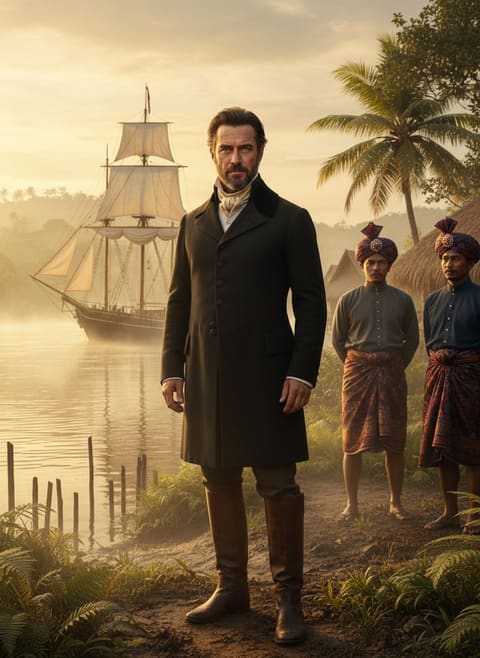
The scratch of a quill on parchment was the only sound in the dimly lit room. George Goldie, an unassuming figure with the somber face of a man who truly understood the weight of imperial ambition, sat hunched over a sprawling map of West Africa. This was not merely a drawing but a chessboard on which he moved the pieces of an empire he was crafting with audacity and ink. The genteel murmur of London life below his window offered scant intrusion into the strategic alchemy unfolding beneath Goldie's fingers.
Maps and Monopoly: A Businessman’s Game
In the latter half of the 19th century, the idea of empire was one still festooned with generals in red coats brandishing swords upon foreign soils. But George Goldie, a quiet revolutionist of the British Empire, played a different kind of game. Bereft of soldiers, he wielded the power of consolidation and cunning instead. By 1886, Goldie had already positioned himself as a formidable force in West Africa's burgeoning trade markets.
It was from a Fleet Street boardroom, miles away from the dusty banks of the Niger, that Goldie's commercial empire truly began its expansion. The tone was set in 1879 when he persuaded a cacophony of rival British trading firms in the region to merge into a single consolidated entity—the United African Company. With the blessing of a royal charter, Goldie orchestrated a commercial coup of unprecedented scale. The move not only unified varying business interests but also extinguished the niggling French competition with the subtlety of a chess grandmaster. By purchasing and outmaneuvering French trading outposts sprinkled along the Niger River, Goldie systematically sowed the seeds of British dominance in the region.
Known more for his shrewd negotiations and pragmatism than for displays of bravado, Goldie’s genius lay in the establishment of a monopoly. Several Africans tribes across Nigeria were now haggling for their wares with representatives of a single, unified British entity. No gunpowder required. His conquest of the Niger delta was commercial in nature and colonial in impact, making no secret of his intention to transform trade interests into territorial claim.
Read next: When William Adams Became the First Western Samurai, 1600
Charters of Power: The Imperial Distillery
Chartered by the British government in 1886, Goldie’s conglomerate became the Royal Niger Company. More than just a title, the charter equipped Goldie with quasi-governmental powers: rights to negotiate treaties, administer justice, and even exert military might—and all without a single British regiment dispatched to the riverbanks.
Under Goldie’s stewardship, the Royal Niger Company spread its influence like vines over a trellis, leaving colonies of merchants to sow seeds of British cultural and economic hegemony. The British government appeared surprisingly nonchalant throughout Goldie’s machinations, perhaps occupied with matters closer to home or simply unwilling to intervene in a region where success had seemingly come at little public expense.
Indeed, Goldie’s softly spoken supremacy expanded through signed treaties of trade and friendship with local leaders, establishing a complex fabric of economic control that bound tribal chiefs in burgeoning spheres of influence—a process underscored by a palimpsest of geopolitical intrigue. Goldie offered manufactured goods and an ever-tightening grip on trade routes in exchange for autonomy over rivers ripe with palm oil—black gold flowing into the rapidly industrializing heart of Britain.
There were whispers of Goldie's ambition stretching into Parliament itself, as he solo-piloted his dream of a new crown jewel within the British empire. Was it loyalty to country, profit, or prestige that kindled this curiosity? Goldie offered little explanation, his demeanor more revealing of a man who knew action spoke more loudly than words ever could.
Read next: When Two Explorers Vanished Into the Congo, 1887
Ink on Paper: A Nation Conceived
The legacy of George Goldie’s boardroom conquests is one curiously drawn, lacking the theatricality of sword’s edge or the loud drumbeats of war. By 1899, when the British government formally absorbed the Royal Niger Company's holdings into its West African colony, the foundation for modern Nigeria was already laid—meticulously sketched by a quiet figure with vision enough to see beyond the horizon’s edge.
The resonance of Goldie's peaceful conquests underscored not only the malleability of power but its camouflage among the pages of commerce and bureaucracy. No army had swept through these lands, no great flotillas had darkened their rivers. Yet, as Africa's geopolitical puzzle was pieced together by European powers, it was Goldie's work that had handed Britain its prize—a smiling mask hiding trenchant imperial teeth, penned and parcelled with government charters and ink.
In retrospect, Goldie's story is a profound reminder that wars for nations are not always fought with gunpowder and steel. Sometimes, they are waged by a single man at a desk, translating dreams of ownership into reality through the unassuming tools of a quill and map. Goldie’s legacy quietly reverberates through the contours of Nigerian history, the lines drawn on paper still echoing the shape of a nation born from boardrooms rather than battlefields.