They called him H. A soldier's soldier who believed in leading from the front, Lieutenant-Colonel Herbert Jones was the commanding officer of the 2nd Battalion, Parachute Regiment. But on the morning of 28 May 1982, on the rugged, waterlogged terrain of East Falkland, this legendary leader made a surprising move. He charged a fortified machine-gun post alone, a desperate action that defied the entrenched military protocols of command — and it cost him his life.
The Battle of Goose Green was a pivotal moment in the Falklands War, fought between British and Argentine forces over slightly more than 24 grueling hours. Set against the bleak landscape of a South Atlantic winter, the conflict played out on a narrow isthmus critical for strategic movement on the islands. At the heart of the action were over a thousand Argentine soldiers, entrenched in a line across Darwin Hill to Boca House. They held a key position along the isthmus, armed with anti-aircraft guns and entrenched artillery that transformed the rolling hills into a formidable death zone for advancing troops.
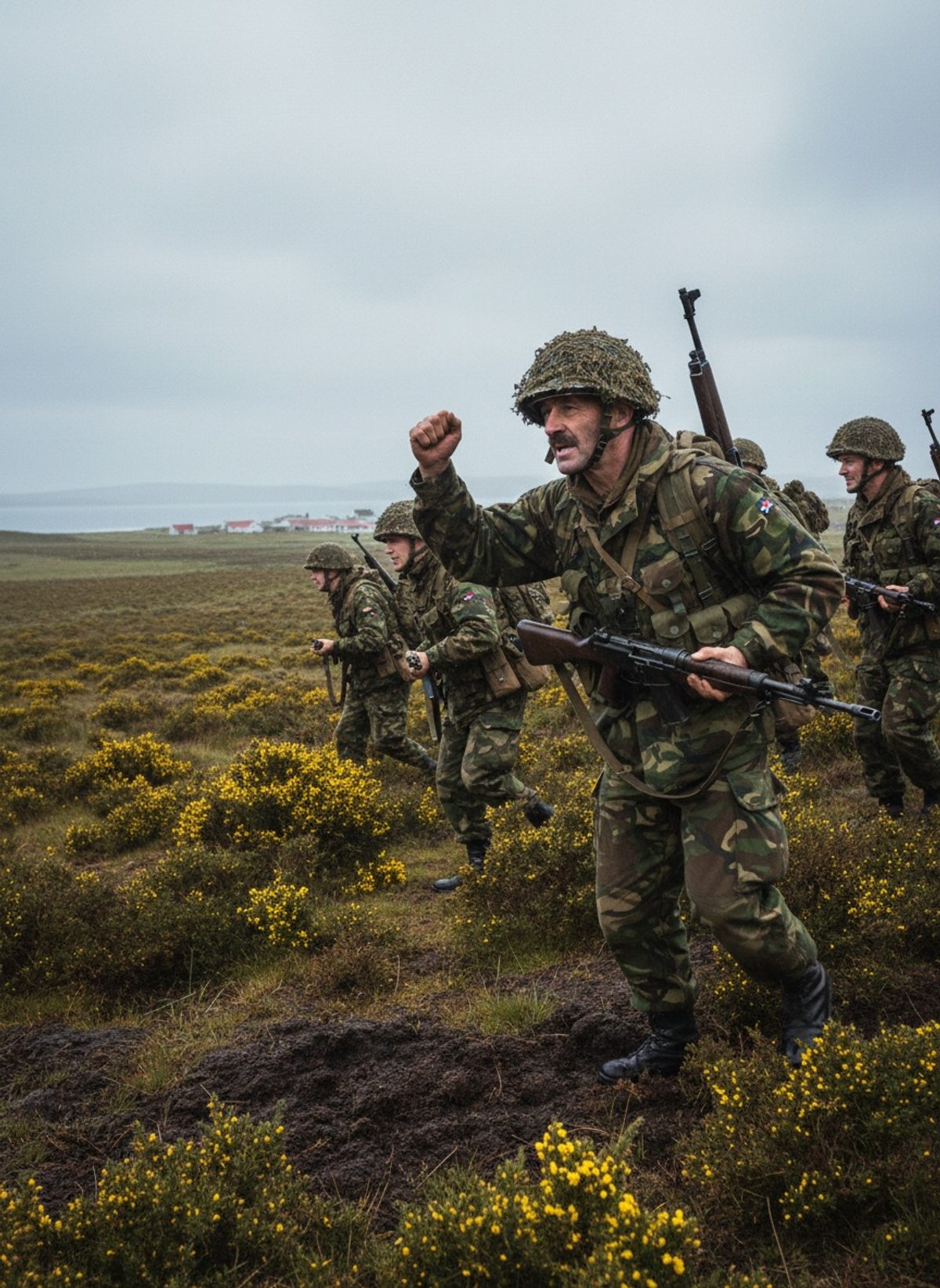
The battle began under the cloak of early morning darkness, with 2 PARA advancing into the gorse-laden fields below Darwin Hill. They quickly found themselves pinned down by heavy and accurate fire. With every attempt to advance meeting fierce Argentine resistance, the momentum of the offensive stalled. The air was thick with the clatter of gunfire; the ground cold and unforgiving. This was no place for indecision.
Faced with increasingly dire circumstances, H Jones made the decision that would immortalize him. Unwilling to leave his men stranded, he leapt into action with the kind of decisive valor that both inspired and concerned his fellow soldiers. Without hesitation, Jones charged up a small gully that led to the Argentine machine-gun post. His actions were more than the instinct of a seasoned warrior; they reflected a leader's urgent bid to break the deadlock and keep hope alive.
Read next: He Was 58, Dying, and He Still Led the Charge
His adjutant Captain Wood, Captain Dent, and Corporal Hardman, caught in the grip of steadfast loyalty and bravery, followed their commanding officer. The attempt was nothing short of heroic, yet heartbreakingly futile. All three perished in the assault. Jones, pressing forward on the lone path of danger, was shot down by Argentine forces, leaving his battalion momentarily leaderless.
Command immediately passed to Major Chris Keeble, who faced the daunting task of rallying exhausted troops. Keeble, embodying steadfast resolve, reorganized the beleaguered forces under dire conditions. Two grueling hours later, the men of 2 PARA were ready to try once more. It took six hours of close combat, with chaos swirling around Darwin Ridge. Despite the cold and lack of resources, Keeble's leadership saw the paratroopers gradually seize control, culminating in a significant victory by nightfall, with the settlement surrounded.
As darkness enveloped the battlefield, the relentless strain began to take its toll on the British forces. Soaked, fatigued, and running dangerously low on ammunition and water, Keeble was forced to contemplate cost-effective ways to conclude the attack. At midnight, he decided to extend an unusual offer. He sent two Argentine prisoners forward with terms of surrender, a shrewd move borne out of both strategic necessity and deep humanitarian consideration.
By morning, 29 May, the garrison surrendered — a powerful demonstration of the paratroopers' perseverance and Keeble's tactical acumen. A total of 961 Argentine soldiers were taken prisoner. The British had paid a heavy price, losing eighteen courageous servicemen, among them the gallant H Jones.
Jones' death was not in vain; it became a crucible around which the resolve of 2 PARA hardened. Goose Green had fallen, capturing the attention of a nation gripped by updates from a far-flung theater of war. For his exceptional courage, H Jones was posthumously awarded the Victoria Cross, a testament to his indomitable spirit and leadership. Buried first at Ajax Bay, he was later laid to rest at the serene Blue Beach War Cemetery at San Carlos, where his bravery continues to echo across time.
The order for this attack stemmed from broader political tides, beyond just immediate military objectives. With a bogged-down British campaign and UN pressure for a ceasefire, the government in London demanded a demonstrable victory. The attack on Goose Green was as much about political momentum as it was military strategy. Ironically, what had been initially mandated as a raid ended as a complete capture, a scenario fitting the vision of Jones more than the original orders intended by Brigadier Julian Thompson.
Battle plans were laid amidst imperfect intelligence, significantly underestimating the Argentine defenses. Yet a critical underestimation evolved into a definitive engagement, reshaping the contours of the Falklands conflict. The victory at Goose Green would bolster British morale and signal a marked shift in the war's progress, laying the groundwork for further operations.
Read next: He Stepped Forward in Lucknow and Offered His Life
The story of H Jones – fearless in the face of insurmountable odds – remains a powerful symbol of the qualities of bravery and sacrifice that define military leadership during a war. His actions transcended the immediate tactical utility of his decision; they embodied the spirit of commitment to one's compatriots even unto death. More than a battle plan on paper, Goose Green became a testament to heroism in its rawest form.
As we remember the selfless actions of figures like H Jones, we are reminded of the profound sacrifice demanded by warfare. His journey illustrates the boundaries of duty, courage, and the often unheralded, complex realities of conflict. Seen through the lens of time, the events at Goose Green underline the enduring truth: that sometimes the tales left out of textbooks are those most worth telling, not just for their heroics, but for their human profundity.
This week, around 150 British paratroopers and local reservists rehearsed a landing and a 20-mile march to Goose Green.
Part 1 of 24: One Falklands story a day until Remembrance Sunday