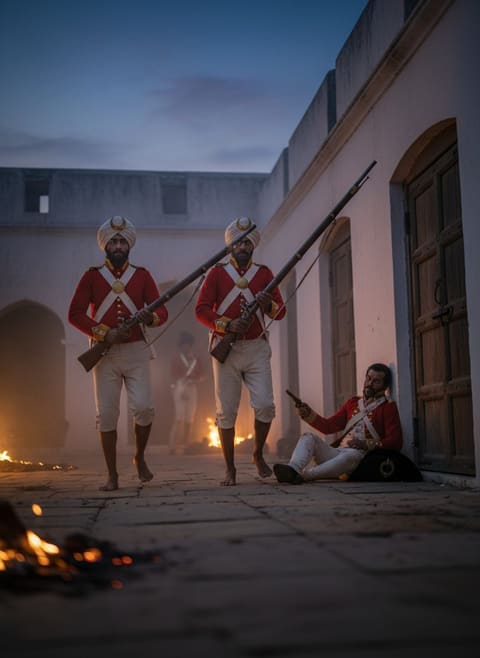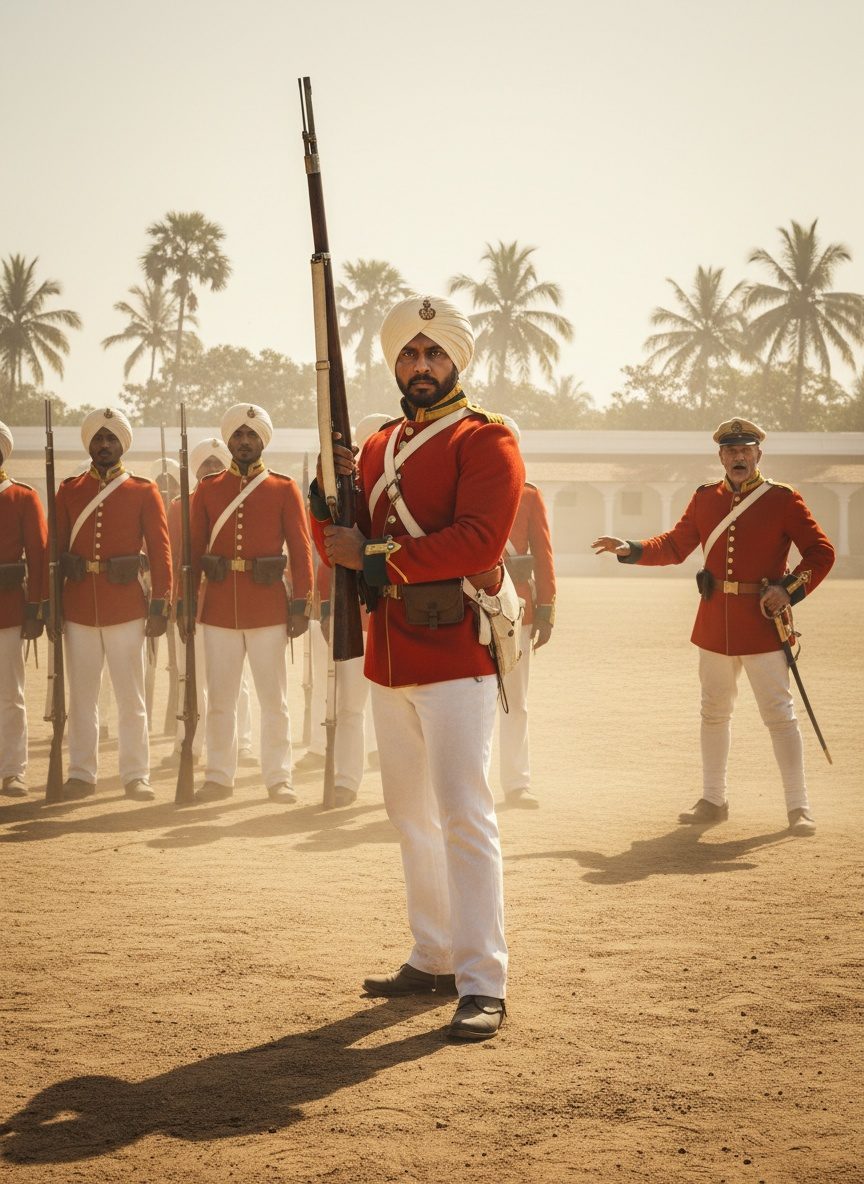
He was twenty-nine years old. His defiance sparked the fires of revolt that would forever change a nation.
The Shot Heard 'Round India
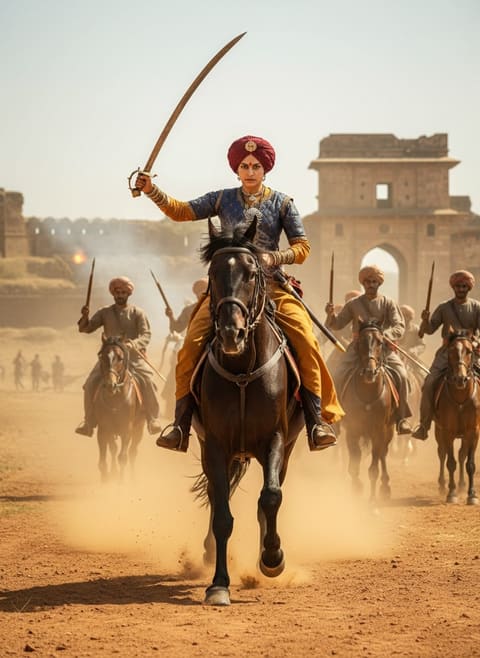
On a sweltering day in March 1857, the rumblings of discontent echoed across the barracks of Barrackpore, a significant cantonment near Calcutta. Amidst the regimented precision of the parade ground, a sepoy named Mangal Pandey resolutely stepped forward. With unwavering determination, he raised his musket, the symbol of his service and now his rebellion. As he pulled the trigger, a singular gunshot rang out, shattering the tense air and igniting the spark that would blaze across the subcontinent. It was an act of extraordinary courage, one that rang louder than the discharge itself — a challenge to the pervasive presence of the British Empire in India.
The underlying tensions had been simmering for months, if not years. Sepoys, Indian soldiers in the employ of the British East India Company, faced a range of grievances, from cultural insensitivity to discriminatory practices inherent in colonial rule. However, the catalyst for this spontaneous revolt was a seemingly trivial matter: rumors that the new Enfield rifle cartridges were greased with beef and pork fat, anathema to Hindu and Muslim beliefs respectively. Such an offense, touching the very core of personal faith and identity, was the proverbial straw that threatened to break the back of compulsory compliance.
Amidst this charged atmosphere, Pandey's daring volley resonated beyond his regiment, echoing through the ranks of soldiers across the varied soils of India. For Pandey, the actions of that day were not simply a response to the immediate affront of the cartridges but a broader stand against a system that treated soldiers like expendable tools. His cry of rebellion underscored not only his personal indignation but also the collective grievances festering under colonial domination.
Read next: When Wat Tyler Faced the King in Smithfield, 1381
A Nation's Deep-Rooted Resentment
The British presence in India was not merely a political occupation; it was a cultural imposition that wedged itself deep within the heart of Indian society. The disquiet at Barrackpore was a microcosm of the greater resentment that brewed across the expanse of the subcontinent. The British East India Company, which had its tentacles stretched over vast territories, was viewed as a dominion of exploitation rather than a partnership of mutual progress. The sepoys, mostly hailing from rural and conservative backgrounds, witnessed first-hand the cultural and economic upheavals imposed by the British. Their land was being transformed, their traditions marginalized, and their honor constantly under siege.
Mangal Pandey’s regiment, the 34th Bengal Native Infantry, became the unlikely vanguard of unrest. As Pandey stood before his colleagues that day, his actions mirrored the collective frustration of a people grappling with an alien rule that was as disrespectful as it was dominant. For many fellow sepoys and civilians, his act resonated as an affirmation of their unvoiced anguish, a call to reclaim dignity in an era devoid of it.
Although Pandey’s uprising initially seemed isolated, word of his rebellion traveled rapidly, awakening simmering tensions across other regiments. The march of discontent did not stop at the barracks; it spilled out onto the streets, into villages, and through the native courts, punctuating everyday life with echoes of past glory and egalitarian dreams. It marked the beginning of what would later be known as the Indian Mutiny or the First War of Independence, a struggle as much for identity and pride as for political freedom.
Read next: When Disguise Carried a Fugitive Through Empire's Heart, 1876
The Ripple Effect: Unseen Consequences
Mangal Pandey’s name is often recorded in history with a reverent whisper or a defiant shout, depending on who recounts it. His singular action became a linchpin, a moment that drew a dividing line between eras, altering forever the fabric of colonial endeavor in India. His rebellion, though quashed with immediate and brutal military precision, succeeded in birthing a new era of consciousness among Indians of all walks of life. The unity forged in blood and shared cause resonated much longer and far broader than the shot itself.
It was, to say the least, a point of no return. British authorities were forced to recognize that their reign was contingent not just on military supremacy but also on the consent of the governed—a consent that, as Pandey demonstrated, could be withdrawn at any continent-spanning collision of moral insult and collective resolve. No longer could the British casually dismiss the sepoys’ grievances as petty and provincial; their authority was shaken, and with it, the illusion of invincibility.
As the embers of rebellion cooled and the colonial administration sought to cement its grip again, the mutiny’s whisper lingered long into the corridors of the Viceroy’s council and the drawing rooms of London. For India, the ramifications were profound. The psychological surge initiated an enduring legacy of resistance that would fuel future generations in their journey towards sovereignty. Mangal Pandey’s action, however contentious it remains in colonial histories, is a poignant reminder that the fires of freedom often begin with a single, improbable spark in the hands of the resolute. His story remains an enduring symbol of the power individuals hold to ignite change amidst overwhelming odds, transcending the immediacies of their time to shape destinies yet unwritten.