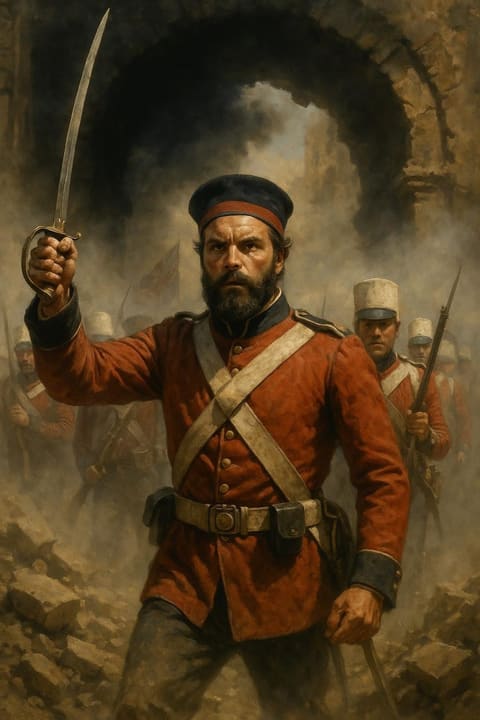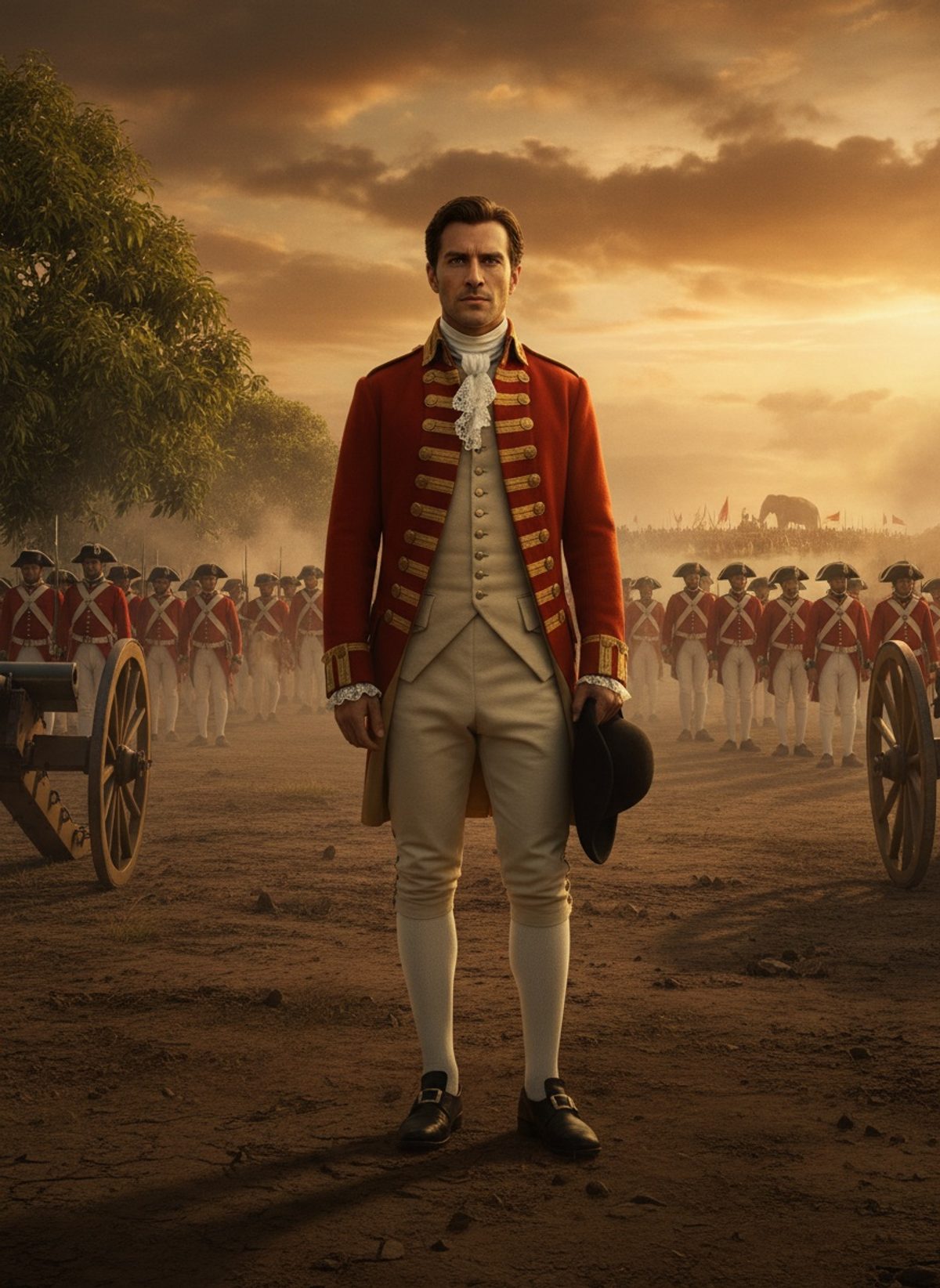
The air crackled with the thunder of cannons, the acrid smell of gunpowder hanging heavy as the sounds of battle echoed across the humid Bengal plain. Robert Clive, a man more accustomed to ledgers and quills than swords and strategy, stood amid the chaos, his small band of soldiers poised against the vast army of Nawab Siraj ud-Daulah. Here, in the oppressive heat of June 1757, the future of an empire pivoted on the resolve of a few determined men.
The Gambler's Moment
Clive’s journey from the bustling offices of the East India Company in Madras to the battlefield of Plassey was as unlikely as it was daunting. A young clerk burdened by immense debt and persistent melancholy, Clive had fled his desk for the muddy fields of war, believing he could carve a destiny where once there was only monotony. What lay before him now was a gamble of unprecedented scale. His troop of 3,000 — a mix of European and Indian sepoys loyal to the Company — faced an army that dwarfed them in size, an intimidating force of 50,000 soldiers, including towering war elephants and cavalry that flashes of light danced off their sabres.
This wasn’t merely a battle for the soul of Bengal but a calculated move to tip the balance of power in the Company’s favor, a chance to replace trade ambitions with dreams of dominion. Surrounding Clive were the formidable forces of the Nawab's allied commanders, yet rumors of treachery floated through the ranks. Mir Jafar, a key commander in the Nawab's forces, had clandestine discussions with Clive, promising to defect at the opportune moment. Such was the complexity of the chessboard that lay before Clive as he plotted his every move.
The Battle Unfolds
As the hot Bengal sun reached its zenith, casting harsh shadows across the battleground, the first cannon shots were exchanged. Groans of pain and cries of war merged with the relentless drumming of rain that began to pelt down, briefly reducing visibility and muddying the earth beneath pounding feet. Tactics honed amidst Indian campaigns and the lessons of European warfare guided Clive's strategic mind. He maneuvered his men with a precision that belied both their numbers and experience.
Read next: When William Speirs Bruce Planted a Flag on No Man's Ice
In the chaotic swirl of battle, Clive’s cannon battery roared defiantly, each blast propelling the iron projectiles at the heart of the Nawab’s forces. While the Nawab's soldiers encircled, the continuous barrage from Clive’s side began to break their resolve. The shifting tides of combat soon revealed Mir Jafar's hand. As promised, he and his men stood down, significantly weakening the Nawab’s lines and turning the engagement in Clive’s favor.
The Nawab’s troops, sensing the faltering command and growing disarray among their ranks, wavered. The disciplined line of Clive’s soldiers advanced steadily, exploiting every lapse in the enemy’s defense, every hesitation in their tactics. It was a scene of brilliant but brutal maneuvering, where strategic foresight overcame sheer numbers.
Read next: When George Everest Measured the Roof of the World, 1856
The Birth of Empire
The retreat sounded not as a noble resignation but a faltering collapse. As daylight waned, Clive’s troops surged forward, securing a victory that seemed improbable mere hours before. The Nawab fled, leaving the remnants of his once-mighty force scattered like autumn leaves. Plassey had become a name that would ripple through history, echoing within the marble halls of both local palaces and distant London meeting rooms.
Yet, what unfolded in the day's aftermath was as significant as the battle itself. In the defeat of the Nawab, a door opened through which the East India Company didn’t just trade—it ruled. Bengal, with its inexhaustible resources and its strategic position, was now the gateway to imperial ambitions. This wasn't merely about tea or textiles but sovereignty, a pivot from commerce to conquest.
Robert Clive, once an inconspicuous clerk, emerged a national hero, hailed as an architect of empire. His audacity rewrote the fate of two continents, an audacious victory seized from the jaws of overwhelming odds. The battle of Plassey turned a company's enterprise into an imperial epoch, introducing a new chapter where boardroom strategies and battlefield tactics wove the fabric of modern colonialism. As the sun set over Bengal, the pages of history turned, heralding the dawn of the British Raj.