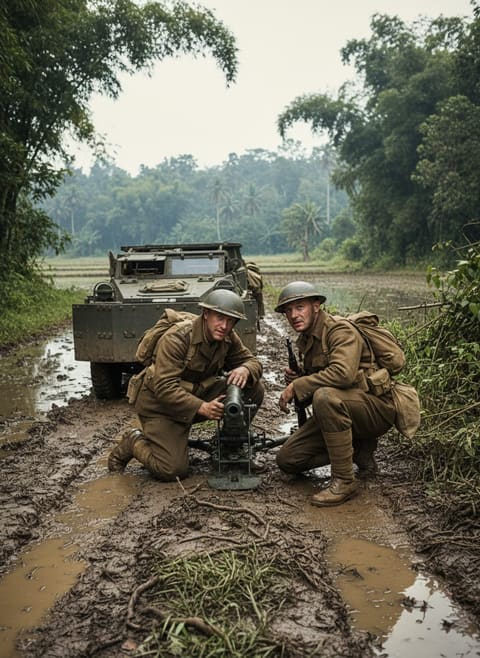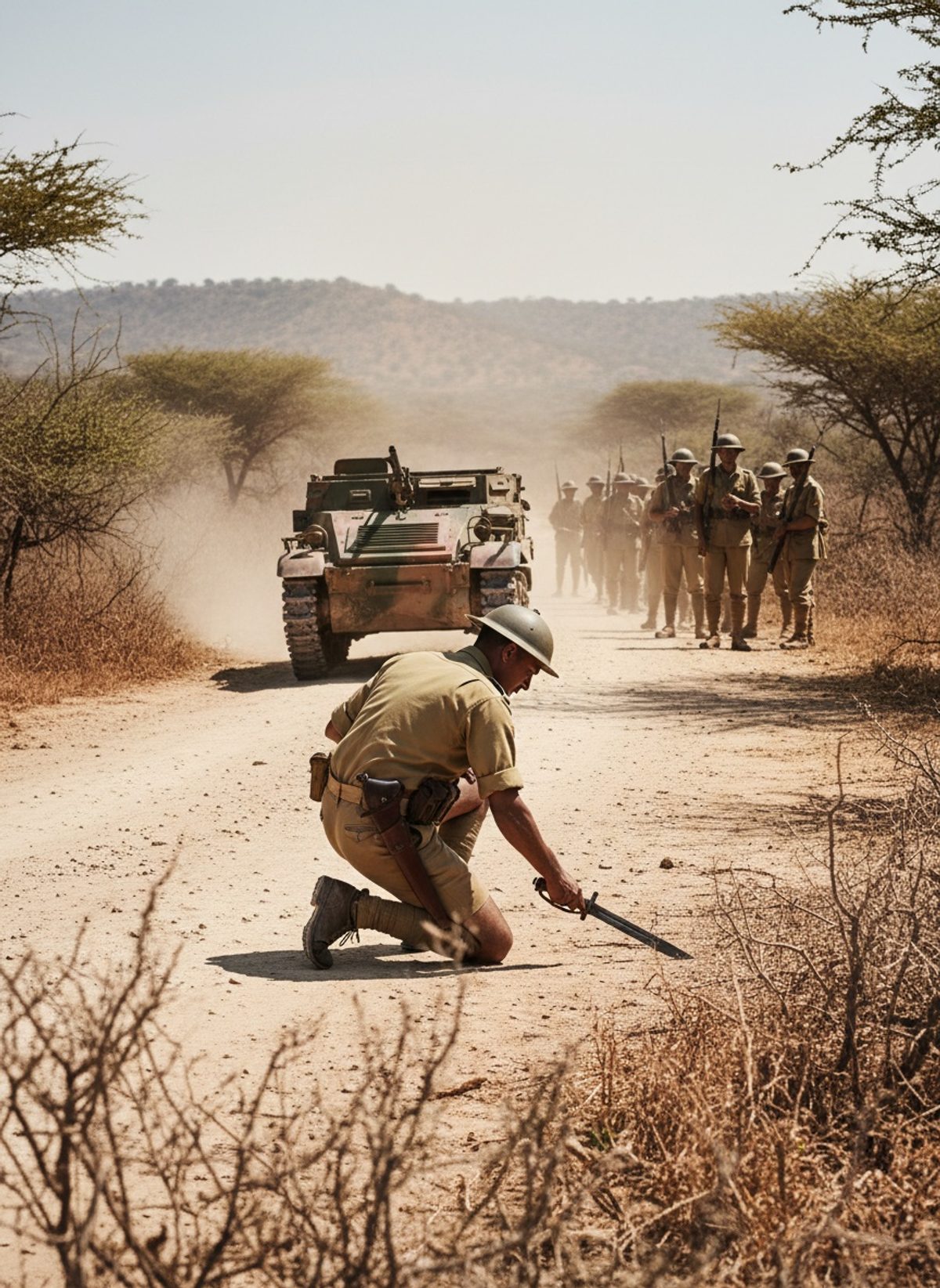
In early 1941, during the pursuit of the enemy following the capture of Metemma, 55 miles of road had to be cleared of mines. The task fell to Second Lieutenant Premindra Singh Bhagat, 22, of the Corps of Indian Engineers, serving with the Royal Bombay Sappers and Miners. Over four days he cleared 15 minefields, and he was awarded the Victoria Cross.
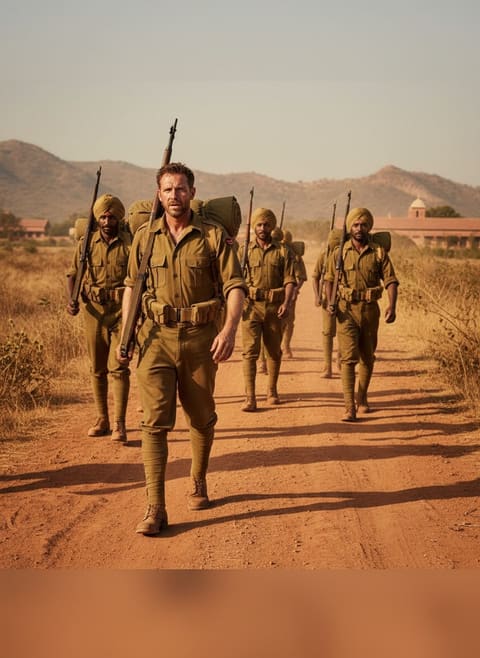
On 31 January 1941 a mobile column of the 3/12 Royal Frontier Force Rifles, including a detachment of 21 Field Company under Bhagat, was sent on a reconnaissance mission towards Metemma. Bhagat commanded a section of a field company detailed to accompany the leading mobile troops, the Bren carriers, and to clear the road and adjacent areas of mines. He rode in the leading carrier and led the column.
Bhagat's Bren carrier passed through a heavily mined stretch of road and set off two mines. The second destroyed the carrier and killed the driver and a sapper. Bhagat continued in another carrier and defused mines by hand as the column moved down the road.
Speed was essential. According to his citation, he himself detected and personally supervised the clearing of no fewer than 15 minefields of varying dimensions, working at high pressure from dawn to dusk each day. He did it under close enemy fire and without food or rest.
Read next: When Sergeant Ian McKay Charged the Guns on Mount Longdon, 1982
For a period of four days and over a distance of 55 miles, he led the column from the leading carrier. On two occasions his carrier was blown up, with casualties to others, and on a third occasion the column was ambushed and came under close enemy fire. Each time he carried straight on with his task.
On 2 February another Bren carrier was blown up under him, and an explosion punctured an eardrum. Worn out with strain and fatigue, he refused relief, on the grounds that he was now better qualified to continue the task to the end. He was eventually relieved of further duties and evacuated to Khartoum for treatment. His citation praised his "coolness, persistence over a period of 96 hours, and gallantry".
Bhagat was born in Gorakhpur, British India, in October 1918, the son of Surendra Singh Bhagat, an executive engineer in the provincial government of the United Provinces. His mother died in 1927. In 1930 he entered the Royal Indian Military College in Dehradun, where he was an average student, and in June 1937 the Indian Military Academy, where he captained the tennis and squash teams. His instructors noted him as an intelligent all-round sportsman but also described him as a careless student. In January 1938 his father died in a riding accident. Bhagat applied himself to his studies in his final year and was commissioned on 15 July 1939 as a second lieutenant in the Royal Bombay Sappers and Miners. In September, shortly after war began in Europe, he was posted to 21 Field Company at Pune.
On 23 September 1940 his company was sent to East Africa with the 10th Indian Infantry Brigade of the 5th Indian Division, under the overall command of Lieutenant General William Platt. The brigade was commanded by Brigadier William Slim, later Field Marshal the Viscount Slim. On 6 November Slim attacked the fort of Gallabat. It was captured, but an enemy counter-attack forced the brigade to withdraw, and the sappers were tasked with obstructing the enemy. Two broken-down tanks were filled with explosives and placed on a culvert to collapse it, but one tank failed to explode and the culvert did not collapse. With the enemy closing in, Bhagat dashed out from cover and, with bullets flying all around him, detonated the remaining explosives and collapsed the culvert. He was recommended for a Military Cross, but it was downgraded to a mention in dispatches.
His Victoria Cross was gazetted on 10 June 1941. That June, at Asmara, General Wavell presented him with the ribbon, and on 10 November he was formally invested with the decoration by the Governor-General of India, Lord Linlithgow, at Viceroy's House in Delhi. He was the most senior Indian Army officer ever to be awarded the Victoria Cross.
Read next: When British Intelligence Broke Germany's Spies With a Teacup
On 24 February 1942, in Pune, Bhagat married Mohini Bhandari. He spent the rest of the war away from the front, first as a successful recruiting officer for the Bombay Sappers and then as commanding officer of 484 Field Company, which was posted in mid-1943 to Chhindwara to train in jungle warfare for the war in Burma. In January 1945 he was nominated for a course at Camberley Staff College, becoming one of the first two Indian officers to attend Staff College in the United Kingdom. He returned to India in June 1947 as the highest decorated officer in the Indian Army at independence, and served with the Punjab Boundary Force. He went on to command the Bombay Sappers, to serve as Director of Military Intelligence and as Commandant of the Indian Military Academy, and, as a lieutenant general from 1967, to command Central Command and then, from June 1972, the re-established Northern Command.
As Director of Military Intelligence, Bhagat completed a thorough assessment of the Chinese Army's threat to India, but his report was not heeded before the 1962 Sino-Indian War. As Commandant of the Indian Military Academy he co-authored, with Lieutenant General T. B. Henderson Brooks, the Henderson Brooks-Bhagat Report, an incisive review of the Indian Army during that war. The report was initially suppressed and classified top secret, but it soon led to sweeping changes in the army. In 1973 Field Marshal Sam Manekshaw, the outgoing Chief of the Army Staff, chose Bhagat as his successor, but Lieutenant General Bewoor was senior, and the government extended Bewoor's tenure by nine months. Bhagat retired a few months later. In July 1974 he became Chairman of the Damodar Valley Corporation, a major electric utility, and during his tenure its power production rose from 45 MW to 700 MW.
After only ten months at the Damodar Valley Corporation, Bhagat died on 23 May 1975 of anaphylactic shock after an injection of penicillin, to which he was allergic. On 1 February 1976 his wife, Mohini, presented his medals, including his Victoria Cross, to the museum of the Bombay Sappers in Pune. The Indian Army dedicated a Chair of Excellence in his memory at the United Service Institution of India.
Part 7 of 24: One Second World War story a day, 16 November to 9 December