The early 17th-century Irish village of Baltimore is forgotten now. Once, it was impossible to forget.
Whispers of the Sea
The summer of 1631 should have felt like any other in Baltimore, a quaint fishing village nestled on the rugged Irish coast. As the sun faded into twilight on a seemingly peaceful June evening, the fishermen stowed their nets, families gathered around hearths, and a tranquility hung in the air. Unbeknownst to the villagers, this tranquility belied the danger that loomed just beyond the horizon.
Two Algerian ships, sleek and sinister, bobbed gently in the cool waters of the Atlantic. Guided by a renegade Dutch captain—a man driven perhaps by greed or adventure—they had set sail from the Barbary Coast. Their destination was not one dictated by trade or exploration, but by the darker desires of maritime piracy. North African corsairs, feared across the Mediterranean, now set their sights further afield. Their mission? Capture unwary souls and sell them into slavery, a human cargo destined for distant lands.
The Night of Terror
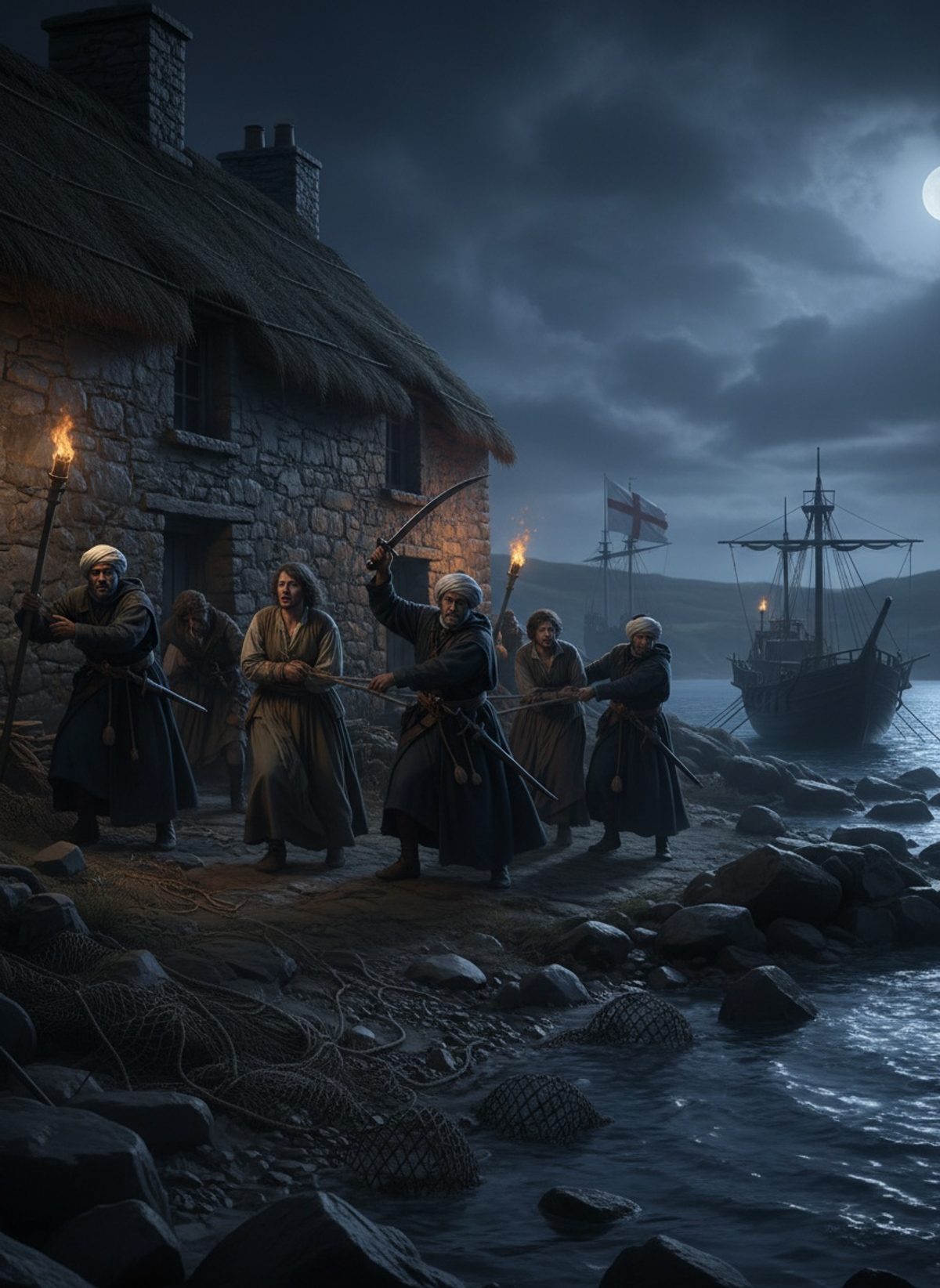
Under the cloak of darkness, the corsair raiders approached the unsuspecting village. They moved with the stealth and precision of seasoned predators, landing silently on the Irish shoreline. The villagers, lulled by the mundane cadence of coastal life, were wholly unprepared for what was to come.
Read next: When Wat Tyler Faced the King in Smithfield, 1381
As the first light of dawn kissed the sea, chaos erupted. The raiders struck swiftly, bursting into homes, dragging men, women, and children from their beds. The air thickened with cries of despair and confusion. In a few short hours, the life Baltimore had known vanished, replaced by the haunting void left by the 107 souls now shackled and bound, led to the corsair ships where the horrors of an unimaginable journey awaited them.
Fear on the Homefront
The raid on Baltimore was a shock, a nightmare imported from distant lands imposed upon the familiar Irish soil. But it was no anomaly. Between the 16th and 18th centuries, the coasts of Britain and Ireland were under constant threat from North African corsairs. Seafarers and coastal dwellers lived with the perpetual fear of being captured and enslaved, an invisible war that raged far from the battlefields of empires.
For many, the sea, once a source of sustenance and livelihood, became a feared adversary. The Royal Navy, stretched thin, found itself ill-equipped to curtail these brazen incursions, its ships occupied with myriad demands that came with protecting an emerging global empire. The corsairs exploited this deficiency, capitalizing on their agility and sheer audacity to strike where defenses were weakest.
The Ripple Effect of Catastrophe
The repercussions of the Baltimore raid were profound, reverberating not only across Ireland but echoing through centuries. Communities along the British Isles adapted, fortifying their shorelines, building watchtowers, and forming militias. A once seemingly insignificantly distant threat became visceral and immediate, forever altering the rhythm of coastal living.
Read next: When Disguise Carried a Fugitive Through Empire's Heart, 1876
Yet, the raid’s legacy was not solely one of fear and fortification. It ignited political debates in London and Dublin, compelling authorities to intensify their gaze upon the fragile fringes of their domains. Encouraged by public outcry, efforts to counteract the slave trade gained momentum, albeit slowly. Even among those who despised their governments' many failures, there was a renewed resolve to protect their people.
A Distant Storm Still Felt
As history unfurled, the terror of the corsairs eventually faded, swallowed by the march of time and technological advancements that rendered their wooden ships obsolete. But the story of Baltimore lingers as a vivid reminder that the legacies of piracy and human trade stretch far further than the Mediterranean's warm waters, deep into the heart of unsuspecting Europe.
In an age where the tales of pirates often wear the sheen of romance, it is crucial to remember the real human cost behind those lost village souls. Baltimore stands—not merely as a footnote in history—but as a testament to the relentless human spirit that endures the darkest nights. It is a tale of unexpected bravery, remarkable in its capacity to remind us of the chaotic unpredictability of history and the enduring need for vigilance against the tides that threaten to pull us unbidden into their depths.