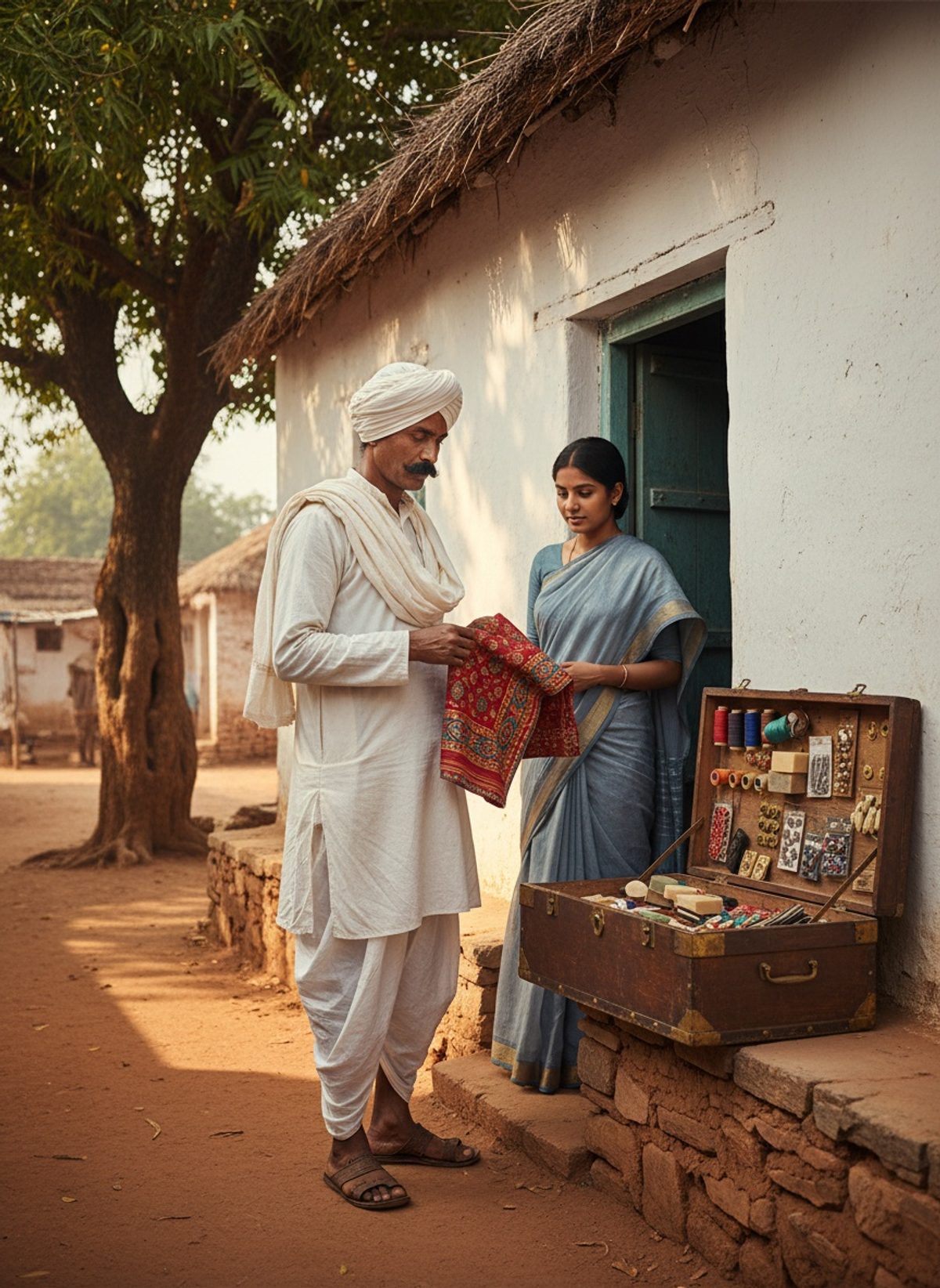
Dust crept slowly into the creases of his sun-beaten face as the blistering midday sun illuminated the dirt track stretching towards the horizon. Each step sent a small cloud of dust swirling around his feet, a chaotic dance that settled onto the hems of his dhoti. Balancing his hefty, meticulously organized wooden box with practiced ease, the box wallah arrived at the first village of the day, summoning curious faces with a shout that echoed through the narrow pathways of mud-walled homes.
The Lifeline in a Box
It was India in 1880, a cacophonous tapestry of cultures under the vast reach of Victorian Britain, where the grind of daily life for many was punctuated by the arrival of the box wallah. Known in the local languages by various terms, these itinerant merchants became the de facto purveyors of goods in regions of the subcontinent untouched by the burgeoning network of British-established markets and shops. As the box wallah entered the village, the rhythm of daily life slowed; farmers paused mid-scythe, wives laid aside their chores. A motley crowd gathered around the traveler like bees drawn to the nectar, eyes avidly drinking in the sight of exotic goods spilling from the lid of his treasure chest.
The box wallah was no ordinary seller. His inventory was a nomadic bazaar, a microcosm of the empire's wealth that operated on neither fixed prices nor the logic of conventional markets. In his box rested carefully curated items that catered to the wants and demands of his rural clientele: lengths of colorful fabric, glinting needles, aromatic soaps promising unfamiliar cleanliness, and glossy magazines depicting the far-off worlds of the British elite. More than goods, he sold stories and whispers of faraway lands, bringing with his wares an unmistakable aura of the exotic. Bargaining was both an art and a ritual, full of jocular exchanges and mutual respect that laid the foundation for a transaction where trust carried more weight than currency.
The Invisible Roads of Commerce
The lives of these box wallahs unfolded against India's sprawling and diverse backdrop, navigating from Punjab in the arid northwest to the verdant backwaters of Kerala in the south. Their paths stretched like invisible roads winding through the subcontinental vastness, facilitated by the absence of formal marketplaces in numerous villages. The railroad, while transforming larger towns and cities, rendered scant assistance to those like him who plied their trade away from the iron tracks of the colonial machine.
Read next: When the Hill Station Post Office Linked Two Worlds, 1885
This merchant life was forged through relentless perseverance and intimate knowledge of local terrains and customs. Box wallahs were the nexus between the village economies and the wider imperial trade networks, adept at adjusting their selection of goods to match the shifting demands and preferences of their clientele. For these merchants, the success of their enterprise hinged not on advertising but on the enduring relationships cultivated over countless dust-laden, sun-scorched miles.
Yet this existence was not without its hazards. The threat of theft and the perils of nature were constant companions. Each year, the onset of monsoons brought torrential rains that turned roads into rivers and tested the durability of the wooden box strapped to his back. In such times, the box wallah had to rely on the hospitality of the villagers, trading goods for shelter, and weaving his stories in exchange for rice and curry. Always, he would move on, a transient specter following the whispers of need and opportunity.
Read next: When the Dak Runner Carried the Empire's Word, 1880
The Legacy We Don't Recall
In the echo of fading footfalls, the receding silhouette of the box wallah symbolizes a forgotten chapter of the imperial jigsaw—a network of lifelines outside the narrative of grand strategies and imperial politics. For the rural inhabitants with limited access to the wider world, this merchant-on-foot represented far more than mere commerce. He was a crucial bridge between isolation and engagement, a traveler whose footsteps intertwined lives across cultures and landscapes.
The legacy of the box wallah did not persist beyond the transformations of the 20th century, swept away by the tide of industrialization and the advent of modern distribution networks. Yet, his stories are worth remembering as they reflect the vibrancy and resilience of local economies and the uncharted influences of colonialism on everyday life. Such histories challenge us to appreciate the grit and adaptability of those who operated in the margins of empire, shaping the fabric of commerce and culture through simple acts of trust and exchange—a narrative often overlooked in our textbooks but alive in the paths they once traveled.