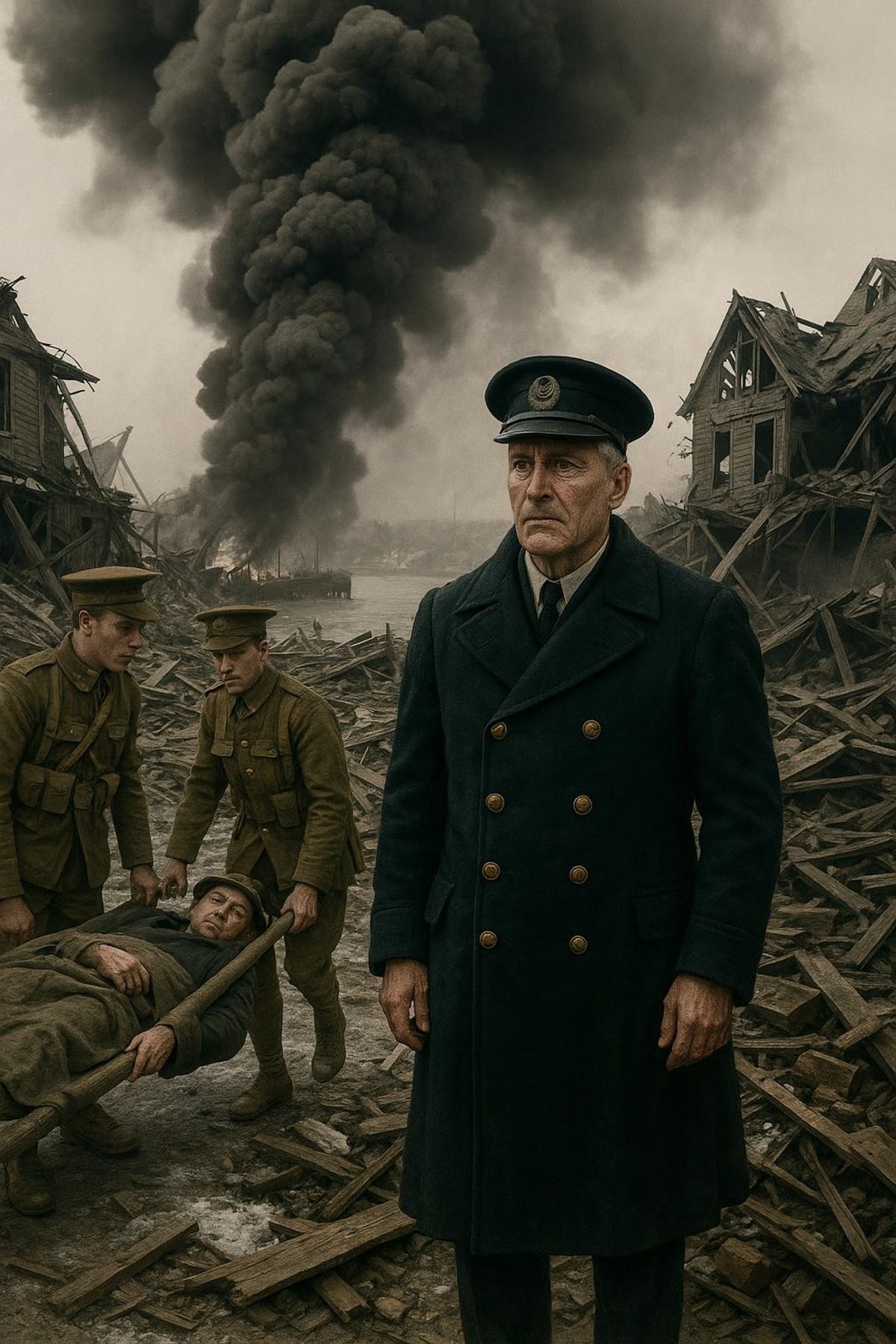
On a frigid, clear December morning, the skies over Halifax were a sheer expanse of pale blue, stretched taut above the snow-dusted streets. Frost adorned the wharves where ships stood silently in the harbour, masts reaching skyward like skeletal fingers against the horizon. The sounds of an awakening city — the distant clatter of horse-drawn wagons and the sporadic calls of vendors — echoed through the crisp air. Yet beneath this peaceful exterior lay a simmering tension, a portent of disaster. In mere moments, the hustle and bustle of this British imperial port would be replaced by chaos as it faced its darkest hour.
The Ill-Fated Meeting of Mont-Blanc and Imo
In the shadowy dawn of December 6, 1917, the French ship SS Mont-Blanc, heavily laden with nearly 3,000 tonnes of explosives, navigated into Halifax Harbour. This floating arsenal was a product of the war effort: its cargo of picric acid, TNT, and other volatile materials was intended to bolster the Allied front. In an unfortunate twist of fate, the entry of the Mont-Blanc was matched by the exit of the SS Imo, a Norwegian vessel chartered as a Belgian relief ship. The convergence of their paths would set off a sequence of events that would shatter the city's tranquility.
The harbour's narrowest point, the Narrows, became the stage for a calamitous encounter. A series of miscommunications, misunderstood sound signals, and an unfortunate sequence of actions culminated in the two ships grazing past each other in a fateful dance. The scraping hulls emitted a shower of sparks — innocuous at first sight, deadly given the cargo the Mont-Blanc held within its steel belly.
Inferno on the Water
As flames hungrily licked the decks of the Mont-Blanc, an ominous black smoke plume spiraled into the sky, marking an impending disaster. The city’s inhabitants, dark silhouettes against the morning light, gathered along the waterfront, entranced and bewildered by the burning ship. They watched, captivated, unaware that they were mere moments away from catastrophe.
Read next: He Was 58, Dying, and He Still Led the Charge
At 9:04 a.m., the breach occurred; the munitions ship erupted into an explosion with an intensity unimaginable before the atomic age. The blast vaporized water in its vicinity, leaving the harbour floor exposed for an instant. The shockwave, like a malevolent giant's sweep, flattened everything in its two-kilometer radius — homes, businesses, lives. The air filled with demolished structures and shattered glass, lethal projectiles freely hurtling through the sky. Those gazing from their windows were suddenly engulfed in a maelstrom of debris.
The Splintered City
Halifax, a city steeped in maritime pride, now lay torn and tattered. The immediate aftermath revealed entire neighborhoods leveled, a landscape hauntingly bereft of its familiar contours. The North End was hardest hit, a wasteland of broken wood and twisted iron. Buildings stood like skeletal ruins against the winter sunrise; where life once thrived, there was now only devastation and the plaintive cries of the wounded.
In the following hours, a grim silence descended as the extent of the destruction became clear. Nearly 2,000 lives had been taken in the explosion's fury, with thousands more injured by the inferno and falling debris. Hospitals, already strained by the wartime demands, became overwhelmed with the influx of the desperately wounded, the halls echoing with the sounds of suffering and loss.
Against the Odds: Acts of Heroism
In the midst of humanity’s greatest despair lies the opportunity for profound bravery. Despite the chaos, stories of heroism emerged from the ruins. Volunteers, medical personnel, and ordinary citizens rallied to the call, a testament to the resilient spirit of Halifax’s people. From the twisted wreckage came seafarers and soldiers, government officials and laborers, all united by a singular will to save whoever could be saved.
Read next: He Stepped Forward in Lucknow and Offered His Life
The formidable winter weather added to the rescue operation's difficulty, with a biting wind cutting across the exposed city, threatening to snuff out the fragile embers of survival. Yet support from the wider imperial network and the humanitarian aid from across the globe began to pour in, as a world at war paused momentarily to extend a hand to a stricken city.
In the Wake of Destruction
The reverberations of the Halifax Explosion were felt far beyond the city's physical collapse. The incident prompted significant changes in maritime navigation regulations and emergency response preparedness, serving as a harsh reminder of the potential for peacetime activities to become unintentionally entangled in the mechanisms of war. Halifax was slowly rebuilt but bore permanent scars in its collective memory—a memory indelibly marked by that singular event.
As the first hints of a pink dawn began to seep into the cloud-laden sky, Halifax stirred from its nightmare, having learned hard-won lessons amid the ruins. What transpired in 1917 stands not only as a historical record of unprecedented explosion but also as a testament to human resilience and the enduring spirit to rebuild. The Halifax Explosion reminds us that against the backdrop of empire and war, the stories that endure are those of shared humanity, the courage to face devastation, and the relentless hope for a new dawn.