Most people think of tanks when they consider armored warfare. Yet, before tanks emerged from the trenches, an unexpected invention roared onto the battlefield.
A Bold New Idea
In the late summer of 1914, as Europe plunged into the chaos of World War I, innovation found its unlikely ally in desperation. British forces were trying to stem the German advance through Belgium when word spread of an ingenious creation. A young naval officer from the Royal Naval Air Service, driven by the immediacy of warfare's demands, decided to take the fight mobile.
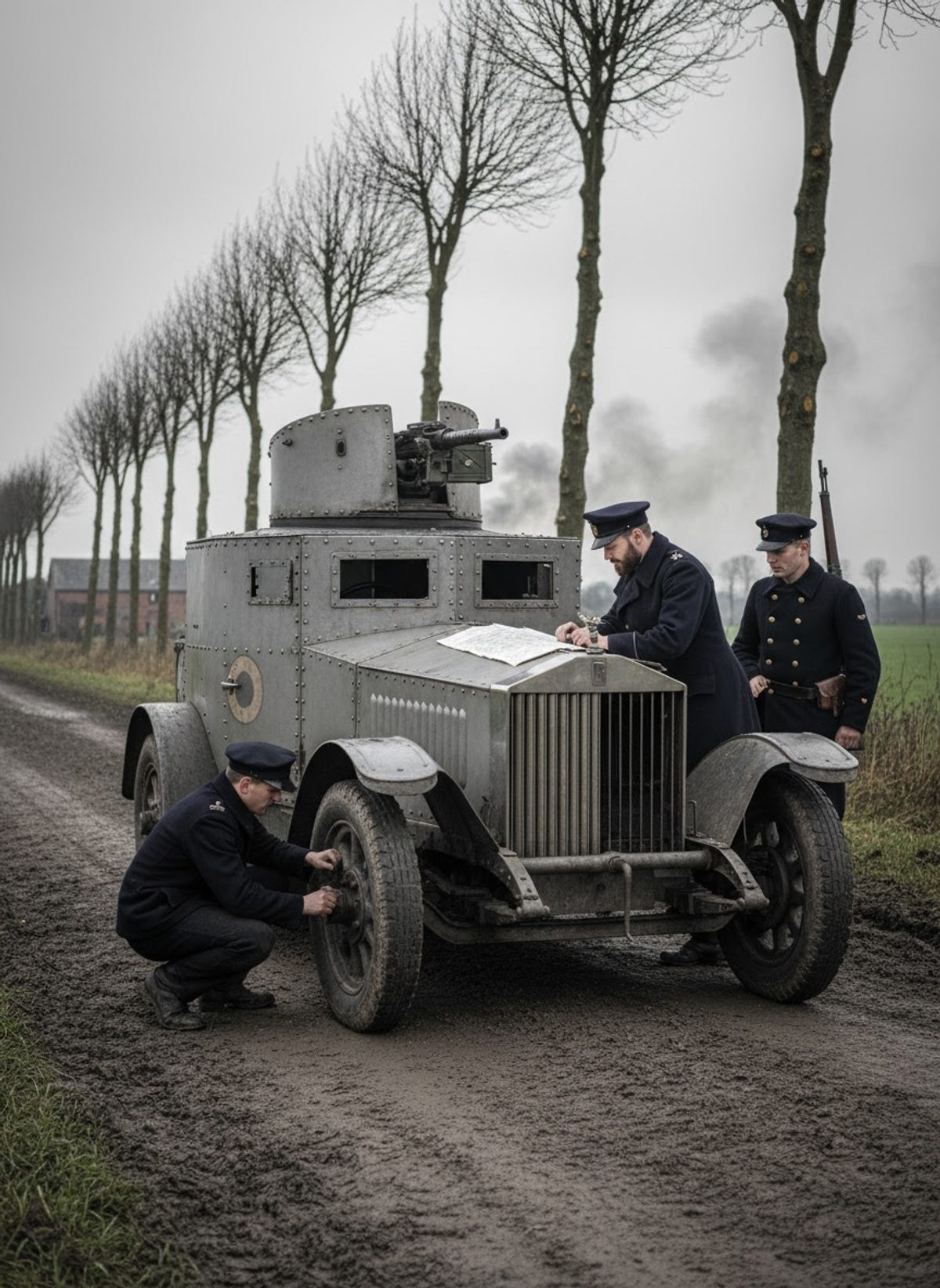
The idea was simple yet revolutionary: bolt a Maxim machine gun onto a touring car. This was no ordinary vehicle; it was a robust Rolls-Royce car, known for its durability. Paired with armor plating strong enough to deflect small arms fire, the world's first genuine armored car was born. Its presence meant that mobility and firepower could now advance hand in hand across the battlefields of Belgium.
The armored car could negotiate the rugged terrains of war-torn landscapes, providing both offensive power and a level of crew protection previously unseen. Its deployment allowed rapid movement where once bogged-down infantry or immobilized artillery had struggled for traction. The warfront had rarely seen such a blend of elegance and lethality: an automobile that could chase down threats and deliver a decisive sting.
Read next: When Britain Built a Tank Nobody Could Stop, 1917
Despite its radical approach, this new invention was met with enthusiasm by the rank and file who witnessed its debut. Its effectiveness quickly became evident as it supported reconnaissance missions, shielded retreating forces, and disrupted enemy communications and logistics. Although improvised and decidedly low in priority for military funding, the armored car proved an invaluable force multiplier that opened new tactical possibilities in the tumult of early 20th-century warfare.
Improvised Warfare Brings Results
The armored cars of the Royal Naval Air Service were more than just metal and ingenuity. They symbolized a new way of thinking about warfare, one that transcended the static lines of entrenched armies. Their nimble forms provided not just firepower but also surprise, a capability that soon caught the enemy off guard.
As the armored vehicles blazed through Belgian fields, they played a pivotal role in operations that required speed and precision. The cars became a dreaded presence, capable of striking swiftly before vanishing into the fog of war. Unlike the lumbering tanks that came later, these vehicles were about quick, strategic hits, highlighting a doctrine that capitalized on movement and adaptability.
The cars were not without their drawbacks. The impromptu nature of their development meant they often faced logistical challenges. Armor plate, after all, wasn't designed for Rolls-Royce frames. Yet these drawbacks were seldom cause for complaint among the crews tasked with operating them. The thrill of this new warfare style was enough to maintain their morale and keep ingenuity flowing.
Read next: When the King's African Rifles Tracked Rebels Into the Bush, 1905
On the ground, the enemy grew wary of these newfound adversaries. While their rigidity might have seemed like a strength in traditional battle scenarios, these mobile units exploited the gaps, constantly weaving through opposition and sowing confusion. This new form of mechanized warfare introduced a level of unpredictability that commanders had not yet encountered, catching them flat-footed time and again.
Echoes of Innovation
The story of the world's first armored car is one of invention under pressure, a narrative showing that necessity truly is the mother of innovation. Though they emerged in the frenzied environment of war, these vehicles were a testament to human resourcefulness and improvisation.
The success of the Royal Naval Air Service's armored cars barely rippled through history's broader narrative, overshadowed by the ascent of tanks and the grand strategies that characterized later stages of the Great War. Yet, in the folds of history, these vehicles set a precedent, demonstrating that speed and surprise could redefine battlefield engagements. They became a quiet catalyst for future military architects, who would eventually expand these ideas into the armored divisions that reshaped 20th-century warfare.
Today, as mechanized units zoom across battlefields with unparalleled speed and armor, understanding their modest progenitors provides intriguing context. It began humbly, with a naval officer envisioning a new world of combat through the reinvention of common objects. The armored car of 1914 offers a lesson in leveraging contemporary technology to weave new patterns of strategy, reminding us that future innovations may find their most profound applications in places we least expect.