The Battle of El Alamein marked a turning point in World War II. Yet, what came next baffled everyone: a bizarre half-track motorcycle dragging itself across the desert sands.
The Relentless Desert and Its Unexpected Gift
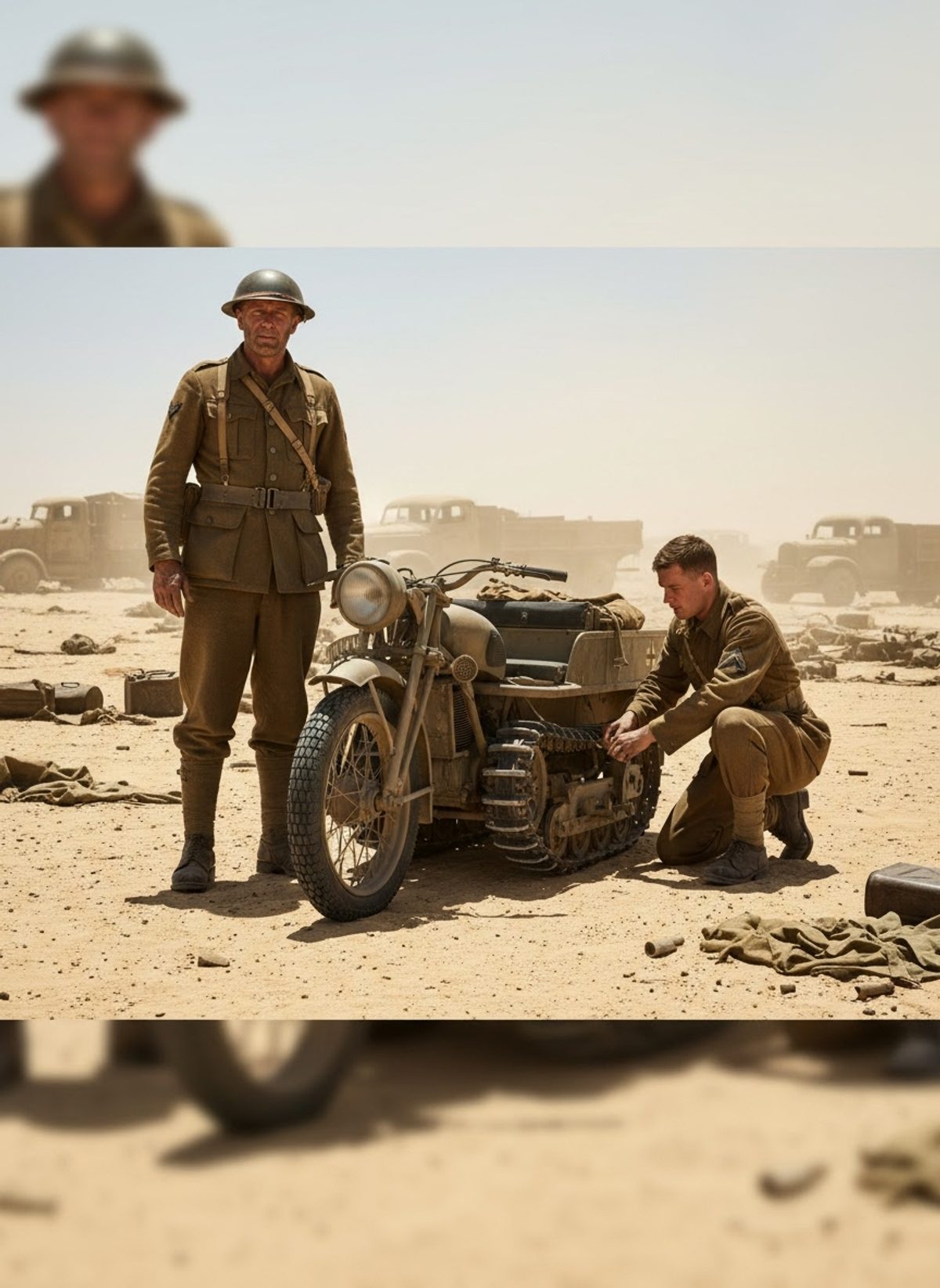
As the dust of battle settled in the expansive North African desert, British forces embarked on the customary sweep for useful debris. Amid the detritus of war—a chaotic landscape of abandoned tanks, broken artillery, and scattered supplies—they unearthed something altogether peculiar. It was a small machine that seemed part motorcycle, part caterpillar; a strange hybrid the likes of which most had never encountered.
This curious contraption, roughly the size of a bathtub, lacked any armament or armor—features seemingly essential for the harsh demands of desert warfare. Closer inspection revealed it had tracks instead of rear wheels and handlebars similar to a common motorbike. The British troops, seasoned by months of arduous campaign, were intrigued by this mechanical oddity that appeared at odds with the technological sophistication typically associated with the Axis powers.
The Enigma of the Kettenkrad
The thing that lay before the troops was a Kettenkrad, officially known as the Sd.Kfz. 2. Originally designed for the Luftwaffe’s paratroopers, this German innovation intended to offer flexibility and power across various terrains. Sporting neither guns nor fortifications, it was engineered to tow small artillery and transport supplies in environments where traditional vehicles floundered.
Read next: When HMS Prince of Wales Sailed Into the South China Sea, 1941
The tiny titan was constructed with a powerful demeanor encased in simplicity. Its most striking feature was the continuous track system that gripped the ground with a tenacity no wheeled counterpart could match. In the sandy and rocky expanse of the desert, where tires whimpered and bogged down, these half-tracks marched confidently.
A young engineer among the British troops recognized this potential and spoke excitedly of its utility to transport lightweight cargo and frontline posts, even suggesting it could bring swift ferrying of ammunition during assaults. Such pragmatism, coupled with its whimsical appearance, propelled the Kettenkrad into the annals of military folklore.
A Marshall's Delight in a Bicycle's Disguise
The British command didn’t waste time in harnessing the newfound machine’s utility. As tales spread of its impressive maneuverability and endurance, stories morphed into legend. Here was a machine that seemed almost to dance where others labored—and always with a peculiar grace no vehicle of war should own.
Many who encountered it for the first time noted its unlikely charm, the juxtaposition of bicycle handles against the robust flanking tracks lending a strange, almost endearing character. It became a subject of many anecdotes, the clumsy mascot of the battle-scarred desert divisions. Such tales merely added to its growing enigma: what else, beyond these ruins of warfare, had it seen? What adventures had it powered through the shifting sands of North Africa?
Read next: When Second Lieutenant Bhagat Cleared 15 Minefields in Four Days, 1941
Perhaps most fascinating was the way individuals adapted the Kettenkrad for various uses. Modifications blossomed each time it found a new purpose: not just hauling men and material but also ferrying water and even laying communication lines across vast distances. The limits of its innovation were tested and retested, yet it rarely faltered.
A Legacy Tracked in Sand
By war's end, the face of Europe and North Africa was irrevocably changed; however, the Kettenkrad's image endured, a quaint footnote in military history. Not a weapon but rather a steadfast enabler of soldiers’ necessities, it introduced the world to a new realm of military logistics—one defined by versatility and resourcefulness.
Though initially met with laughter and skepticism, this machine earned its stripes alongside much larger and louder brethren. It highlighted the unpredictable nature of innovation and adaptation in times of conflict. Long after its tracks vanished from the desert sands, the memory of the peculiar half-track motorcycle remained an enduring testament to the ingenuity required in war.
In the stories whispered through generations, where myth and reality blend, the Kettenkrad stands as a quietly profound reminder that sometimes, the oddest inventions can shape the course of history. This is why its story matters, highlighting what can be found when people look beyond the obvious and see the potential wrapped in an unexpected guise. Such legends are often left out of textbooks, but they teach invaluable lessons worth remembering.