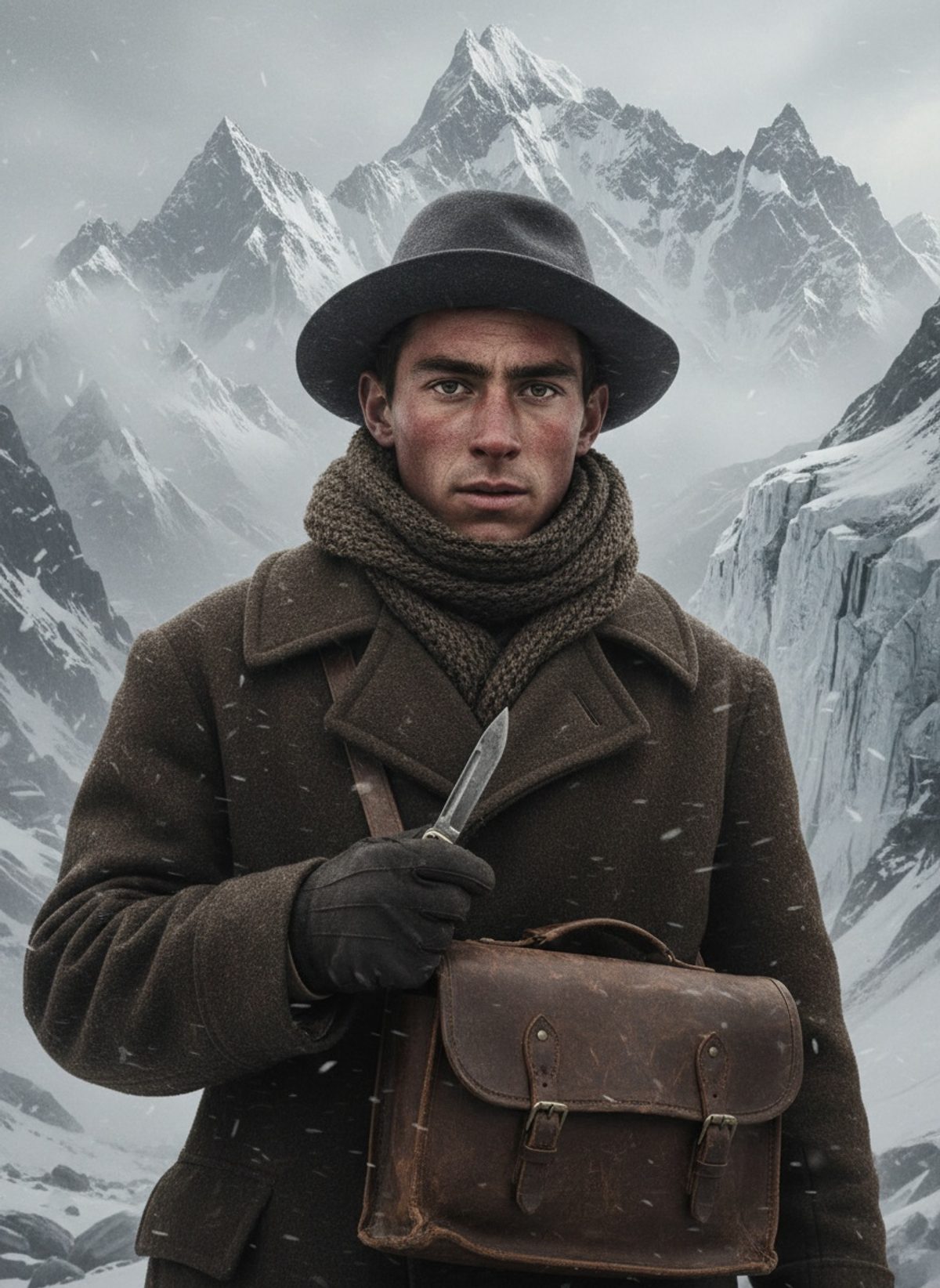
1887. The cold wind howled relentlessly over the desolate expanse of ice and snow.
The Uncharted Wilderness
In the heart of the Victorian Era, a young British explorer named Francis Younghusband embarked on an audacious journey that would defy the bounds of human endurance and the expectations of seasoned Himalayan adventurers. His goal was to map the vast, mysterious lands that stretched across the roof of the world. At the tender age of just twenty-four, Younghusband took on a formidable challenge that would see him facing the unfathomable dangers of the Mustagh Pass, one of the highest and most treacherous mountain routes, alone and armed with nothing more than a penknife. Unwaveringly resolved to chart a course that defied disbelief, he set out into the icy wilderness without a guide, ropes, or even a detailed map.
The remote Mustagh Pass was an obscure gateway nestled within the harsh Karakoram range, a place where few dared to tread due to its perilous reputation. Experienced mountaineers would have avoided such a trek during the winter, when the unforgiving elements magnified the inherent dangers of the terrain. Yet, for Younghusband, this was precisely the time to challenge the limits of exploration and stake a claim as an empire builder of the mind and spirit. His journey would become a saga of grit and determination underscored by the breathtaking beauty and chilling isolation of the high Himalayas.
The Solitude of the Heights
On the lonely expanse of the high altitudes, Younghusband was enveloped in an otherworldly quiet, a silence broken only by the crunching of snow underfoot and the occasional gust of frigid air. In the face of such solitude, he found no company but his own resolve. The Mustagh Pass, with its labyrinthine slopes of ice and treacherous crevasses, rose up like a frozen beast eager to swallow its challengers whole. Yet, equipped with an almost rudimentary set of tools, his journey was a testament to human resilience. Younghusband carried only his penknife, using its blade to carve steps into the ice, inching his way forward with each precise, labored motion.
Read next: When George Sheppard Hired a Town Instead of a Machine
Though this might seem an impossible feat by modern standards, in 1887, it was an audacious defiance of nature's cruel hardships. With no ropes to provide security, every step forward also carried the terrifying risk of a fatal plunge into an abyss of uncertainty below. But Younghusband's solitary trek was not merely a tale of survival; it was a venture into a new frontier, a place where destiny favored the bold and uncharted horizons beckoned to a fervent curiosity about the world beyond the known.
Disbelief upon Arrival
When Younghusband finally descended from his icy odyssey and reached the safety of India, his monumental achievement was met with skepticism. The reception he received was not one of acclaim but rather incredulity. How could a lone man, equipped only with the barest of tools, have accomplished what seemed an impossible task? In an era that celebrated bold enterprises and imperial expansion, his story was regarded with disbelief by many who could not fathom the sheer magnitude of the undertaking.
Yet, Younghusband's incredible journey across the Mustagh Pass was not merely about conquering the environment. It was also a testament to the exploratory spirit that defined the Victorian age. His expedition ran parallel to the grander narrative of exploration and conquest that underpinned British imperial efforts, capturing the essence of human tenacity against nature's formidable barriers. This act of mapping an unknowable frontier was, in many ways, a microcosmic reflection of the Empire's vast ambitions and the innate yearning to surpass the limitations imposed by geography and circumstance.
The Echoes of Exploration
Younghusband's story, though overshadowed by larger-than-life tales of conquest and empire building, remains a poignant illustration of the enduring spirit of exploration. His solitary journey speaks to the power of courage and conviction, defying the very conceptions of what was possible in an era obsessed with pushing boundaries both physically and intellectually. It is a chapter in the annals of history that reminds us of the relentless curiosity that has always driven humanity to seek, discover, and understand the vastness of our world.
That fateful year in 1887, the gusts of wind that buffeted Younghusband on the Mustagh Pass echoed more than just the howl of a winter's fury; they resonated with the undying human desire to delve into the unknown. In a world where the blank spaces on maps were slowly being filled, Younghusband's defiance of the impossible stands as an emblem not just of a geographical conquest, but of the indomitable spirit that dared to live the legends that textbooks might leave untold.