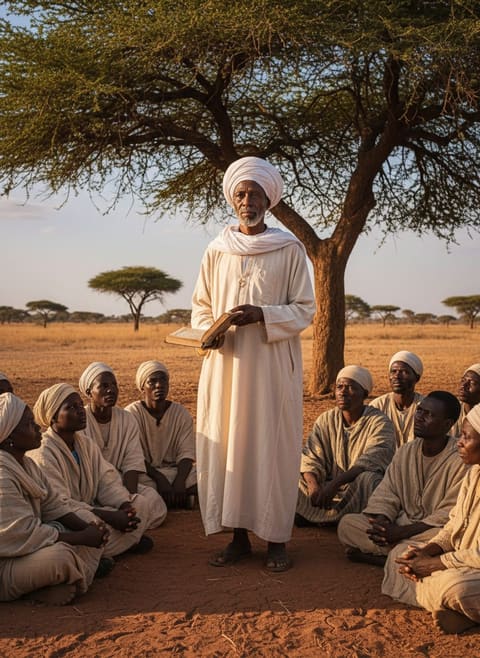
He wrote more than forty books. He did so while shackled in a prison cell.
In 1594, the famed scholar Ahmad Baba al-Timbukti found himself forcibly removed from the intellectual heartland of Timbuktu. Although history talks fondly of this center's grandeur, few know the story of the towering personality that was Ahmad Baba and the trials he endured to preserve African scholarship. Born on October 26, 1556, in the town of Araouane, Ahmad Baba moved to Timbuktu at a young age to pursue his education. He was nurtured in a family steeped in scholarly tradition. His father, Ahmad ibn al-Hajj Ahmad ibn ‘Umar ibn Muhammad Aqit, along with other instructors like the formidable Mohammed Bagayogo, honed his intellect. From a young age, Ahmad Baba was surrounded by the erudition that defined this legendary city.
Timbuktu, at the time, stood as a beacon of knowledge and a hub at the crossroads of desert and river. Its mosques and madrasahs shone like beacons to truth-seekers across Africa and beyond. Books flowed like a lifeblood through its streets—1,600 of which Ahmad Baba personally owned. However, this intellectual utopia was not immune to the whims of power. By the close of the 16th century, as the Songhai Empire crumbled, Timbuktu became a prize coveted by the rising force of Morocco. In 1593, this desire spilled into action. Moroccan soldiers stormed into the city under Sultan Ahmad al-Mansur’s orders, bringing with them both might and destruction. During this chaos, they seized Ahmad Baba, his books stripped, his freedom wrenched away. They accused him of sedition—his only true crime being his refusal to curtail his ceaseless questioning spirit.
The grim odyssey that followed was a horrific one. Bound in chains, Ahmad Baba was dragged across the endless, unforgiving sands of the Sahara—a harrowing journey from the warmth and vibrancy of Timbuktu to the cold cells of Marrakesh. For many, such captivity would have meant silence, compliance, and perhaps an end to ambition. But for Ahmad Baba, the stone walls of his prison cell became a new kind of university Hall. Despite the oppressive confinement, his mind blossomed like a desert flower after rare rains. Even in chains, his resolve remained unshaken. He persisted, with lectures rippling through prison bars. Through these bars, students flocked, pursuing knowledge with a hunger that knew no chains.
Read next: He Walked Into the Desert With Gold. He Gave It All Away.
In the heart of Marrakesh, Ahmad Baba found an unexpected role—one that resonated with a deeper purpose. For thirteen years, he became the imprisoned sage, his captivity a testament to the resilience of the human spirit. During these years in Morocco, he wrote extensively, defying his captors by creating works which remain invaluable to history today. These writings bridged the past and future of African scholarship, maintaining historical records such as the biography of Muhammad Abd al-Karim al-Maghili, a pivotal character in the religious jurisprudence of the time.
The ripples of Ahmad Baba’s legacy extended far beyond Marrakesh’s prison walls. Upon returning to Timbuktu on April 22, 1608, after the exiles were pardoned by Sultan Zaydan An-Nasser, his impact on Islamic scholarly culture persisted. The very name of Timbuktu's public library, the Ahmed Baba Institute, honors his everlasting influence. This repository houses over 18,000 manuscripts, each a tribute to the city’s golden age of knowledge and a nod to Ahmad Baba’s indomitable spirit.
In addition to his scholarly prowess, Ahmad Baba's ventures into moral and ethical debates marked him as a reformer of his time. His writings on slavery reveal a complex man trying to navigate the moral intricacies of his era. He advocated against the conflation of race and slavery, critiquing the common narrative that painted Black Africans solely as enslaved peoples. His stance on racial slavery urged a reformation of the slave trade, emphasizing religious lines rather than racial ones. While not entirely divorcing from the period’s norms, his advocacy for religious ethics regarding slavery stands as a unique record of the period’s philosophical discourse.
Read next: Khama III Crossed the Ocean. He Saved His People.
Ahmad Baba was unafraid to stand against hegemonic misconceptions. He tenaciously argued against the misinterpretation of the Curse of Ham—a biblical story misused to justify racial supremacy and subjugation. Firm in his belief, Ahmad Baba called for a recognition of the humanity and equality of all believers. Though his ideas navigated deeply controversial waters of his time, he unwaveringly advocated for principles that many today regard as foundational—an astonishing insight from a man in chains.
The dedication Ahmad Baba displayed in his teachings serves as an outstanding instance of intellectual bravery. His life’s work did more than bridge cultural and historical gaps; it preserved vital histories that might have otherwise been lost to time’s relentless tide. Today, we see echoes of his dedication in the remaining manuscripts and the continuing reverence for Timbuktu as a symbol of African wisdom and scholarship.
Ahmad Baba's story is more than just a tale of triumph over adversity. It’s a reflection on the power of knowledge as a form of rebellion and an affirmation that scholarship can transcend the strictures of power and location. His remarkable legacy offers a thought-provoking reminder that the quest for enlightenment—for all its chains and challenges—is a quest worth enduring, inspiring future generations to seek knowledge and justice even under the gravest of circumstances. His cell in Marrakesh was not a mere place of incarceration, but a beacon that continues to light the path for those who dare to pursue wisdom. As we reflect on his legacy, Ahmad Baba beckons us to examine how we, too, might champion truth and equity in our times, guided by his example of unwavering resilience and intellectual courage.