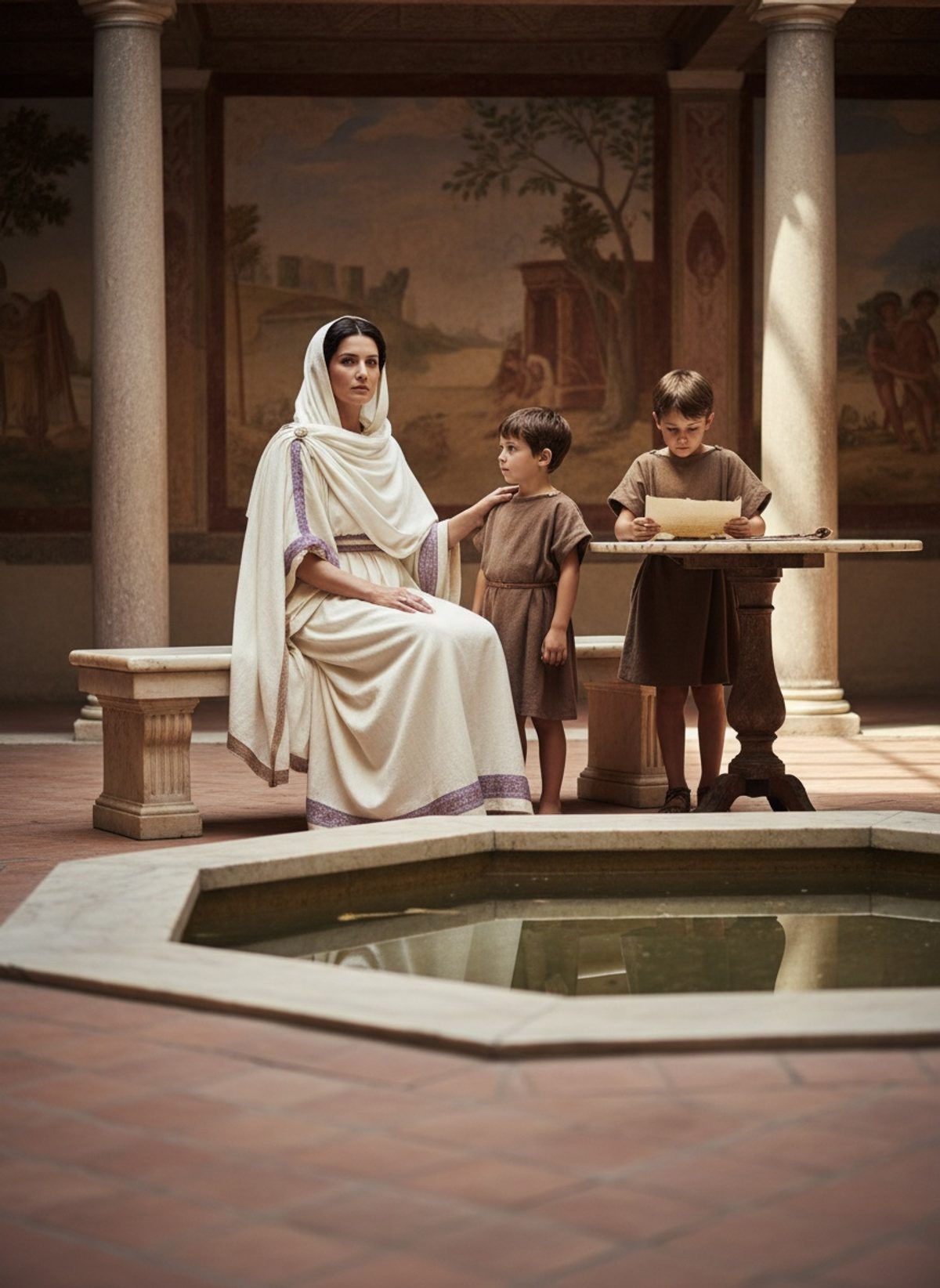
Most Roman women left the choices to the men in their lives. Cornelia Africana did not.
Rome’s Jewel in the Turmoil of Power
In the heart of Rome, around 162 BC, a remarkable woman named Cornelia stood as a beacon of virtue and intellect. Born into the illustrious Scipio family, she was the second daughter of Scipio Africanus, the celebrated general who defeated Hannibal in the Second Punic War. Her upbringing was steeped in the traditions of the *gens Cornelia*, one of Rome's most distinguished patrician families. This heritage instilled in her a sense of duty and determination that would shape the future of the Roman Republic.
Rome, as ever, was a cauldron of intrigue and ambition. Yet, amidst it all, Cornelia was seen as the epitome of Roman womanhood—respected, beloved, a paragon amidst the chaos. After the death of her husband, Tiberius Gracchus the Elder, Cornelia was left with the monumental task of raising her children alone. She had opportunities many could only dream of; she could have been queen, or spent her days indulging in luxury. But when a foreign king offered her a crown and position by his side, Cornelia famously declined, gesturing to her sons, declaring, “These are my jewels.”
The Silent Influence of a Mother’s Teachings
What drove Cornelia’s refusal of the throne? Perhaps she had the foresight to see her children as Rome’s true future. Tiberius and Gaius Gracchus, her precious jewels, were young, yet already reflections of her own virtues. Cornelia’s refusal to be swayed by external power showed Rome a new kind of strength—the silent strength of a devoted mother.
Read next: Calpurnia Begged Him Not to Go. He Went Anyway.
Cornelia dedicated herself to the education and moral upbringing of her offspring. She was not merely imparting academic knowledge but instilling in them a deep sense of justice and empathy. As a woman who maneuvered through Roman society and its patriarchal leanings, she understood the nuances of power and politics. Under her guidance, Tiberius and Gaius learned the art of rhetoric and the complexities of Roman law, but more importantly, they inherited her values.
This upbringing bore its fruits. Cornelia’s influence spurred Tiberius and Gaius Gracchus to become two of Rome’s most revolutionary figures. Their political reforms shook the very foundations of the Republic. It was a testament to the kind of education and principles that Cornelia had carefully woven into their childhood.
The Gracchi Revolution: Seeds from Cornelia’s Garden
Their mother’s commitment and sacrifice were etched into the very fabric of Tiberius and Gaius's careers. Both brothers would take up the mantle of reform, addressing the stark inequalities that plagued Roman society. The land reforms introduced by Tiberius in 133 BC aimed to redistribute public land to disenfranchised Roman citizens, a radical plan meant to curb the excesses of the wealthy elite.
Such actions, although noble in intent, unsettled the establishment. Tiberius understood the risks; yet, his resolve was unwavering, forged by years of maternal guidance. His untimely death in 133 BC, a result of political betrayal and violence, marked a grim warning that change was as dangerous as it was necessary. However, Gaius would rise not long after, continuing the torch of reform his brother ignited.
Gaius Gracchus pushed the reforms further, implementing measures like subsidized grain and judicial restructuring. His actions, driven by a fervent desire for equity, drew inspiration from the silent lessons taught by Cornelia. However, like his brother, Gaius also faced ferocious opposition. His fate mirrored Tiberius’s, ending in death in 121 BC, a martyr for the cause he fought for.
Read next: Spurinna Warned Caesar. Caesar Laughed. Then He Went.
The Unseen Foundations of Reform
Cornelia’s unwavering dedication to her sons nurtured the seeds of societal transformation. Her influence was subtle but profound—like the steady flow of a river carving paths through timeworn rocks. While her sons took the public stage, igniting debates and conflicts, Cornelia operated in the background, her influence resonating through their actions, long after her sons’ voices had been silenced.
This quiet yet commanding presence was a rarity in the male-dominated spheres of ancient Rome. Women of her time rarely participated directly in politics; however, Cornelia’s legacy challenges the notion that power only lies in the public arena. She mastered the art of indirect influence, her vision echoing through the legislative reforms and debates that shaped the Roman Republic.
More than Jewels: A Legacy Shaped by Sacrifice
Cornelia’s story is more than a tale of motherhood; it is an extraordinary narrative of sacrifice, foresight, and resilience. Her rejection of a crown in favor of raising her sons to be men of principle set in motion a transformative wave that washed over Rome’s political landscape. The legacy of the Gracchi brothers, laden with both triumph and tragedy, speaks to the enduring power of love and education.
In a world fraught with political strife, Cornelia represents the quieter strength that underpins grand movements. Her commitment to her sons, and by extension to Rome, reflects a deep-seated belief in shaping the future through wisdom and virtue. As the matriarch of change, she was both the architect and the muse behind Rome’s most significant reforms, underscoring that the true jewels of any civilization are its ideals and the people who dare to pursue them. The lessons she imparted resonate through the ages, reminding us that personal sacrifice can provoke enduring societal change.