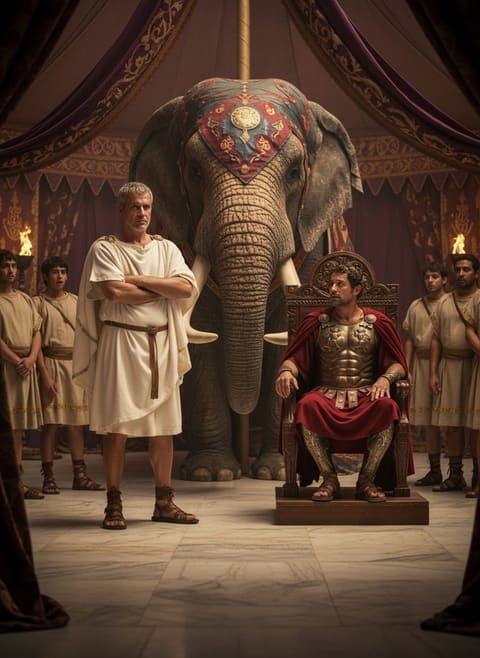
March 15, 44 BC. The Roman streets buzzed with an undercurrent of tension, their cobblestones whispering secrets beneath the sandals of the citizens who passed over them.
The Ides and the Omen
"Beware the Ides of March." A cautionary tale told through the ages, but how many know it sprouted from an ancient Roman seer's lips? This enigmatic figure was Spurinna, who bore the weight of premonition upon his shoulders. Within the Roman world, a place where divine will and human affairs often intersected calamitously, Spurinna's warning stretched like a shadow over one of its most powerful figures, Julius Caesar.
The Ides of March—its ominous reputation belies its mundane roots as the midpoint of the Roman month. Yet in 44 BC, it became the cornerstone of a story entwined with destiny and hubris. Historical accounts, from Plutarch to Suetonius, captured the tradition of such warnings, told to Caesar as the masses thronged about him in Rome's bustling streets. Spurinna, a haruspex skilled in interpreting the will of the gods through the inspection of animal entrails, foresaw a grave danger awaiting Caesar.
In Roman society, such omens were seldom dismissed lightly. Yet Caesar, a man accustomed to bending fate to his will, paid little heed. As he made his way to the Theatre of Pompey, the Senate house's temporary home due to renovations, he encountered Spurinna once more. "The Ides of March have come," teased Caesar with a sardonic smile. "Yes," replied Spurinna, his eyes lingering in what might have been sorrow or duty, "but they have not yet gone."
Read next: Regulus Was Freed. He Walked Back to His Death.
The Seat of Power
Caesar, crowned as *dictator perpetuo*, sat astride the Roman Republic with both triumph and trepidation marking his journey. From his audacious crossing of the Rubicon in 49 BC, his path carved through civil war and into the heart of Rome. In doing so, he amassed unmatched power, reshaping the Republic’s governance to his vision. His reforms—a new calendar, broadening citizenship, and swelling the Senate—spoke of a man with an eye on posterity.
Yet for all his achievements, Caesar's dominance roused fear in various quarters. The Senate, a place pregnant with political machinations, stood divided in admiration and resentment. Caesar's persona danced between the savior and the tyrant, a perception exacerbated by his public refusal of a king's crown offered by Mark Antony during the feast of the Lupercalia.
It was in this theater of power that the seeds of conspiracy took root. Rome's senators, led by Marcus Junius Brutus and Gaius Cassius Longinus, saw in Caesar not only the twilight of the Republic but a potential monarchy. In secret gatherings, they plotted an end that they believed would serve the greater republic. The conspirators envisioned a future unshackled from the chains of autocratic rule, without foreseeing the chaos that their actions would unleash.
The Ides Decided
On that fateful morning, ominous portents loomed as Caesar prepared to attend the Senate meeting. Reports whispered of ill dreams suffered by his wife Calpurnia, tomes of superstitions cataloged over centuries. She implored him to stay away, but Caesar, perhaps out of arrogance or resignation, resolved to go forth. Thus, with steps steady yet unknowingly towards an end, he departed for the Theatre of Pompey.
The Senate meeting commenced, steeped in the routine veneer of political discourse. Surrounded by his peers, Caesar settled into his seat, partaking in affairs both mundane and monumental. It was a moment deceptively ordinary, a calm before violence erupted—a signal that rang true when Lucius Tillius Cimber approached, plea in hand to recall his exiled brother. But beneath Cimber's benign intentions lay betrayal.
Read next: He Stood Before the Senate. He Spoke for His Enemy.
With a sudden tumult, the conspirators sprang into action. A frenzy of blade and body ensued, resulting not in mere death but spectacle—a chaotic dance of destiny and deliverance. Amid this tumult, Caesar attempted to rise but quickly fell, succumbing to the relentless assault. The last witness of his life, perhaps most poignant of all, was Brutus, whom Caesar addressed with his reputed last words, "Et tu, Brute?—Then fall, Caesar."
The Aftermath and Its Ghosts
With Caesar’s fall, the Roman Republic reeled in confusion and chaos, thrust into a maelstrom of power struggles. The conspirators, triumphant for a fragile moment, soon found themselves as targets, casualties of a public rage they neither anticipated nor assuaged. Civil war simmered once more, boiling into outright conflict as control of Rome and Caesar's legacy was hotly contested.
It was his great-nephew, Octavian, alongside Mark Antony and Lepidus, who maneuvered through the power vacuum, forming the Second Triumvirate to exact revenge and restore semblance to governance. Their rule laid the foundation stones of the emergent Roman Empire, marking the Republic's end and Caesar's apotheosis—not only as a memorialized leader but as a deified figure echoing through history.
In the grand tapestry of time, the Ides of March threads through more than just the Roman narrative. It serves as a poignant reminder of how power's allure and peril are as timeless as the human heart that beats for them. Caesar, over centuries, has been transformed from man to legend, yet remains ever tethered to that singular day. For readers today, it prompts contemplation of the fragile tether between fate, foresight, and the fallibility of even the mightiest rulers.