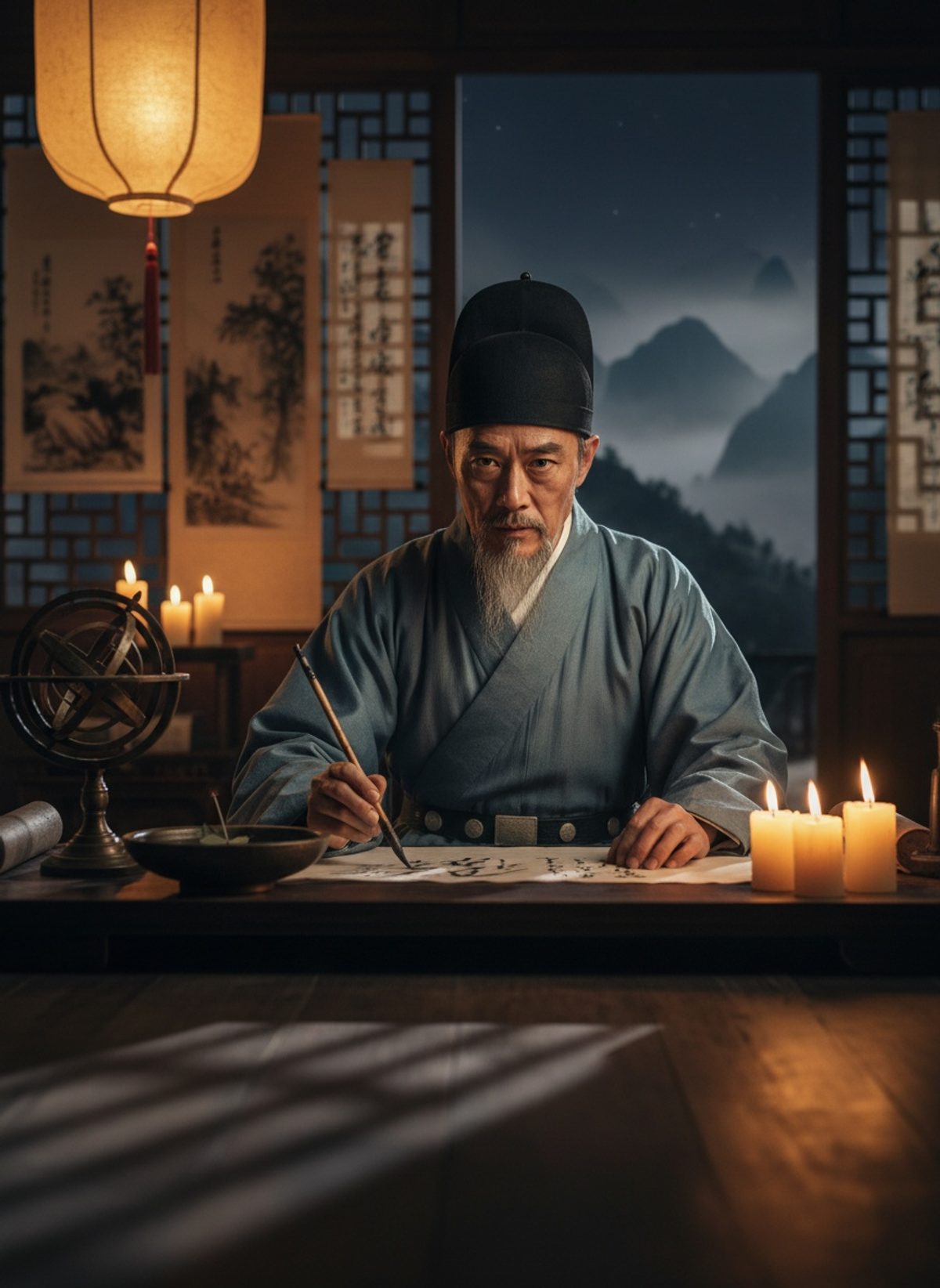
The year was 1088 AD, and the landscape of the Song Dynasty was painted in hues of thriving green interlaced with stretches of misty grey. Early morning dew hung like a veil over the Zhejiang plain, with the damp earth sending whispers of petrichor into the air. Amidst this tranquil setting, a particularly brilliant mind was engaged in charting the very cosmos itself. Shen Kuo, the polymath of his age, with eyes fixed on the heavens and tools in hand, mapped the universe. Yet little did he know, terrestrial politics would soon trap him in a net of exile and disgrace.
The Wonder of the Stars
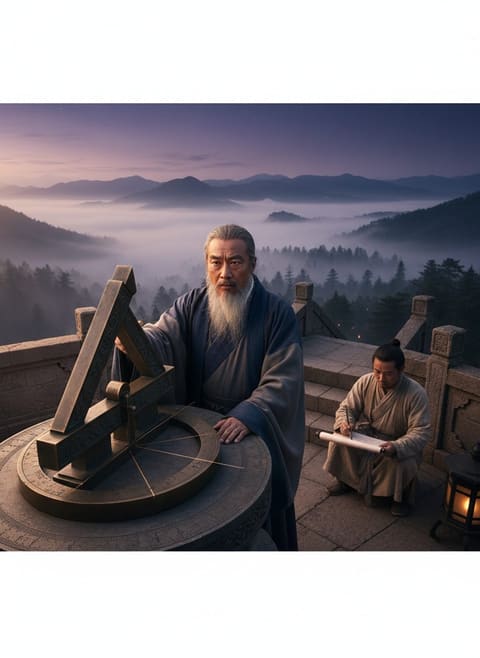
In the courtyard of the Bureau of Astronomy in grand Bianjing, the capital of the Northern Song dynasty, Shen Kuo stood as a towering figure of knowledge. His head was adorned with thoughts as infinite as the stars he diligently observed. A sea of scholarly texts surrounded him, while instruments of his design—a wood masterpiece inflow water clock, an armillary sphere, and improved gnomons—laid testament to his quest for understanding.
With the acuity of a master, he discovered magnetic declination, the subtle drift of the compass needle from true north to magnetic north. While Europeans would not grasp the utility of this for another four centuries, Shen Kuo had forever altered navigation on the high seas, silently pivoting history from the heart of the celestial dome.
Even more ambitiously, alongside his colleague Wei Pu, Shen endeavored to map the elliptical dances of the Moon and the planets. This meticulous project demanded five years of unbroken celestial observations, testament to centuries of accumulated Chinese astronomy. But the night sky was about to become as turbulent as the political currents beneath.
Read next: Su Dongpo Was Exiled. He Fed the Hungry Anyway.
The Political Maelstrom
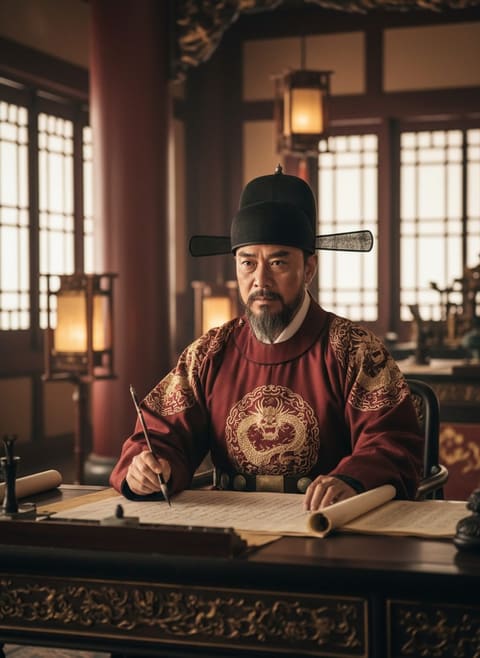
The Song court was a sea of ebbing loyalties and ideological storms. Shen was a loyal supporter of the New Policies Group, led by the formidable Chancellor Wang Anshi, pushing for radical reforms that promised to alter the very fabric of the empire. Shen's progressive ideas earned him both esteem and animosity in equal measure. In an age where scholarly insight could be feted one day and condemned the next, Shen's luminous mind found itself overshadowed by darker courtly intrigues.
Political opponents, wary of the change that Shen's allegiance symbolized, thwarted his astronomical endeavors. Ambition, envy, and the perennial lust for power clashed, rendering the academic unfathomable amidst their discord. The rich, enlightening project died prematurely, leaving celestial paths a mystery waiting to be unraveled anew in distant epochs.
Exile on the Marshland
Shell-shocked by political machinations, Shen Kuo faced an ignominious retreat into enforced exile. The physical landscape around him changed from city bustle to the haunting silence of rural Yashi, a marshland far removed from the glistening towers of Bianjing. The air was thick with a different charge, the marshland's fecund aroma of decay mingling with the quiet resilience of the flora.
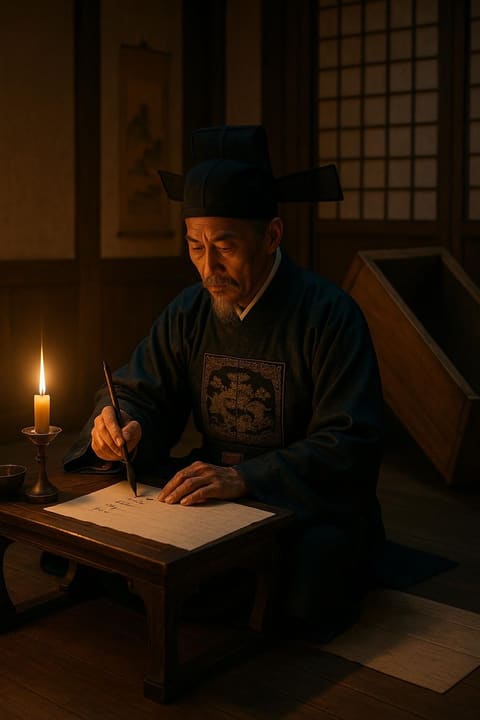
Retreating to his country estate, Shen might have been defeated menially but not in spirit. In solitude, his intellect roamed unfettered, allowing contemplation and reflection that bore fruit in the form of the Dream Pool Essays. This compendium of keen observations would, paradoxically, cement his immortal legacy—a text brimming with insights about geology, astronomy, and beyond, centuries ahead of its time.
Read next: He Stood Before the Emperor. He Handed Back the Sword.
Legacy Etched in Ink
Shen Kuo's Dream Pool Essays were far more than merely musings; they were the sediment of a lifetime's worth of discovery. Observing marine fossils far inland, Shen postulated a geological hypothesis of land formation and climatic variation that predated the Western scientific understanding by hundreds of years. Petrified bamboos in northern climates where they should not exist spoke to him of a landscape long transformed by time.
A polymath in the truest sense, Shen turned his keen observations to hydrology and engineering, chronicling innovations such as the drydock and the canal pound lock. His work carved channels of knowledge that would water the garden of Chinese science for a millennium.
Yet, Shen was much more than a mere scribe of natural phenomena; he captured the ineffable sense of wonder, the delight in the mystery that became the scaffold for future exploration—a legacy as deep and untamed as the Yangtze.
Beneath the Same Sky
Shen Kuo's tale offers a timeless lesson about the resilience of the human spirit. Even in the face of political ruin, he found solace and purpose in the woven threads of science and philosophy. His passion transcended the immediate shadows cast by the corridors of power, allowing his inquiries to echo through the annals of history. As night falls and we gaze upward to the labyrinth of stars that map our universe, Shen Kuo's star continues to burn brightly, a guide for all those who dare question and dream.