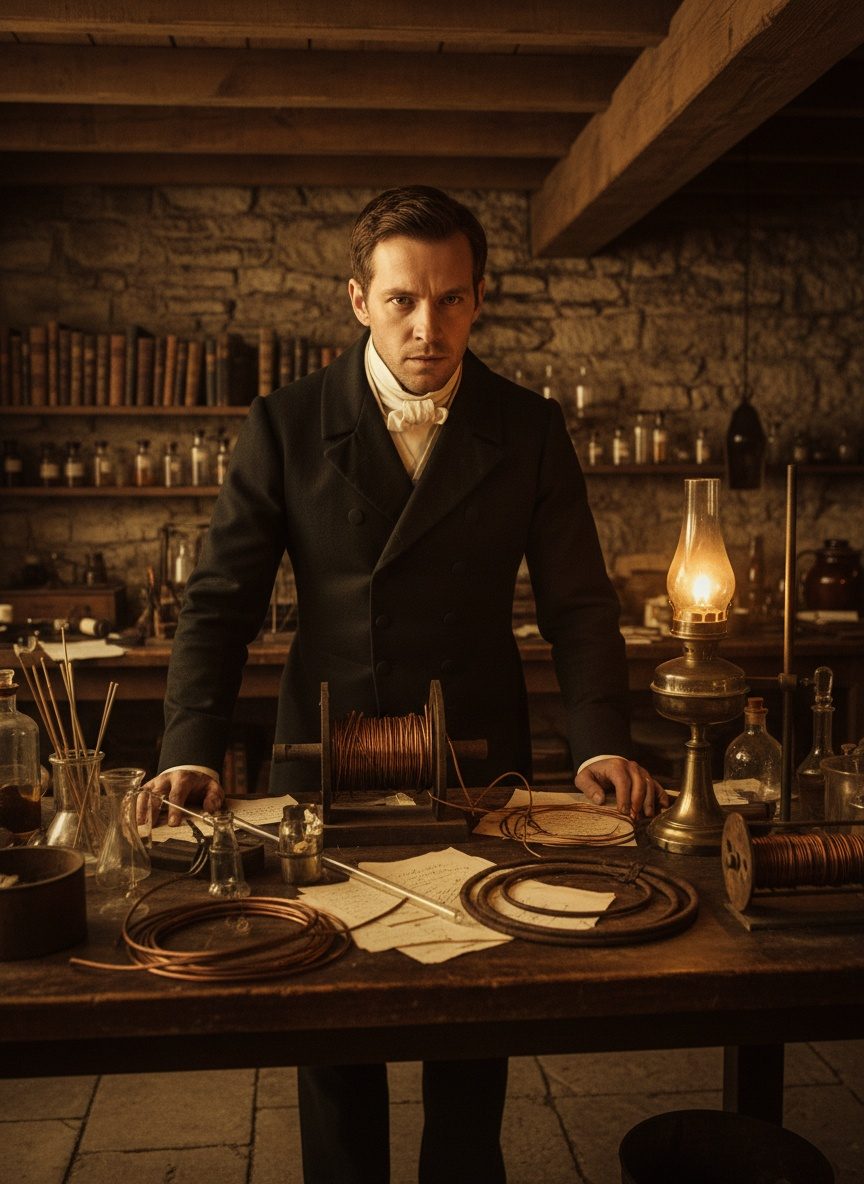
Michael Faraday is not the name most people associate with the foundations of modern electricity. It should be.
Born in 1791 to a humble blacksmith’s family in Surrey, Faraday’s early life bore none of the marks typically associated with scientific genius. His formal education ended at thirteen, a casualty of circumstance rather than choice. Who could have predicted that this self-taught student of science, once a mere apprentice bookbinder, would one day illuminate the world? As Faraday turned the pages of the very books he was charged with binding, he absorbed the knowledge that would fuel his relentless curiosity and forge his path to unprecedented discoveries.
Faraday’s journey from a life of obscurity to legendary inventor began with the simple act of reading. Reading voraciously, Faraday was captivated by the works of celebrated scientists like Isaac Newton, and his mind brimmed with questions and possibilities. At a young age, Faraday found himself in the audience of lectures by Sir Humphry Davy at the Royal Institution, taking careful notes, which he later bound into a book and sent to Davy himself. This unconventional act of self-promotion caught Davy’s attention, leading to Faraday securing a job as his assistant. It was here, amidst the chemical experiments of his mentor, that Faraday’s own talents began to shine.
While assisting Davy, Faraday had ample opportunity to marvel at and question the world around him. Yet it was in his own modest lab that his most revolutionary ideas emerged. He experimented ceaselessly, driven not by the desire for fame or academic accolades, but by pure scientific fascination. It is said that by following the delicate threads of magnetic forces, Faraday uncovered the secrets of electromagnetic induction—a phenomenon that enabled the conversion of mechanical energy into electrical energy. Though such a discovery seems commonplace in our modern world, in Faraday’s era, it was akin to magic.
Read next: The Day a Deaf Man Gave the World Its First Electric Motor
The establishment, steeped in tradition and hierarchy, often viewed Faraday’s work with skepticism, an affront to the conventions of the time. Yet, as Faraday tinkered away, his ingenious insights defied their scorn. Without the academic laurels that typically conferred scientific authority, he forged his own intellectual freedom, unburdened by the biases of the day. A byproduct of his countless experiments and demonstrations of electromagnetic phenomena was the precursor to the modern electric transformer and generator. It is hardly an exaggeration to say that Faraday was the man who connected the scientific community to the vast potential of electricity.
His success was not only a triumph over the social barriers of his day, but a testament to the power of belief—the belief in oneself, and the belief in the unyielding laws of nature. Such was the impact of Faraday’s work that it even caught the attention of Queen Victoria, who sought his insights for understanding lightning in light of a catastrophic fire at the Tower of London. However, Faraday remained grounded, steadfastly refusing any political or courtly trappings that might cloud his judgment or mission.
Though he lived in an era dominated by class and credentialism, Faraday’s discoveries eventually transcended these barriers. Indeed, his ability to inspire those around him extended beyond his theoretical understandings. He delivered the Christmas Lectures for children at the Royal Institution—a tradition that began in his time and persists to this very day. Faraday believed that science should be accessible to everyone, a sentiment that brought him both admiration and respect from laymen and intellectuals alike.
As Faraday’s career progressed, his unwavering curiosity exposed yet another critical principle: the laws governing electrolysis. These laws laid the groundwork for countless future innovations and opened yet another portal to scientific discovery. Faraday's explorations into molecular science deepened our understanding of the invisible forces that animate the physical world. Yet he was not swayed by the noise of worldly recognition, often choosing to retreat into the silent sanctuary of his work rather than bask in the limelight.
Michael Faraday’s achievements, monumental in scope, were woven from strands of simplicity, curiosity, and tenacity. The son of a blacksmith without university education or formal training had, by all accounts, no business entering the pantheon of scientific pioneers. However, it was Faraday's unquenchable thirst for knowledge and steadfast belief in the truths hidden within nature that propelled him to ignite a blackened world with the sparkle of scientific enlightenment. This was not simply an illumination of cities and homes, but an inspiration igniting curiosity and courage in hearts and minds across the world, ensuring that light, once discovered, could never again be hidden.