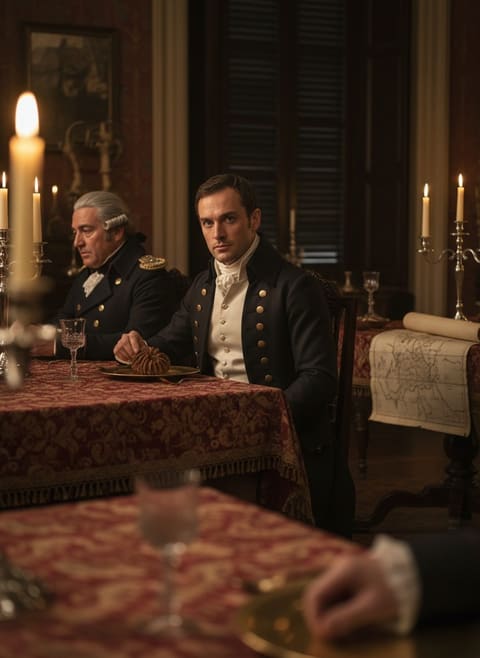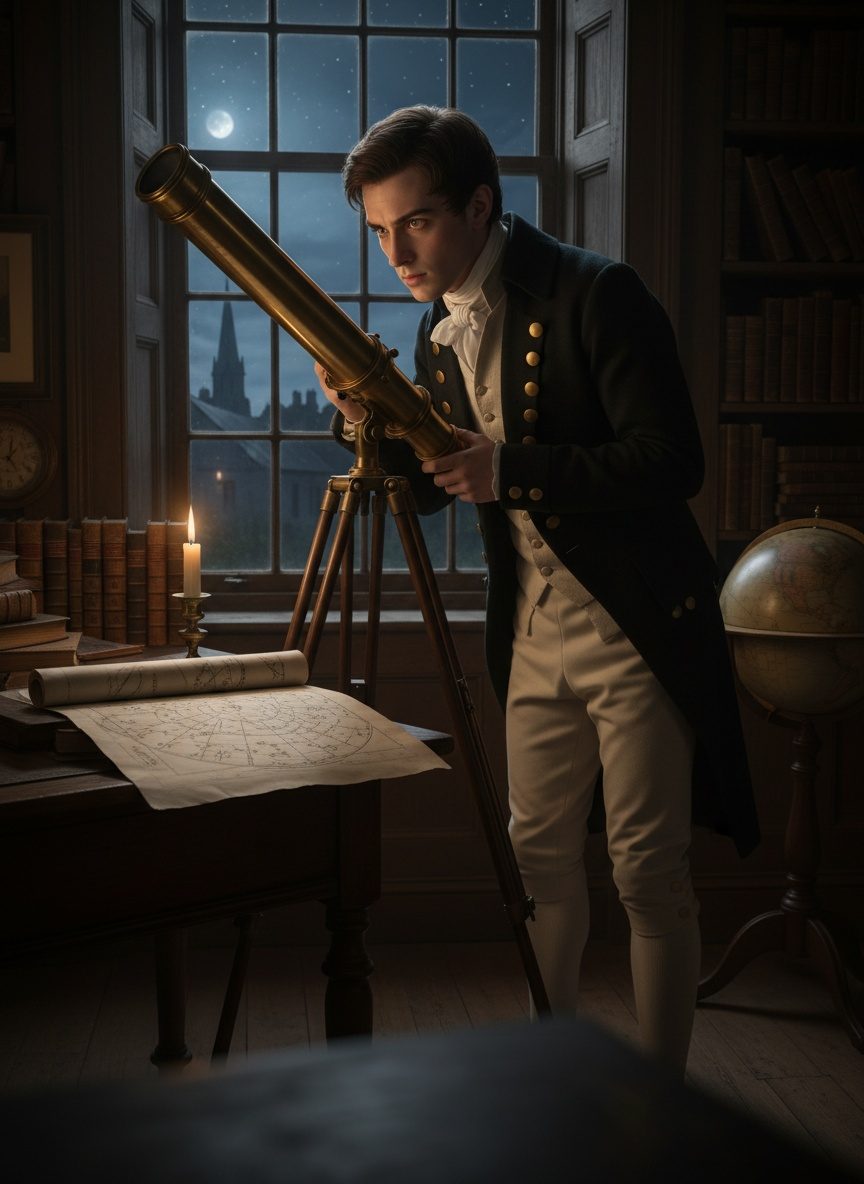
The damp chill of a Georgian night seeped into the ancient stones of York, as the city lay shrouded in an ethereal mist. Lamp-lit, cobbled streets were silent but for the distant burbling of the River Ouse, gliding calmly beneath the cloistered sky. In a modest townhouse, dimly lit by flickering candlelight, an extraordinary observation was quietly unfolding. Not amidst the hubbub of scientific salons in London or Paris, but here in the quietude of Northern England, an eighteen-year-old deaf and nearly blind boy was poised to reshape the firmament of astronomy. His name was John Goodricke, and against all odds, his observations of a single twinkling star would solve a cosmic riddle that had confounded Europe's greatest minds.
The Flicker in the Heavens
The year was 1781, and the world was expanding in both terrestrial and celestial understanding. The Age of Enlightenment had bred a fervor for knowledge in every realm, with astronomy capturing the imagination of both kings and commoners. Yet beyond the grand observatories and esteemed societies, a young astronomer was about to unveil a discovery with little more than simple instruments and razor-sharp intuition. John Goodricke, born into privilege but faced with profound challenges, possessed a determination that was less seen and more felt.
Goodricke's silent world was one through which he navigated with acute insight. His diligent study at the Academy for the Deaf in Edinburgh had sharpened his mind, while his passion for the stars was encouraged by his influential family. Yet it was in York, at a small telescope nestled amongst the house's trove of mathematical instruments, that Goodricke found his true calling. There, over consecutive nights, he meticulously charted the flickering dance of a star known as Algol — the Demon Star. Considered erratic and unexplainable by seasoned astronomers, Algol revealed to Goodricke a regular pulse of brightness and dimness.
It took the sharp acumen of John Goodricke to recognize a pattern where others saw chaos. Beneath the star's capricious facade lay a natural dance — a binary system composed of two stellar bodies orbiting a common center of mass. Though it was an understanding disparate from widely-held beliefs, Goodricke's hypothesis elegantly explained the observed pattern of Algol's dimming: one star eclipsed the other in periodic regularity.
Read next: The Day a Devon Captain Charted the Pacific and Changed the World
The Silent Observer's Triumph
At the age of just eighteen, Goodricke presented his findings with the quiet confidence of a scholar well beyond his years. He penned a series of letters to the Royal Society, articulating his theory of eclipsing binaries — a notion novel and revolutionary for its time. While other astronomers had spent lifetimes entangled in theories and conjecture, it was Goodricke's simple but brilliant insight that illuminated the mysterious variability of Algol.
In 1782, as the ink dried on his extraordinary correspondence, the Royal Society acknowledged the significance of Goodricke's work with the prestigious Copley Medal. Though a young man with impairment, he had listened with his eyes to what the stars were whispering, and the scientific community had listened back.
But the accolades came shadowed by irony; the stars that had offered Goodricke so much joy and understanding would also be witnesses to his fragile mortality. Three short years after solving the puzzle of the heavens, John Goodricke succumbed to pneumonia, leaving behind a legacy as fleeting and poignant as the celestial phenomena he adored. His was a life altogether remarkable for its brevity and the depth it left in its wake.
Read next: The Day a Devon Sailor Mapped the Roof of the World Alone
The Enduring Legacy of a Young Star
Why does John Goodricke's story linger, captivating us across the centuries? Perhaps it is because it embodies the unyielding spirit of human curiosity and resilience. Despite the profound silence that enveloped his world, Goodricke's observations spoke volumes to future generations. He exemplifies the possibility inherent in looking beyond our immediate circumstances, in listening to the universe in the ways we can, and how sometimes the most profound insights emerge from seemingly insurmountable limitations.
His contributions to the understanding of variable stars laid a foundation for future astronomical breakthroughs, sparking a quest that expanded from the dim, flickering lights of the known cosmos to the infinite mysteries that lay beyond. In a world where scientific advancements often emerged from collaborative efforts and towering institutions, Goodricke’s solitary revelations remind us of the profound impact of individual brilliance.
As we gaze skyward today, searching for our own fleeting flickers in the vastness of space, we can find inspiration in John Goodricke—a young pioneer whose sight was limited but whose vision was infinite. His story is not merely an echo of past success; it is a testament to the profound difference one resolved soul can make, mapping unknown stars to guide the explorers who would follow.