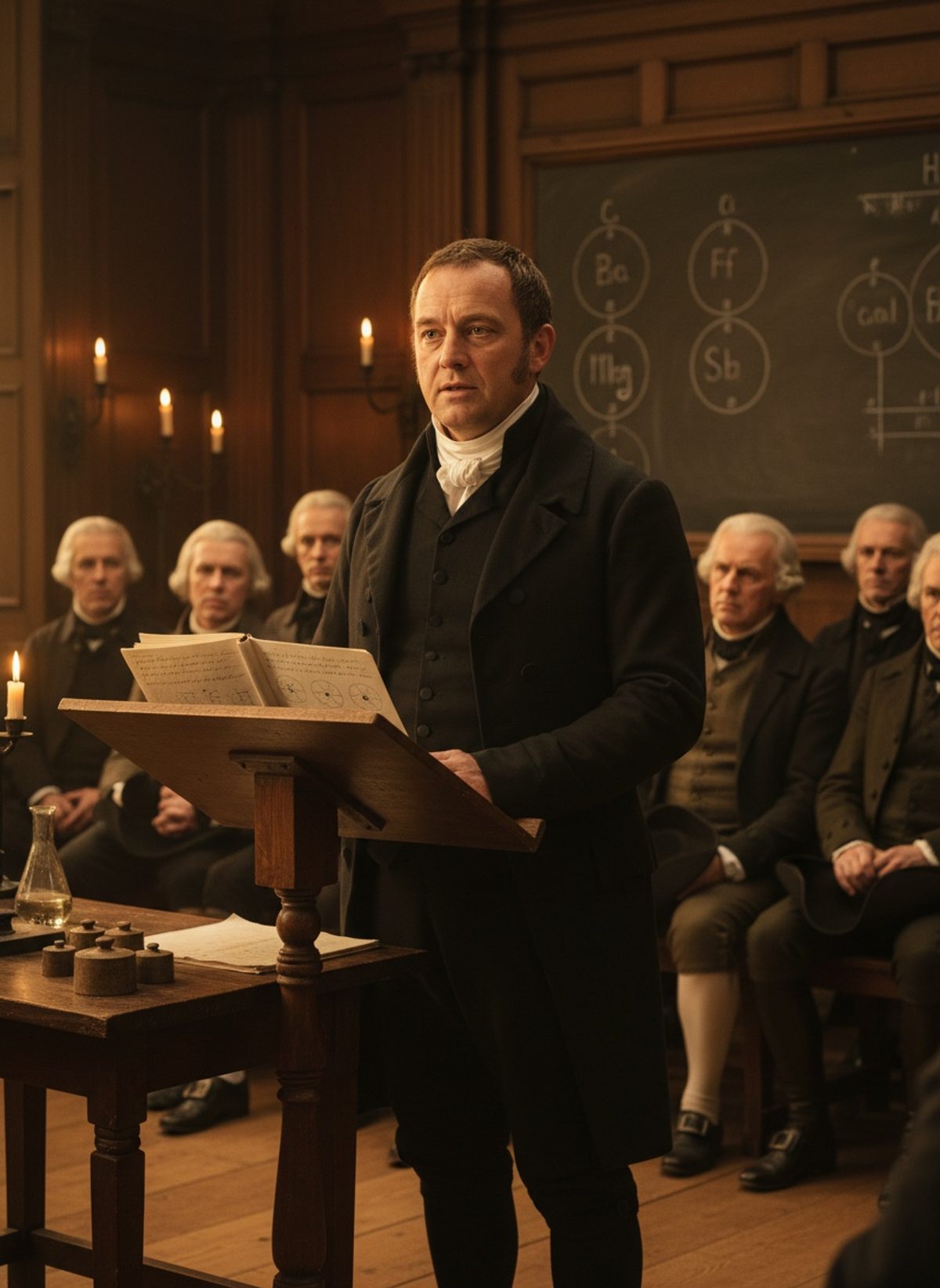
A faint flicker of candlelight danced across the faces of the gathered intellectuals in the Manchester Literary and Philosophical Society, their eyes fixed on the stoic figure of John Dalton. The air was thick with anticipation as the solemn schoolteacher, clad in simple Quaker attire, silently paced the room before halting abruptly. With an air of quiet defiance, he began to speak, his voice steady as the rhythmic tick of the room’s gigantic grandfather clock. In that moment, in the year 1803, the silent teacher from Cumberland revealed a truth that would ripple through the scientific world, changing the way humanity understood the essence of matter itself.
A Modest Man in an Age of Revolution
To understand the magnitude of Dalton’s revelation, one must first picture the man himself. John Dalton was born into modesty in the verdant landscape of Cumberland. As the son of a weaver and the child of a time where birthright dictated one’s destiny, Dalton was destined for a life defined by limitations. But his innate curiosity about the natural world drove him to question and seek answers beyond the woven looms and rolling hills of his youth.
By the time he stood before the learned society in Manchester, Dalton had already crafted a name for himself as a dedicated teacher and a diligent researcher. His Quaker upbringing instilled in him values of simplicity and truth, reflected in his earnest pursuit of knowledge. While the world rumbled with the echoes of industrial and political revolutions, Dalton’s revolution was one of thought—a silent, intellectual upheaval hidden behind his unassuming exterior. It was within this tapestry of cotton and coal, of radical ideas and technological innovations, that Dalton stitched his tapestry of atomic theory.
Atoms Weighed by Candlelight
The notion of atoms was not born with Dalton. It was a resurrected relic of ancient Greek philosophy, scattered across time like so many particles. However, what set Dalton apart was his audacity to weigh the unseeable. Equipped not with advanced instruments but with a mind sharpened by reason, he embarked on a journey to give substance to the intangible.
Read next: The Day a Surgeon's Son Gave the World a New Kind of Vision
In the dim glow of his study, Dalton tirelessly conducted experiments in what might seem like a laboratory of humble resources by today’s standards. He observed the absorption of gases in water, noting something peculiar: gases seemed to absorb in predictable, quantifiable patterns. This observation became a keystone in his theory.
Dalton proposed that each element had its own unique atom, varying in size and weight, creating a mosaic of matter. Through meticulous calculations, he inferred relative weights from observable phenomena, assigning the simplest known atom, hydrogen, a weight of one. Though his figures were crude by modern reckoning, the methodological elegance of his approach laid the cornerstone for the periodic table, as weighty as any industrial revolution.
The Unveiling: A Quiet Revolution
As Dalton presented his findings, an audience that had convened for discourse on gases and rain instead found itself on the precipice of a new scientific age. The room, lined with genteel gentlemen clutching tea cups, was alive with the soft rustle of paper as attendees recorded notes with quills dipped in ink. The air, infused with the musky scent of academia and human ambition, crackled with possibility.
Dalton’s presentation was not one of grand gestures or rhetorical flair. Rather, it was his steadfast commitment to simplicity and clarity that brought the room to a contemplative silence. He articulated his atomic theory with precision, laying out his findings without embellishment. The world before this moment considered matter to be continuous and infinitely divisible. Dalton presented a revolutionary vision: that these building blocks—atoms—were discrete and finite, fundamentally altering chemical science.
Read next: The Day a Potter's Son Decoded the Language of the Rocks
This was the essence of Dalton's genius not just in postulating the existence of atoms, but in devising a method to quantify them. The impact of this evening was akin to a pebble cast into still water, spreading ripples of change across both scientific and educational landscapes.
A Legacy Measured in Elements
Though met initially with skepticism, Dalton’s atomic theory gradually permeated scientific communities, giving birth to modern chemistry. His principles provided a framework, allowing chemists to classify elements and compounds, signifying a paradigm shift from alchemical pursuits to precise chemical sciences. Over the years, mistakes in Dalton’s calculations were corrected by others, yet the foundation he laid proved unshakeable.
Dalton’s work exemplifies the profound impact of a single mind in the grand tapestry of scientific progress. His theories challenged long-held beliefs and ignited a path of inquiry that has propelled humanity into uncovering the subatomic mysteries of our world. As we delve deeper into quantum realms, the resonance of Dalton’s bold claims remains—a testament to the power of observation, hypothesization, and the courage to defy convention with clarity and conviction.
In the end, the story of John Dalton is one of quiet revolution, of ordinary beginnings yielding extraordinary insights. It reminds us that sometimes it is the most humble of beginnings, nestled in a world of industrial clamor, that lead to the most profound of discoveries, articulated in the most plain-spoken of voices—the voice of a brewer's son who dared to weigh an atom.