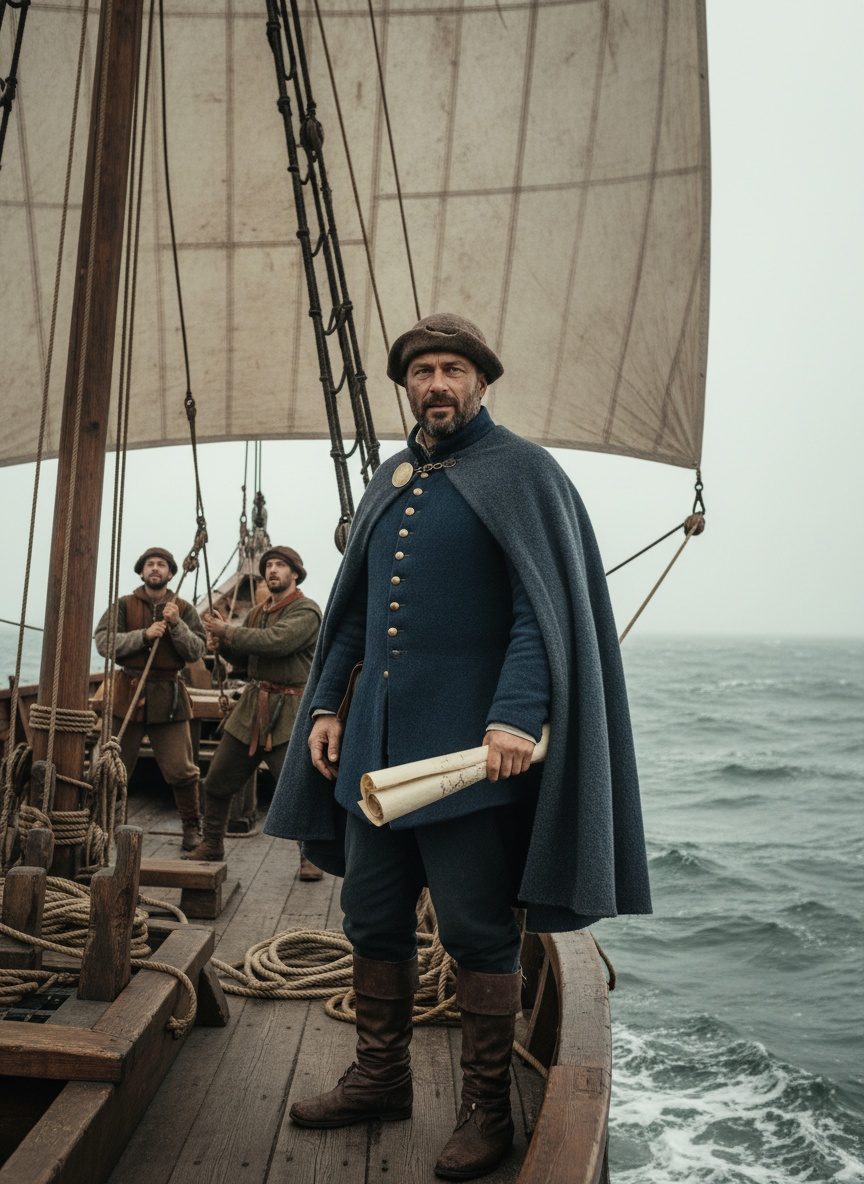
May 1497. A single ship rocked gently in Bristol’s harbor, its silhouette dark against the early morning mist.
The Quiet Resolve of a Venetian Mariner
As the dawn broke on that fateful May morning, a sense of anticipation mingled with apprehension among the onlookers watching from the docks. Amongst them stood John Cabot, a Venetian by birth but English by enterprise, readying himself for a voyage many deemed foolhardy. To his crew of eighteen men, the prospect of sailing west into the unknown seemed a maddening enterprise. Yet, Cabot carried in his heart the fire of exploration ignited by Columbus's recent ventures across the Atlantic. With the support of King Henry VII, who offered him letters patent and a modest sum, Cabot was determined to chart new waters and perhaps find a direct route to the rich markets of Asia, or so it seemed.
John Cabot's ship, the Matthew, was by no means grand—a mere 50-ton caravel. But she was sturdy, a compact vessel equipped to take on the daunting expanse of the Atlantic. Drawing inspiration from trade-driven winds and the whispers of promises unspoken, Cabot's vision extended far beyond this docks—their departure marked the audacity of a man whose sights were set on sailing off the edge of the known map.
Set Adrift in a Sea of Doubts
Once the Matthew slipped away from the familiarity of the English coast, a brooding anxiety descended upon its crew. These men, accustomed to coastal waters, now faced the intimidating open Atlantic with suspicion. The notion of falling off the edge of the earth never quite left their minds, a testament to the persistence of medieval beliefs despite the dawning of a new era of exploration. Despite their fears, Cabot's presence reassured them; his unwavering confidence spoke to a vision unseen and stories yet untold.
Read next: The Day a Devon Captain Charted the Pacific and Changed the World
For five weeks, they traversed the vast ocean, navigating with basic tools and a map that, for all intents and purposes, ended before their destination. Supplies dwindled, and the ocean's vast emptiness bore heavily on their spirits. Yet, Cabot’s conviction never wavered, buoyed by tales of lands across the horizon and the faith placed upon him by a skeptical English crown.
It is said that during their journey, the crew's desperation was punctuated by sightings of what Cabot interpreted as shoals, signals to him of land not too far away. Each passing day fell under his determination to reach the destination he envisioned when many had only dared to dream.
A New World Unveiled
Their perseverance finally rewarded them when a call went up from the crow’s nest—a muddled, verdant outline against the ocean blue. The landfall was unexpected yet undeniable, marking the climax of ambition what had pushed their vessel past the boundaries of the known world. What Cabot had stumbled upon was the crude expanse of Newfoundland, though he believed it to be the eastern fringes of Asia—a mistake that only time and subsequent voyages would correct.
With little fanfare, Cabot set foot on this new land and, planting the English flag, claimed it in the name of King Henry VII. To Cabot and his men, it was a triumph of human spirit and camaraderie, their modest expedition achieving what many thought impossible.
Read next: The Day a Devon Sailor Mapped the Roof of the World Alone
What unfolded on those shores was not immediately recognized as a turning point. Upon Cabot's return to Bristol, his report was subdued, eclipsed by other matters of state and a general air of skepticism. Unlike Columbus, whose discoveries were met with fanfare across Europe, Cabot's success did not instantly engrain itself into the annals of English lore.
The Overture to an Age of Discovery
In hindsight, the quiet significance of Cabot’s 1497 voyage cannot be overstated. Though his journey did not claim the glory of those which followed or immediately alter England’s maritime ambitions, it marked a seminal pivot to the age of New World exploration. It was a stone dropped into a vast ocean, the ripples of which would ultimately shape centuries to come. The territory he stepped upon, however presumptuously claimed, laid the groundwork for what would become geopolitical ambitions spanning continents.
The story of John Cabot serves as a compelling reminder of the indomitable human spirit—a Venetian in Tudor England, undeterred by skepticism, led men into the uncertainty of the Atlantic with little more than hope to guide them. It speaks to the dreams that dared to tear away from the momentary confines of known worlds, forging paths beyond the immediate horizon.
Cabot's voyage illustrates the quiet nature of true discovery, often overshadowed by louder voices or immediate fame, but no less impactful. His journey across the Atlantic may not have been recorded with fables or grand ceremonies, but it subtly adjusted the compass of exploration. Often lost in the unfolding drama of history, his quest laid unseen currents that would guide the sails of another age, quietly cementing its place in the chronicles of human exploration.