
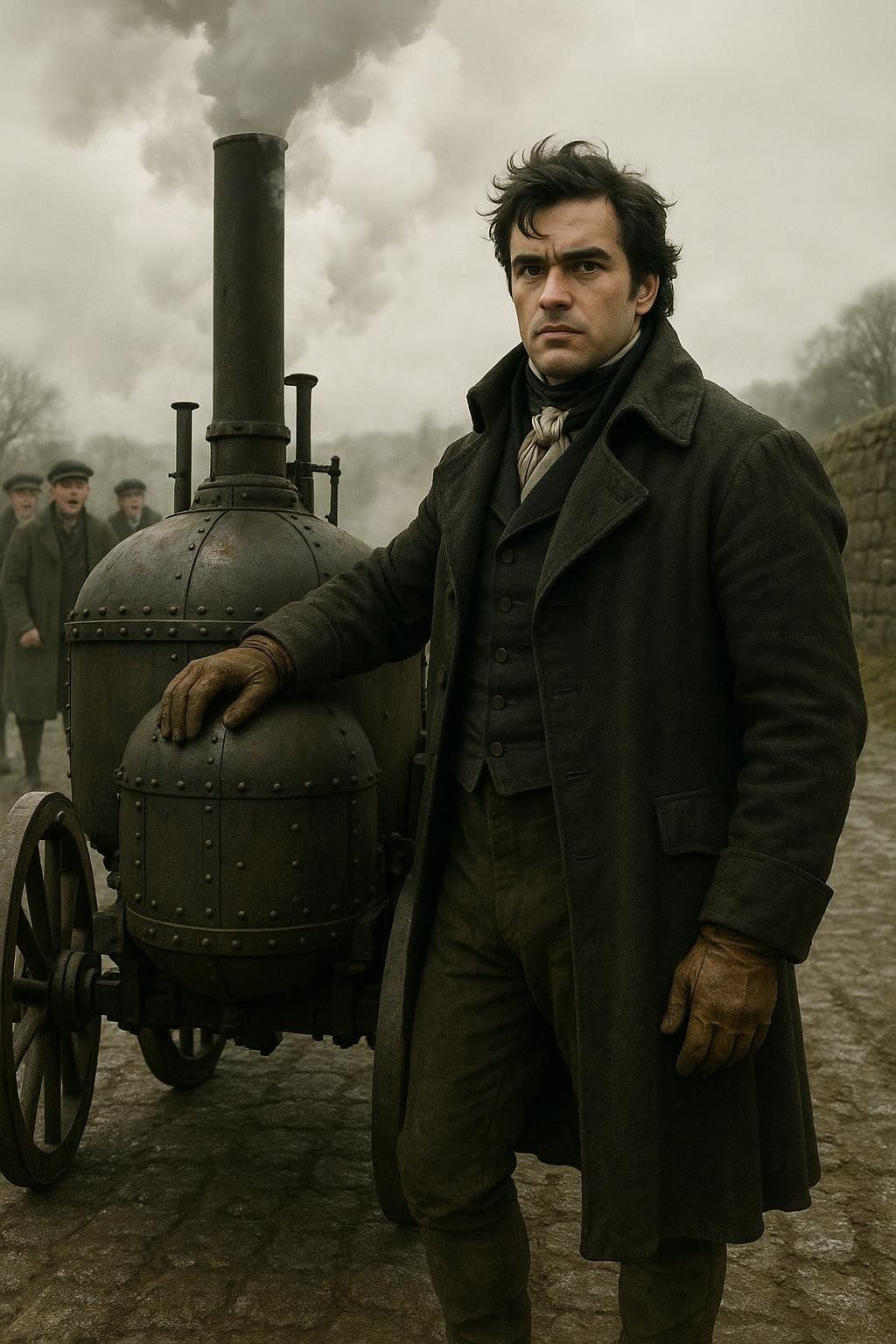
December 24, 1801. The crisp Cornish morning air was punctuated by an acrid steam as it drifted over the road.
The Iron Leviathan Awakens
On that fateful Christmas Eve, a modest road in Camborne, Cornwall became the unlikely stage for a mechanical revolution. Richard Trevithick, a son of the Cornish soil, brought to life a creature of iron and fire the likes of which had never been seen. Conceived in the mind of a blacksmith’s son and crafted by his own hands, Trevithick’s high-pressure steam carriage roared to life with an unfamiliar ferocity. Its iron belly hissed and snorted, belching steam into the winter sky, as curious onlookers scampered back in awe and intrigue. This was not a machine wealthy men of London had envisaged; it was the unimaginable birth of the world's first locomotive.
From Mine Shafts to Mechanical Dreams
Richard Trevithick was a product of Cornwall’s tin mines, a realm where the natural world’s gifts were wrenched from the earth by human ingenuity and determination. Born in 1771, he grew up amidst the clatter of mining tools and the sweat of men laboring under ground. While Trevithick’s peers learned to bend metal to utilitarian ends, he dreamed of possibilities far beyond the usual shafts and smelting pits.
Trevithick was well-acquainted with steam power, but where others saw machines for pumping water out of mines, Trevithick saw untapped potential. His visionary mind was particularly captivated by the idea of a steam engine that moved more than just pistons — one that could traverse the earth itself under its own mighty propulsion. His steam carriage was born from these bold imaginings, challenging the then-accepted notion of steam power’s capabilities.
Read next: The Day a Deaf Man Gave the World Its First Electric Motor
The Ingenious Charm of High-Pressure Steam
In an era where low-pressure steam engines reigned, Trevithick’s use of high-pressure steam was profoundly revolutionary. Steam engines of the day were behemoths that hulked, stationary and solid, their low-pressure systems demanding enormous boilers and wasting precious coal. Trevithick's innovation did away with this inefficiency. His high-pressure engine was compact enough to be mobile, yet powerful enough to move its own weight — a stark departure from the machines that had come before.
The tale of Trevithick’s design unfolds like an alchemist’s legend of peculiar brilliance. He knew the risks, the blasted pipes and scarred hands serving as architects of cautionary tales. Yet he persisted. On that December morning, Trevithick fastened his faith to this iron steed and unlocked the potential of his invention in the eyes of merchants, soldiers, and the world. In this moment, the future pathway of locomotion was laid, simple tracks in the mud that led onward to something much greater.
A Resonance Through History’s Tracks
The success of Trevithick's steam carriage might seem like an isolated milestone, soon to be shadowed by more refined machines, but its echoes resonated throughout the industrial landscape. Over the ensuing decades, where steam engines would become the powerhouses of revolutions, one could see the breadcrumb trail leading back to a Cornish blacksmith’s son with a heart as ambitious as a thousand pistons.
The roads that windy Cornish morning bore witness to the frightening power and the liberating promise of mechanical mobility. With each cautious turn of its iron wheels, Trevithick’s carriage not only traversed physical space but also the minds of engineers and visionaries across the globe. They took note, and soon rail lines crisscrossed continents, defining trade, warfare, and the very map of human interaction. As locomotives conquered land, they shrank the vast distances, reducing once epic journeys to the mere whispers of passing mile posts.
Reflections on the Iron Dream
Trevithick's gift to the world was not merely a machine, but the very essence of revolution — a spark that would kindle the fires of industrial change. With a simple steam carriage, he dared to challenge the perceptions of humanity’s capabilities on that chilly December day. His creation spoke to a boundless ambition, a bridge from the simple, laborious past to an electrified, steam-fueled future. Though Trevithick himself would not see the pinnacle of locomotion dominance, his indomitable spirit and vision burned brightly in the fireboxes of countless engines that followed.
Today, as bullet trains streak across the landscape at unimaginable speed, it is worth remembering a Cornish morning when a brave few witnessed something truly extraordinary — a time when the earth shook, not with the tremors of industry, but with the first audible and mighty sighs of a single, brilliantly conceived idea.