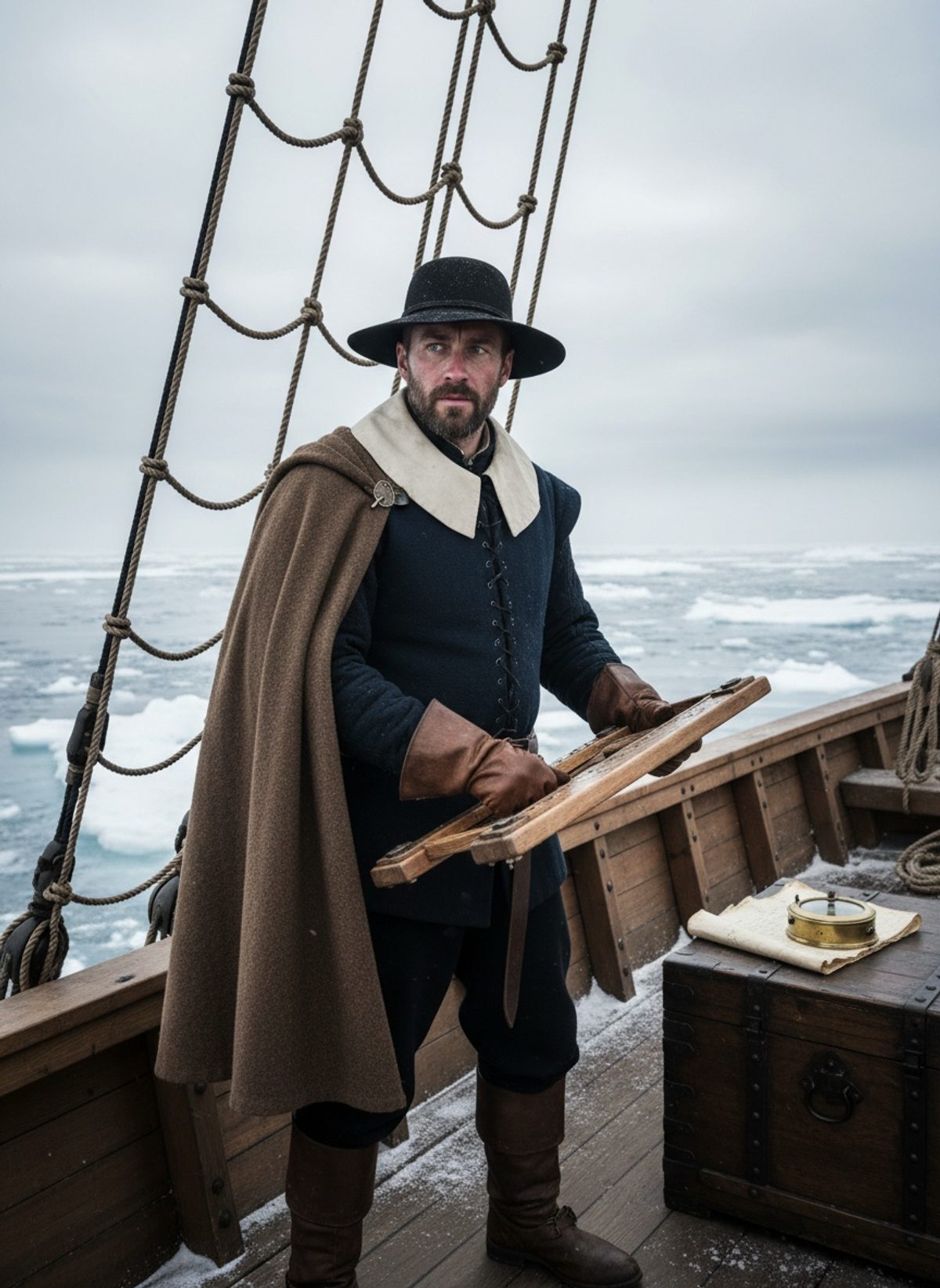
John Davis sailed into the Arctic with a quiet resolve. Few knew of his plan, and even fewer believed it could succeed.
The Dream of Northern Passage
In an era dominated by the lust for discovery, Elizabethan England was a tapestry of ambitions. Explorers sought new worlds, richer lands, and shorter routes to trade riches. Among them was John Davis, a captain from Devon, whose gaze was fixed on the icy Arctic. The allure of finding a Northwest Passage to the Orient had captivated minds, yet the North remained a chilling enigma—uncharted and unforgiving. Davis, with his trusty ship and a handful of determined crew members, set sail from Dartmouth in 1585 without the aid of maps or prior voyages to guide him. His mission was one of equal parts folly and foresight.
This period of exploration was not merely about expanding borders but about challenging what was known. Ships like Davis's were more than wooden vessels; they were carriers of hope and ambition, cutting through the oceans to the edges of the known world. The sea was a canvas painted with dreams of discovery, and Davis intended to draw new lines.
Into the Ice: A Journey of Isolation
As the crew pressed northward, the seas began to change character. The familiar tones of England’s coast gave way to a silent world of leaden skies and crackling ice sheets. Here, the world was stripped to its bare essentials, a realm where the only constants were the biting cold and the thundering sound of collisions as ice met hull. Many would have turned back, faced with the reality of Arctic isolation. Yet Davis continued to press forward, spurred by the whispers of a passage beyond and the silent urging of the north winds.
Read next: The Day a Devon Captain Charted the Pacific and Changed the World
The conditions were beyond harsh. Ice floes scraped the sides of the ship like ghostly apparitions, each contact a reminder of the thin line between exploration and oblivion. The celestial dance of the Northern Lights illuminated the sky, casting an eerie glow over the endless expanse of white. This ethereal spectacle, while visually enchanting, underscored the smallness of man against nature’s majesty.
The Strait That Bore His Name
Davis's courage was rewarded when he stumbled upon a narrow channel slicing through the Arctic land—the strait that would forever bear his name. The discovery was not merely geographical; it marked a triumph of will in the face of overwhelming adversity. The Davis Strait, as it came to be known, was a pathway that promised new connections, though not quite the direct passage to Asia anticipated. It was, nonetheless, a critical piece of the Arctic puzzle.
This discovery proved to be more than a mere highlight in navigation history. It showed that amidst the Arctic’s frigid menace, perseverance could uncover new hope. Davis's work laid the groundwork for future explorers who would tread these icy waters in the quest for understanding and connection.
A Return to England, Unheralded but Unbowed
Davis returned to Dartmouth, a hero in silence. The land he had seen, the strait he had navigated, were pieces of a larger game in which individual stories were subsumed into the grand mosaic of exploration. Elizabethan society, enamored with tales of the wealth of the Indies, heard little of icy straits and barren waters. Yet Davis returned with knowledge—a silent testament to the ingenuity of human spirit and perseverance.
Read next: The Day a Devon Sailor Mapped the Roof of the World Alone
He embarked on two more voyages to the Arctic in subsequent years, each time delving deeper into the icy unknown. His contributions to navigation and Arctic geography were foundational, though his name did not echo with the same reverence as those of other explorers of more temperate waters. Still, his legacy would emerge in the quiet admiration of global navigators who understood the enormity of his feats.
Why John Davis Still Matters
John Davis’s journey into the polar north reveals a tale not just of exploration but of audacity and the pioneering human spirit. It is a narrative that asks us to reconsider the limits we perceive. Why venture into the unknown, into lands that offer no gold, no spices, no promise of easy return? Because such ventures define us, pushing human capabilities and curiosity to their utmost. The Davis Strait remains a symbol—a testament to courage and the relentless pursuit of discovery.
In today's world, where the Arctic remains a topic of geostrategic interest and environmental importance, Davis's voyages hold an enduring relevance. They remind us that the unknown is always at our boundaries, whispering tales of what lies beyond. We are called not just to explore these limits but to understand and cherish the worlds we reveal. John Davis, in his quiet determination, teaches us that exploration is a tapestry of courage, a journey tied together by the threads of human resilience.