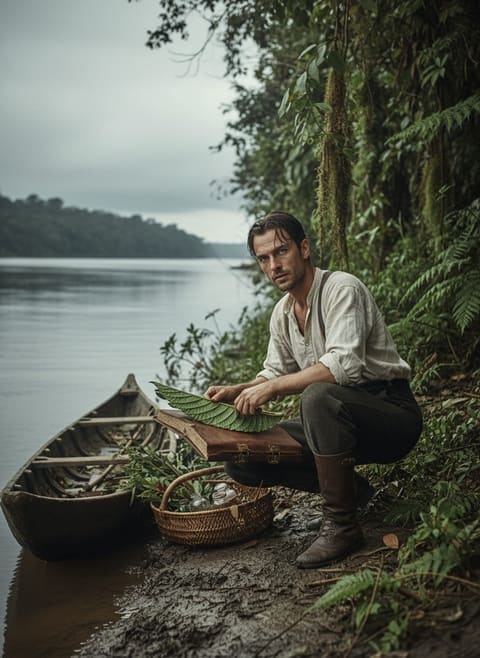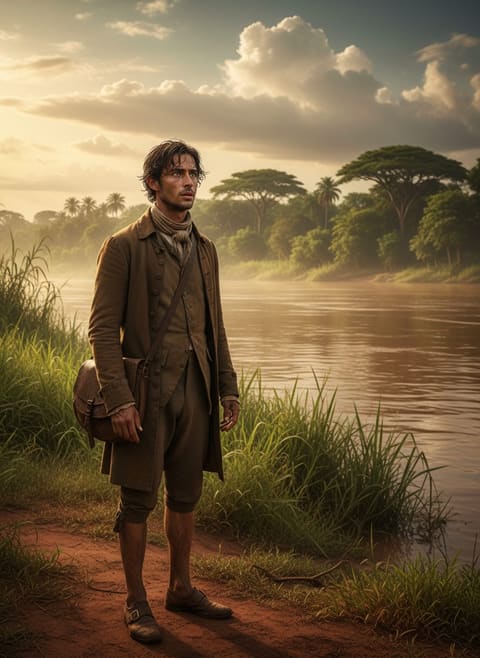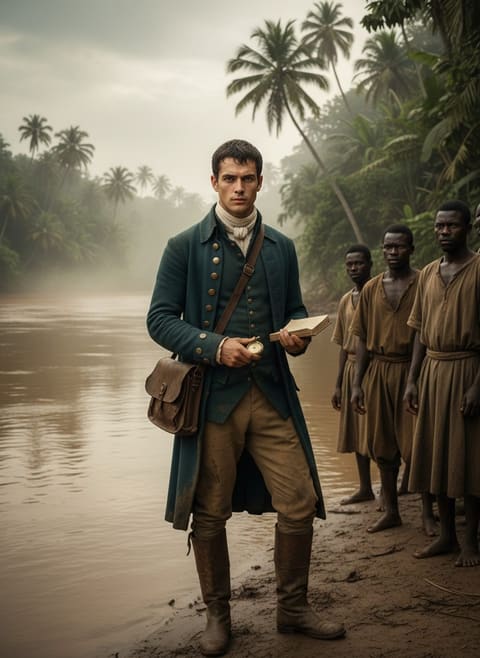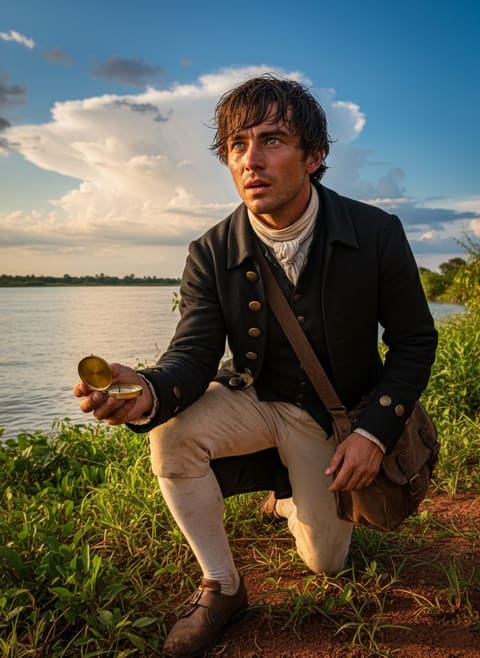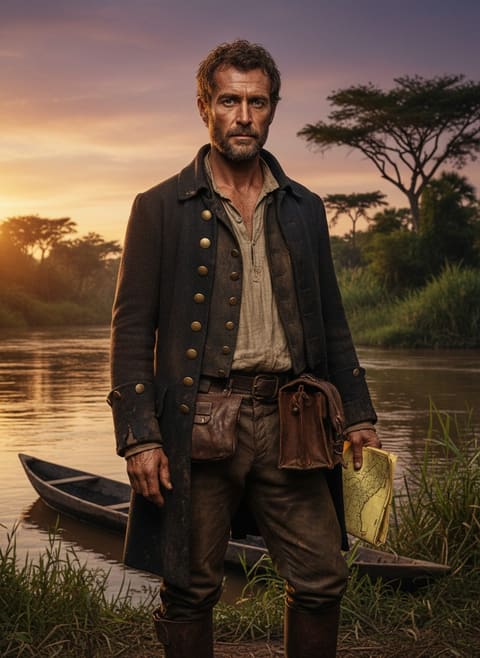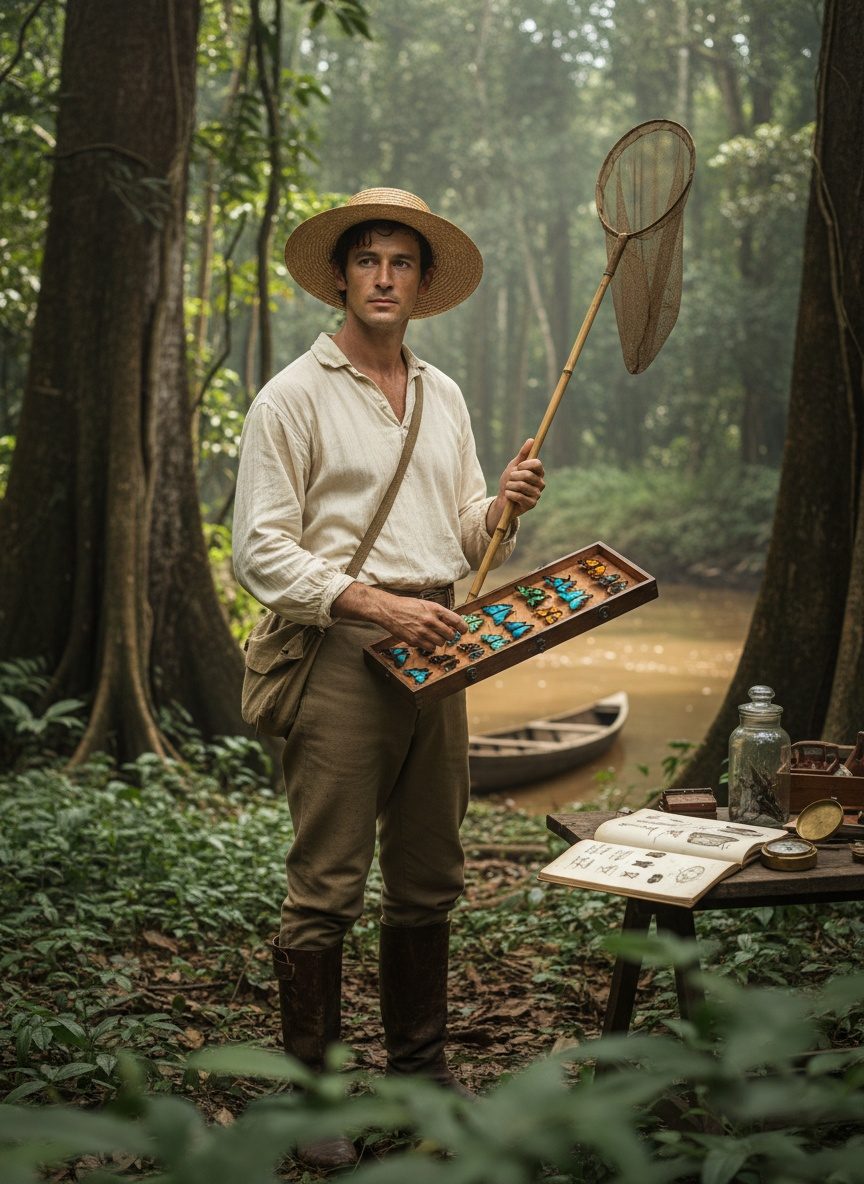
The man who cataloged the most species from the Amazon had never studied biology formally. He was a self-taught naturalist whose education came as much from the banks of the River Soar as from any academic institution. In 1849, Henry Walter Bates, armed only with a notebook and a butterfly net, stepped off a boat at Belém, gateway to one of the most inhospitable and mysterious regions on Earth.
Born in Leicester, Bates was the son of a hosiery worker. His dreams extended beyond the knitwear factories that framed his childhood. Inspired by the tales of exotic lands and the meticulous craft of collecting, Bates saw the natural world as his real classroom. His informal education was fueled by a passion for entomology. And so it was that, at the age of 24, Bates ventured into the verdant and unfathomably vast Amazon, unencumbered by the sensibilities and routines of high academia but driven by insatiable curiosity and an unwavering resolve.
The Amazon in the mid-19th century was a place less mapped than the moon. It was a world of towering trees and winding waters that cradled secrets in its tangled grasp. Sweltering, buzzing, and teeming with life, its biodiversity was unparalleled and undiscovered. Bates had no funding beyond his own modest savings and no team beyond the occasional local hired to assist him. Stepping into the jungle's lush darkness, Bates began a journey against the odds, mapping not just the land's feature but its living corridors, bringing hidden life into the light.
Over eleven years, Bates amassed a collection of 14,712 specimens. This achievement would not only change scientific understanding back in Victorian England but also challenge concepts of life itself. Eight thousand of these specimens were species new to science—a testament to the sheer biological novelty of the Amazon that greeted Bates at every turn. One can imagine him, swathed in sweat, cataloging beetles the size of his thumb or butterflies whose wings mirrored the sun’s dazzle as if wearing the rainforest's very soul.
Read next: The Day a Devon Captain Charted the Pacific and Changed the World
Despite the hardships—sweltering heat, unending rain, bouts of fever, and the logistical nightmare of transporting thousands of delicate specimens back to British shores—each captured creature was a hard-won treasure. His letters to colleagues back home often vibrated with the excitement of discovery, noting organisms that fluttered, skittered, and squirmed into his traps. These letters and the specimens themselves would ripple across the scientific community, a clarion call to the wonders of a realm few dared explore.
But how did a young man, flagged by nothing more than sheer determination and a curious mind, come to explore the Amazon? The story begins with a striking friendship. Bates, alongside fellow naturalist Alfred Russel Wallace, boarded a ship named the Mischief in 1848. Their shared voyage was as much piloted by Victorian science's burgeoning romance with taxonomy as by the rivers and currents themselves. Although Wallace and Bates would part ways—Wallace moved further east into the Malay Archipelago—their initial endeavor set the tone for Bates’ subsequent solitary expedition into the Brazilian interior. And it was Bates’s eventual analysis of mimicry among insects, found during these exploratory years, that provided crucial insights bolstering Darwin’s revolutionary theories.
Read next: The Day a Devon Sailor Mapped the Roof of the World Alone
The lush canopy of the Amazon was not a mere backdrop, but rather an active participant in Bates's scientific saga. Its challenges were as much a tutor as an adversary. Each trekforded river and cleared trail became a page in a profound narrative unfolding in the living library of the wild. Huddled in makeshift camps, Bates meticulously recorded his findings by lamplight. His endeavors were arduous, yet he achieved the extraordinary, penning observations that sketched a new understanding of geographical distribution and divergence. Bates played a silent hand in the realm of natural selection: he had encountered what Darwin had theorized—the fierce force of adaptation and survival in nature's arsenal.
By the time Bates returned to England in 1859, the world he knew had changed. Theories of life's diversity and origin, previously consigned to speculative whispers, had taken scaffold and form. Bates’s findings were integral. His work led to a broader acceptance of evolutionary principles, contributing pivotal evidence for the emerging theory of natural selection, proposed independently but contemporaneously by both Darwin and Wallace. His experiences were chronicled in his book, "The Naturalist on the River Amazons," which emerged not merely as a catalog of species but as a compelling record of human endeavor against the call of the wild.
In Bates's story, we find more than an explorer; we discover a quiet heroism in observation, a marriage of human curiosity and nature's boundless capacity to astonish. The forests he treaded hum a brighter chord in our evolutionary legacy due to his pioneering presence. This is why his work matters. Without his keen eyes and journal notes, science would lack vital footprints along its path to understanding. In the grand tapestry of discovery, Bates's chapter whispers an enduring truth: that Earth still harbors secrets, awaiting the brave and the curious to bring them into the light.