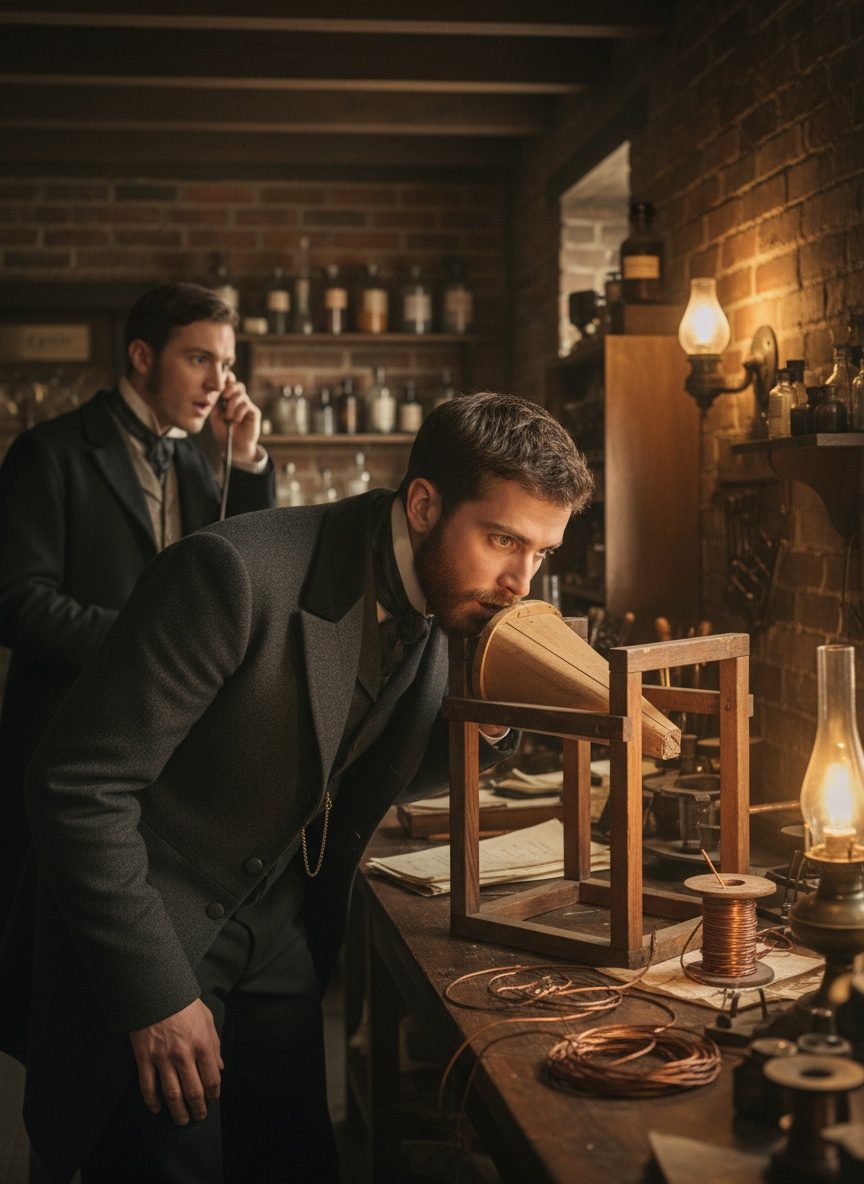
March 10, 1876. The bustling streets of Boston were alive with the sounds of horses and carriages clattering over cobblestone, echoing through the crisp New England air. Yet, inside a modest laboratory at 109 Court Street, a quiet revolution was about to take place—one that would alter the very fabric of human communication.
In this cluttered room, filled with the acrid scent of burning alcohol lamps and the metallic tang of copper wire, a Scottish-born teacher of the deaf named Alexander Graham Bell was poised on the brink of scientific achievement. Though not an engineer by training, Bell's life was a testament to curiosity and determination. He was consumed by a singular obsession: the mechanics of the human voice. This fascination was deeply personal, rooted in his desire to bridge the silent chasm that had isolated his mother, Eliza, who was deaf, from the world of sound.
Bell's genius lay not in the typical spheres of engineering or physics but rather in his relentless experimentation and the deep understanding of the human anatomy, particularly the vocal organs. This understanding was cultivated through his work as an elocution teacher, where he helped the deaf discover their voices, a gift he desperately wished to bestow upon his beloved mother.
On this March day, inspired by a vision of boundless communication, Bell whispered to his assistant in a moment of profound yet pragmatic discovery. Standing over an apparatus consisting of a crude diaphragm connected to an electrical circuit, he articulated seven simple words through the wire: "Mr. Watson, come here, I want to see you." In the adjacent room, Thomas Watson heard the first ever transmitted words through what would soon be known as the telephone.
Read next: The Day a Deaf Man Gave the World Its First Electric Motor
To fully appreciate this miracle, one must picture the scene as it unfolded. The room was a chaotic symphony of books haphazardly stacked, diagrams sprawling across the wooden floorboards, and a tangle of wires that seemed to defy logic. The atmosphere was electric, a palpable anticipation hanging in the air, mingling with the smoke and sweat of men unknowingly on the edge of changing history.
Alexander Graham Bell was not merely an inventor; he was a dreamer driven by empathy. His early life in Edinburgh, Scotland, was marked by the rhythmic cadence of education—a family tradition. Eliza Symonds Bell, though denied the sound of her son's words, unfailingly supported his pursuits. His father, Alexander Melville Bell, was a pioneer in himself, known for his work on "Visible Speech," a written code for phonetic sounds that was intended to help the deaf learn to speak.
The young Bell absorbed these influences like a sponge, carrying them with him across the Atlantic Ocean to Canada and eventually to Boston—a city teeming with intellectual fervor where he would forge the path of his destiny. Here, amidst a milieu of burgeoning innovation, Bell engaged deeply with the era's technological wonders. Yet, it was his unique perspective as an outsider to the fields of engineering and telegraphy that granted him the vision necessary to encroach upon the undiscovered country of voice transmission.
In Boston, Bell's commitment to his patrons at the Boston School for Deaf Mutes grew parallel to his experiments. The lives of these children, their joys and challenges, urged him forward. Every note produced, every mechanical hum rattled his soul with the possibility of a breakthrough. His partnership with Thomas Watson, a skilled electrical designer, solidified this resolve. Watson provided the technical acumen that balanced Bell’s creative flair.
As Bell moved from concept to reality, his work caught the attention of financiers and scientists alike, many of whom scoffed initially at the possibility of transmitting speech. Western Union, the telegraph giant, famously balked at purchasing Bell’s patents, dismissing the telephone as an impractical toy. Yet, the naysayers could not deter Bell from his course, nor could they foresee how swiftly his “toy” would revolutionize communication.
The simplicity of that first sentence, “Mr. Watson, come here, I want to see you,” belied the immense technical challenge it represented. For those seven words were carried from Bell's breath, transformed through the vibration of a membrane, and delivered as an electric signal pulsating through wire. It was a realization as monumental as Prometheus bringing fire to humanity, an act that injected life into the static landscape of human discourse.
After that groundbreaking success, developments would accelerate. By 1877, the Bell Telephone Company was established, and the telephone began its inevitable march into homes and businesses across America—and soon, the world. For many, this invention was nothing short of miraculous. No longer were people constrained by distance; they could reach across towns and continents as easily as speaking to a neighbor over a picket fence.
But beyond the wires and patents, the telephone encapsulated something more profound: the birth of a new age where the world grew smaller, knitted together by invisible threads tenuous yet steadfast. It was a leap toward globalization, a shift into rapid exchange of ideas, a first heartbeat in what would become a thundering crescendo of 20th-century technological advancement.
Alexander Graham Bell’s moment in that Boston room was a testament to the power of dreams anchored in empathy—an affirmation that the purest innovations often arise from a desire to address the unspoken needs of those we love. Though history remembers Bell primarily as an inventor, his heart remained with the deaf community and the broader vision of a connected humanity.
The legacy of this humble Scot's achievement extends beyond the mere mechanical workings of copper and current. It resonates in the ubiquitous hum of conversations that crisscross our planet today, in the digital chatter linking billions in real-time. And while we often take for granted the devices that serve as bridges across the chasms of space and time, it is vital to remember the spirit of ingenuity and compassion from which they sprang.