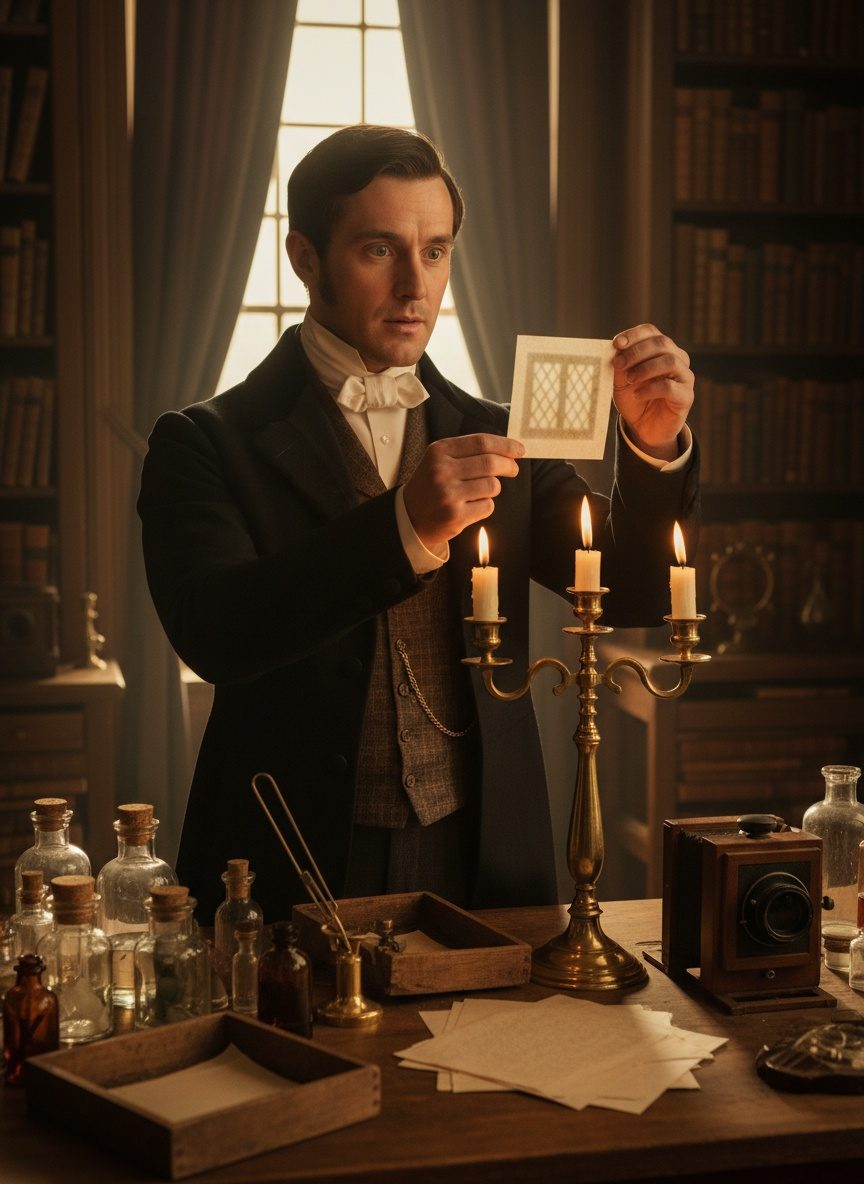
April 7, 1794. A light drizzle played a rhythm on the cobblestones of Manchester's streets.
The Weaver's Son and the Cobweb of Colours
John Dalton, born to a humble weaver in the rolling landscapes of Cumberland, England, stood on the precipice of revolutionizing how we perceive the universe—not in the bustling halls of academia, but within the austere confines of his Quaker upbringing. The son of a simple craftsman, Dalton grew within a tradition valuing education, though formal schooling was limited to a single room in a Quaker schoolhouse. Nevertheless, it was in this Spartan environment that the seeds of scientific inquiry sprouted. His early forays into teaching apparently did little to stifle the flames of curiosity blazing in his mind.
While Dalton might have embraced the art of pedagogy in the classroom, his greatest lessons were self-taught, born out of necessity and personal experience. From a young age, Dalton realized he did not perceive colours as others did. The verdant greens and striking reds spoke in muted whispers to his eyes, an anomaly the world now famously recognizes as Daltonism, but known more commonly as color blindness. Rather than accept this as a mere personal peculiarity, Dalton delved into the workings of his vision with mathematical precision and relentless inquiry.
As Dalton progressed through life, it was this introspection, combined with a deep-seated curiosity, that led him unto paths few men of his standing could tread. In 1794, rooted in his empirical approach, he presented his first papers on colour blindness. The son of a weaver had managed to weave together observations, attempting to understand an affliction few could even comprehend, and thereby lent his own name to the cause.
Read next: The Day a Deaf Man Gave the World Its First Electric Motor
The Invisible Threads of Matter
Perhaps it was his unique perspective on the natural world—seeing it through a slightly different hue—that gave Dalton the distinctive edge to pieces together what many saw as disconnected phenomena. By 1803, he had moved to Manchester, where his studies took another dimension—literally. During these years, he began a transformation from educator to pioneering chemist and physicist, laying down the foundational blocks of atomic theory, which would come to define the science of chemistry.
Dalton's atomic theory posited that matter, rather than being infinitely divisible, consisted of indivisible atoms, a radical idea at odds with the scientific consensus of continuous matter. This reminded the scholars of ancient Greek philosophies, yet Dalton rejuvenated these old ideas with modern, empirical articulation. He suggested that atoms of different elements had distinct weights, a revelation that would shake the very pillars of natural science.
While many current geniuses held positions at grand universities, Dalton's discoveries brewed within the modest rooms of his Manchester lodgings. His words swayed this burgeoning industrial city, far from the noise of capitals of learning like Oxford or Cambridge. Working with his laboratory of the mind, Dalton meticulously recorded data from his atmospheric experiments and chemical reactions, piecing together evidence for the existence of atoms. His work synthesized the random chaos into a coherent, elegant theory, describing how everything—every sensed hue and unseen force—was constituted of these basic building blocks.
The Legacy of a Colourful Mind
What might have remained a footnote in the annals of history was turned into a revolutionary theory due to Dalton's unquenchable thirst for understanding. His venture into the labyrinthine hallways of atomic theory was one of dogged determination and astute observation—a story proving how a different way of seeing connected disparate elements into holistic insights. He published papers that sparked dialogues and debates, embroiling established scientists across continents in vigorous discussions.
Though Dalton never held a prestigious university post, his legacy passed through the halls of every scientific institution. His atomic theory became a language all its own—units named in his honor and concepts taught worldwide to aspiring chemists and physicists. Dalton might have peered at a world adorned in muted colours, but he left it painted in vibrant hues, understood more profoundly than it had ever been before.
Dalton's journey speaks to more than just scientific discovery. Emerging from shadows cast by greater academic institutions, he sculpted a notion that cracked open Earth's secrets. His tale is a reminder of how the limitations of vision, when coupled with unwavering curiosity, can lead to insights that forever alter the perception not just of what we see, but of what lies beneath, undisturbed and awaiting discovery. A lame weaver's son took the world by the hand and showed it anew, one atom at a time.