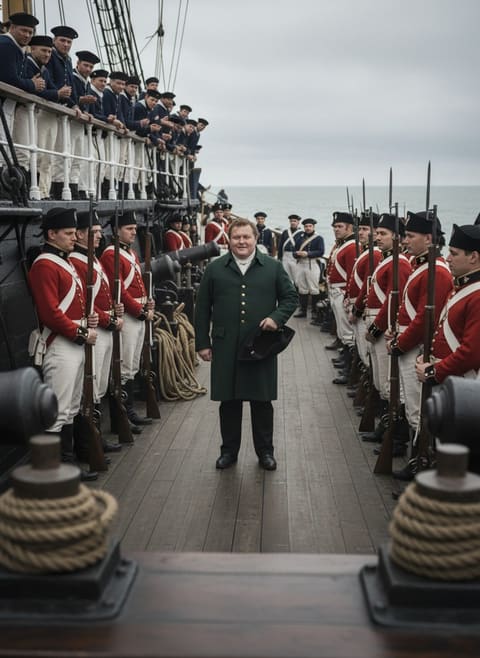
He was calm amid the chaos. He had never ignored the pleas of his sailors, even when they defied him.
Voices of Dissent Below Decks
In the spring of 1797, the sea-worn timbers of His Majesty's ships creaked not just with the usual strain of maritime duty but with the heavier weight of dissent. The Spithead Mutiny, as it would come to be known, unfurled its sails over the southern coast of England. Hundreds of Royal Navy sailors, beleaguered by harsh conditions, mustered the courage to defy the maritime levy of unquestionable obedience. Pressed men, as many aboard were, had seen enough of their ordeal: inadequate pay, spoiled provisions, and the constant encroachment of danger that lined every horizon. The Royal Navy, the empire's bulwark, depended on these very souls to keep the sails billowing against the warring winds of France.
Amongst the salty air and restless men stood a singular figure, a captain known not for his growling commands but for his attentive ears. While other officers may have thought to quell the growing turmoil with force and reprisal, this man, unnamed in the hurried echoes of history, chose instead a path of understanding. Alone, he ventured below decks, an act of sheer audacity that demanded more courage than sabers drawn in battle. There were no armed escorts to protect him from the mutiny's ire—only his own conviction to listen.
The below deck was alive with the fervent whispers and hushed grievances of sailors who had sacrificed their ease for duty. The captain invited these men to speak their minds, and what he heard was more than mere discontent; it was the collective cry of injustice long tolerated. They pleaded for fair treatment, yearning for respect more than the scanty bread they broke. And within this tumult of voices, the captain stood unflinching. He truly listened, an act so rare it became revolutionary.
Read next: The Day a British Captain Rowed Into the Dark to Feed His Enemy
A Promise Carried by the Wind
History often remembers the grand gestures, the tumultuous sea battles, or harrowing tales of survival, but it is the quiet negotiations—the handshakes and words exchanged—that shape the tides of change. What took place aboard that creaking vessel on the April waters of 1797 was not a concession born from weakness but the strength of principled leadership. The captain, bearing all the frustrations gathered like a tempest, made promises on behalf of those voiceless men. He assured them of deliverance from their grievances, pledging not only empathy but action.
Word of this agreement rippled across the fleet, carried over the winds that rustle canvas like ghostly whisperings of hope. The captain, perhaps guided by an immortal belief in justice, engaged not just with his men but further—a communication line reaching beyond the decks he served. Promises were only as good as their delivery, and to gamble trust without fulfillment would risk a justice betrayed.
Back ashore, the Admiralty, ever the steely custodian of Britain’s greatest maritime machine, had begun to take notice. The murmurs carried by the wind had gained in potency, aided by the assurances of one captain whose actions suggested a wider reform. Coerced into compliance not by threat but necessity, the Admiralty began to sketch out preliminary solutions. Pay increases, provisions improved, and a reconsideration of life aboard—were these not unfathomable, radical shifts once? Now, they hinted at a transformation that would echo throughout the ranks.
Read next: The Night the British Ate the President's Dinner
The Steady Hand in Tumultuous Seas
Throughout history's corridors, the tale of a lone captain among mutineers stands apart—not for swashbuckling heroics but for its testament to listening and mediation. His actions in 1797 resonated well beyond the confines of his own vessel. This small, quiet rebellion nudged a transformation not just in procedure but in philosophy—an understanding that even an empire's mightiest instruments required the harmony of human dignity to function effectively.
The repercussions of that spring echoed into arenas beyond maritime boundaries. It experienced a ripple effect as the Royal Navy grappled with its identity, struck between rigidity and reform. The mutiny at Spithead did not spell chaos without purpose; it was the precise stitch in time needed to mend the frayed seams of naval tradition. This captain, whose name may fade, stands permanently as a silhouette etched in the shadows guiding the ships forward.
Today’s world is still navigating these same winds of change, where leadership is too often mistaken for autocracy, and where the power of listening still holds the potential to drive revolutions more enduring than any forcible command. As we gaze across our own uncertain seas, perhaps his story—one of simple but profound integrity and courage—offers a compass pointing to justice. It may just remind us that, like a single captain listening to the whispers below decks, the course of history is often charted by those who choose to hear rather than silence. In a world driven by dialogue as much as action, understanding remains our rudder, steering us clear of unseen dangers and toward necessary shores.