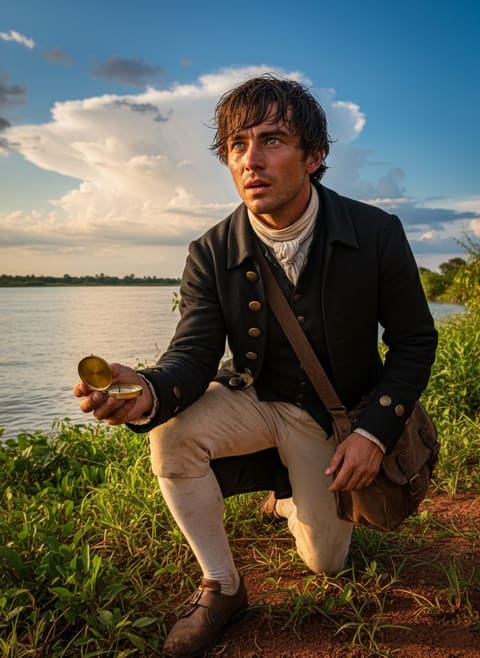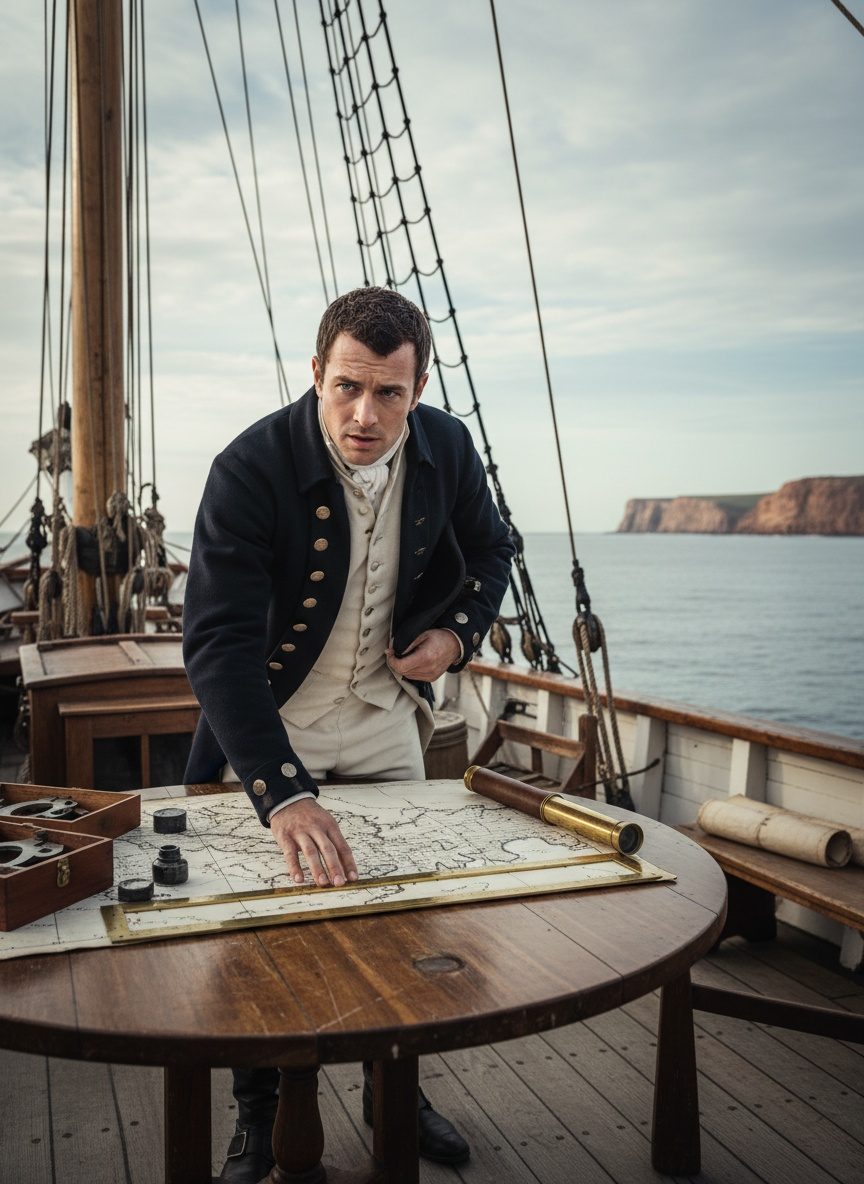
July 14, 1791. The open sea stretched to the horizon, unbroken by human presence.
A Seventeen-Year-Old's Resolve
The summer of 1791 found a young Matthew Flinders gazing out at the untamed sea, a copy of *Robinson Crusoe* clenched in one hand and an unwavering determination grasped firmly in the other. At just seventeen, few could have predicted that this young man, inspired by Daniel Defoe's tale of shipwreck and survival, would one day chart new worlds. Yet, his resolve was as sturdy as the ships he longed to command, driving him to seek places on the globe not yet engraved on European maps.
Born in Lincolnshire, England, Flinders yearned for adventure beyond the whispering fens of his homeland. The Age of Sail, with its promise of discovery and peril, called to his heart. It was during this era that the British Empire, hungry for knowledge and new territories, sought navigational mastery of the farther corners of the world. With dreams mirroring those of the fictitious Crusoe, Flinders set out to the seas, determined to contribute to this expanding tapestry of exploration.
Armed with little more than imagination and ambition, Flinders joined the Royal Navy. His ascent was rapid, and his dedication, unwavering. So commenced a journey that would see him sculpt his name into the annals of history, ultimately carving the path to an uncharted continent far from the familiars shores of England.
Read next: The Day a Devon Captain Charted the Pacific and Changed the World
The Cartographer of Coasts Unseen
Australia — a land known to Indigenous peoples for thousands of years, yet shrouded in European mystery until the Age of Discovery. By the late 18th century, portions of its coastline had been glimpsed, but the vast interior and expansive shores remained full of secrecy. It would take Flinders’ meticulous nature and dogged perseverance to transform these mysteries into the known.
In the company of his loyal ship and crew, Flinders embarked on a series of daring voyages around the Australian landmass. With an iron resolve matched only by the anchors aboard his ship, he charted nearly every bay and headland, sketching the contours of a continent into the heart of navigational charts. His dedication was visible not only in the ink of his maps but also in the precision and care with which he verified each crevice and outcrop. The world was evolving, and Flinders was its chronicler, one nautical mile at a time.
One often-overlooked companion joined him on these ventures: his loyal cat, Trim. Together they faced the elements, from fierce storms to the scorching sun that tested his endurance and spirit. Yet, throughout these trials, it was the companionship and unspoken understanding with Trim that would often guide him through the solitude of the voyage.
A Prisoner's Pen and the Gift of a Name
Flinders’ explorations seemed unstoppable until fate intervened. Captured by the French while returning to England, Flinders found himself a prisoner on the island of Mauritius for nearly six years. Yet captivity did not curb his ambition or creativity. It was within these confined walls that his most important work took form.
Imprisoned but undeterred, Flinders set himself the task of compiling his findings and creating his masterpiece — the complete map of the coasts he had so diligently explored. From these confines, he also initiated the use of a name that would resonate down through history: Australia. Though the term was used informally within the scientific community, it was Flinders who advocated for its recognized adoption, replacing the older term, "New Holland." His prison cell became a sanctuary of thought, where, undistracted by the clamor of the outside world, his vision for the newfound continent crystallized.
Read next: The Day a Devon Sailor Mapped the Roof of the World Alone
Despite the adversity, Flinders' determination to document and contribute to the legacy of discovery stood firm. His charts, drawn in a place of captivity, provided the key to untangling the enigmatic coasts of a vast land, forging an indelible link between Flinders and the continent he had mapped from the decks of his ships and the solitude of his cell.
Enduring Legacy on Uncharted Shores
Flinders’ life was an ode to exploration — the rigorous challenge of discovery that was both a consuming passion and a historical duty. It wasn't just about discovering places or drawing maps; it was about establishing connections across unknown realms, perhaps even bridging the imaginary lines that might have divided worlds. While his physical body was confined in foreign prisons, his mind roamed freely across the seas he had once sailed.
Flinders' aptly named *Terra Australis*, now Australia, stands today as a testament to his life’s work. His story transcends the pages of history due to the sheer audacity of a young man with a dream as vast as the seas he traversed. His interpretations and discoveries, rendered first with ink and then legacy, offered the world a fresh perspective on exploration, ambition, and charting new waters.
Matthew Flinders' endeavors remind us of the power of dreams, endurance, and the relentless pursuit of unveiling the world. His life illustrates a resolute clarity, woven into every ripple and wave on the maps he left behind, ensuring that the treasures of knowledge were shared far beyond the seas that once seemed so daunting. Indeed, his journey inspires the modern explorer in every heart that dares to sail into uncharted waters, alone but for the call of destiny.