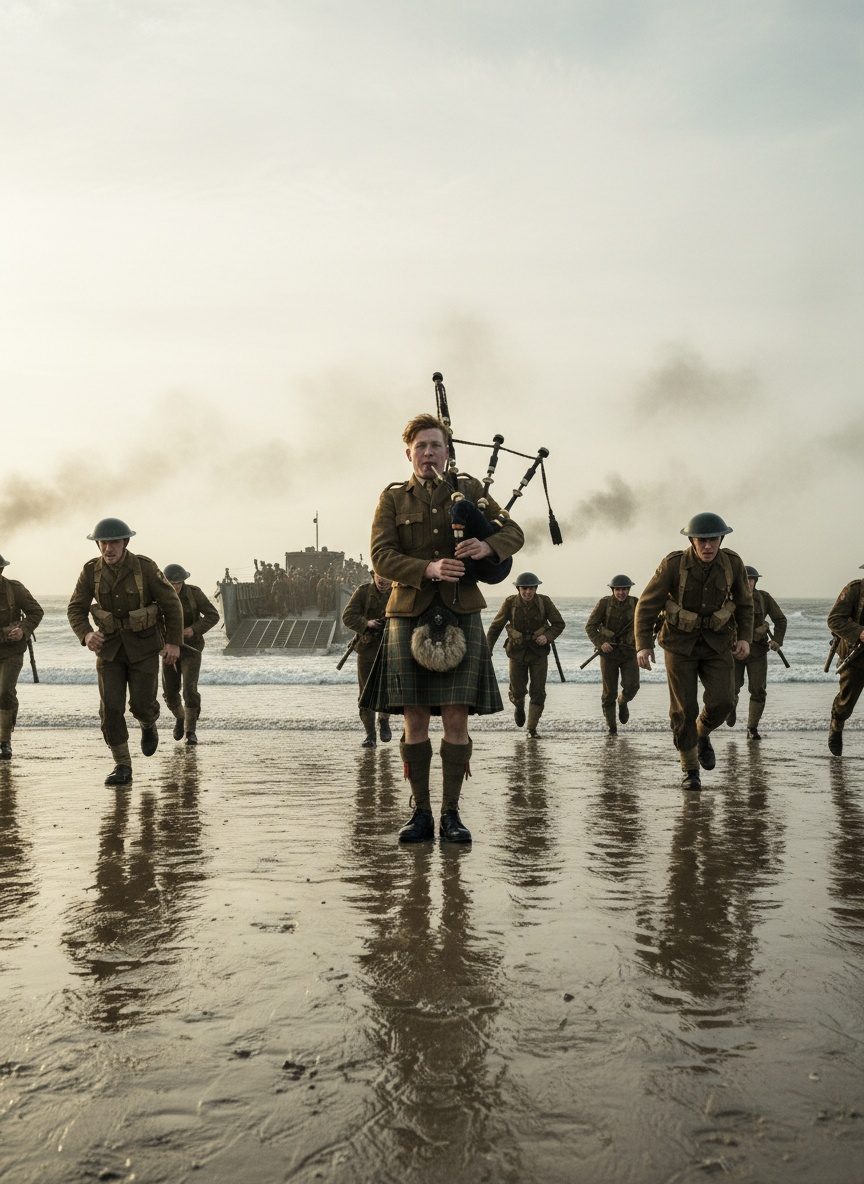
Most people raced for cover on Sword Beach. One man strolled through the chaos with nothing but a tune.
The Reluctant Hero
The chill dawn of June 6, 1944, saw one of the most pivotal events of the 20th century: the D-Day landings on the beaches of Normandy. As bullets flew and explosions rocked the air, a lone figure emerged from the seething surf onto Sword Beach. He was barefoot, carrying not a weapon, but bagpipes. His name was Bill Millin, a 21-year-old private in the British Army, and his bravery, or madness, would become legendary.
Bill Millin's father had been a piper in World War I, and it seemed fate had orchestrated that his son would follow in his melodic footsteps. Standing waist-deep in water, clad in a kilt that belonged to his father, Millin prepared to fulfill an unusual order from his commanding officer, Brigadier Simon Fraser, 15th Lord Lovat. At that moment, reality blended with folklore as he lifted those pipes and began to play.
While Millin expected that his unmistakable presence would make him an easy target, the Germans did not fire at him. In later interviews, captured German soldiers admitted they had refrained, thinking that the sight of a man walking calmly through the chaos playing bagpipes was an absurd vision—a trick of the mind or the actions of a madman.
Read next: The Night a Teenage Gunner Held the Bridge at Arnhem
The Path Through Chaos
Shrouded in the fog of war, the vision of Millin striding across Sword Beach in his tartan kilt, playing the pipes as men fell around him, was surreal. The air was heavy with the acrid smoke of gunpowder and the cries of the wounded. It was as if a sense of the supernatural enveloped Millin, protecting him from the madness engulfing the beach. His tunes, including "Highland Laddie" and "The Road to the Isles," cut through the chaos, providing a semblance of order amid disorder, of tradition in the midst of modern warfare.
Bill Millin's extraordinary walk was not just a simple crossing of land. Every step he took became a courageous defiance of danger that inspired those around him. While men huddled in the scant shelter offered by the Normandy cliffs, Millin’s resolute figure served as a rallying call, encouraging them to press on despite the carnage.
Words somehow fail to capture the full breadth of madness and bravery that his actions signified. Here was a man, armed not with the arsenal of warfare but with the cultural weapon of music, turning the tide against the menacing footfalls of fear.
Echoes of History
This immense tribute to courage wasn’t an isolated moment in history. Scotland’s tradition of pipers leading men into battle is as old as Scotland itself. Yet, by World War II, official military policy had decreed that no piper would be exposed to the dangers of battle this way—a regulation born from heavy losses suffered in the trenches of World War I. Bill Millin's actions defied that regulation; he was one of the last officers to undertake such a role in combat.
Lord Lovat, Millin’s commanding officer, authorized him to play, ironically mentioning, “That’s the English War Office, you and I are both Scottish, and that doesn’t apply.” This disregard for orders reflected a deep-rooted belief in the power of tradition and symbolism, a belief carried over centuries and battles fought. It demonstrated how sometimes, the rules of engagement aren’t written in manuals but in the hearts of those who dare to defy them.
Millin’s bravery did not go impulsive or unrecognized. His story became emblematic of the D-Day operations. Accounts vary with whispers that the sound of the pipes emboldened the troops, providing them a sliver of morale amidst the horrific theatre of war. Every note that emerged from Millin's pipes wove itself into the very fabric of the Allied victory, a soundtrack of hope and unyielding courage.
A Legacy Measured in Notes
After the war, Bill Millin returned to a life less extraordinary, taking on work as a hospital porter and later as a psychiatric nurse. Yet, the pipes he carried that day, which became known as the "D-Day Pipes," were displayed in the Dawlish Museum in Devon until they moved to the Pegasus Bridge Museum in France where they remain a definitive piece of D-Day history.
The house songs that Bill Millin played still echo across the ages, resonating far beyond the beaches of Normandy. His journey serves as a reminder of the profound impact one individual's courage can have on the collective psyche of an army. The decision by German snipers to hold their fire presents a compelling argument that even amidst the precision of military execution, there exist pockets of unexplained humanity.
Ultimately, Bill Millin’s story transcends the mere recital of historical events. It serves as a piercing reminder of the extraordinary bravery overlaying ordinary men, a narrative woven from the fabric of human resilience and the beauty of cultural identity triumphing over conflict. And though the fury of battle has long since faded, the legacy of the war waged on the beaches of Normandy—and the lone piper who refused to yield to its fears—continues to ripple through time, a testament to the power of the human spirit.