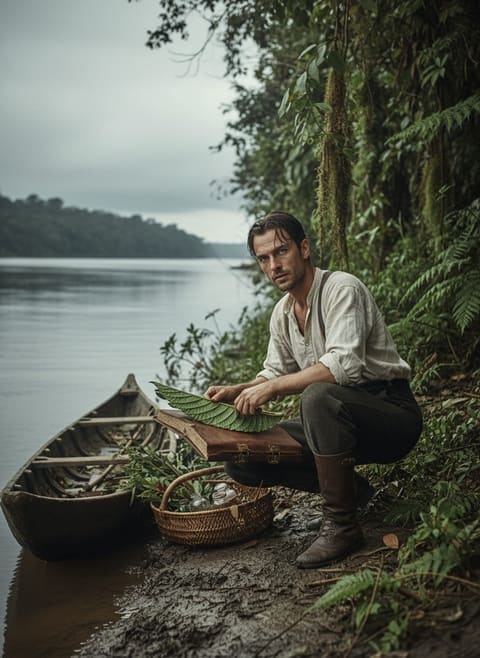
He was a farmer’s son with little formal education. Yet, on that August morning in 1770, James Cook claimed a continent for the Crown.
The Unexpected Navigator
James Cook’s journey from the fields of England to the deck of the Endeavour was as remarkable as it was unexpected. Born in Marton, Yorkshire, to a modest family, Cook was not the heir to a grand seafaring tradition. Instead, he was a self-taught navigator, honing his skills through patient study and practical experience rather than aristocratic privilege or naval academy training. His decision to embark on a maritime career at age eighteen took him from the Yorkshire coast to the farthest reaches of the globe, including the vast and mysterious southern lands that would one day become known as Australia.
Cook's rise within the British Royal Navy was unconventional. He started in the humble position of an able seaman, but his talent for cartography and navigation quickly set him apart. By the time Cook embarked on his first voyage of discovery aboard the HMS Endeavour, he had earned a reputation for accuracy and diligence. This reputation would serve him well as he navigated the uncharted waters of the Pacific, meticulously mapping the coastline of New Zealand and the eastern coast of Australia.
The Voyage of Discovery
In 1768, under the auspices of the Royal Society and the Royal Navy, Cook and his crew set sail from Plymouth, tasked with observing the transit of Venus across the sun—a phenomenon that might reveal the Earth's distance from the sun. However, the mission had a second, more secretive objective: to seek out the hypothetical Terra Australis Incognita, a continent believed to exist in the southern hemisphere. This dual purpose made Cook's expedition not only a scientific endeavor but also a strategic move in the geopolitical chess game of the era.
Read next: The Day a Devon Captain Charted the Pacific and Changed the World
The journey was perilous, punctuated by storms and scurvy, yet it was also one of discovery. After successfully observing the transit of Venus, Cook navigated the treacherous waters around New Zealand, proving it was not a long, sprawling landmass as once thought, but two distinct islands. He then turned his sights westward, towards the unknown coastlines of eastern Australia, which he would quaintly name after his native soil: New South Wales.
Moment of Claim
On August 22, 1770, Cook made a decision that would alter the course of Australian history. With the Endeavour safely anchored off the coast, Cook landed on what is now known as Possession Island. The day was as ordinary as any other, with little fanfare or drama. Yet, the actions he took were anything but ordinary. Under a clear sky, Cook and his small landing party rowed ashore, raised the Union Flag, and ceremoniously claimed the entire eastern coastline of Australia for the British Crown. The magnitude of this claim was staggering: over 2,000 miles of pristine, unfamiliar land, rich with potential resources and strategic value.
This singular moment on a tiny, tropical island stood in stark contrast to Cook’s modest upbringing and rank of Lieutenant—neither noble nor high-ranking, Cook had nonetheless become the agent of imperial expansion. His actions that day, though viewed as a matter of course in the age of exploration, would have profound implications, laying the groundwork for British settlement and shaping the destinies of countless lives.
A Farmer's Son and the Crown
What made Cook’s claim particularly unexpected was his background. His ascension from a farmer’s son to a celebrated figure in maritime history exemplified the exceptional mobility of talent during the Enlightenment, when merit often trumped birthright. His skill was undeniable, his charts detailed and precise; Cook’s work opened up a new world, both literally and metaphorically, to the British Empire.
Read next: The Day a Devon Sailor Mapped the Roof of the World Alone
But it also raises a question—what drove Cook to undertake such a monumental claim? Perhaps it was the identification with the Crown which, like him, reached beyond its own borders to find its place in the world. Or perhaps it was a sheer act of duty, from a man who had built his life around fulfilling the tasks given to him, with unerring discipline and skill.
The Echoes of an Unseen Event
Cook’s landing on Possession Island might have seemed like just another day for the Endeavour crew, but its implications have echoed through history in ways unforeseen on that beachhead. That morning marked the beginning of British colonial interests in Australia, foreshadowing future interactions that would significantly affect the indigenous populations and the landscape of an entire continent. The landing and its legacy symbolize both the daring of human exploration and the complex, often painful intersections of different worlds.
As we reflect on Cook’s extraordinary actions, we recognize that history is often shaped by the unexpected actions of unlikely individuals. James Cook’s unassuming beginnings remind us that history is as much about the personal journeys as it is about grand events. The moment on Possession Island, though absent dramatic ceremony, stands as a quiet keystone in the narrative of exploration, underscoring how the unassuming and self-made can forever alter the course of history.