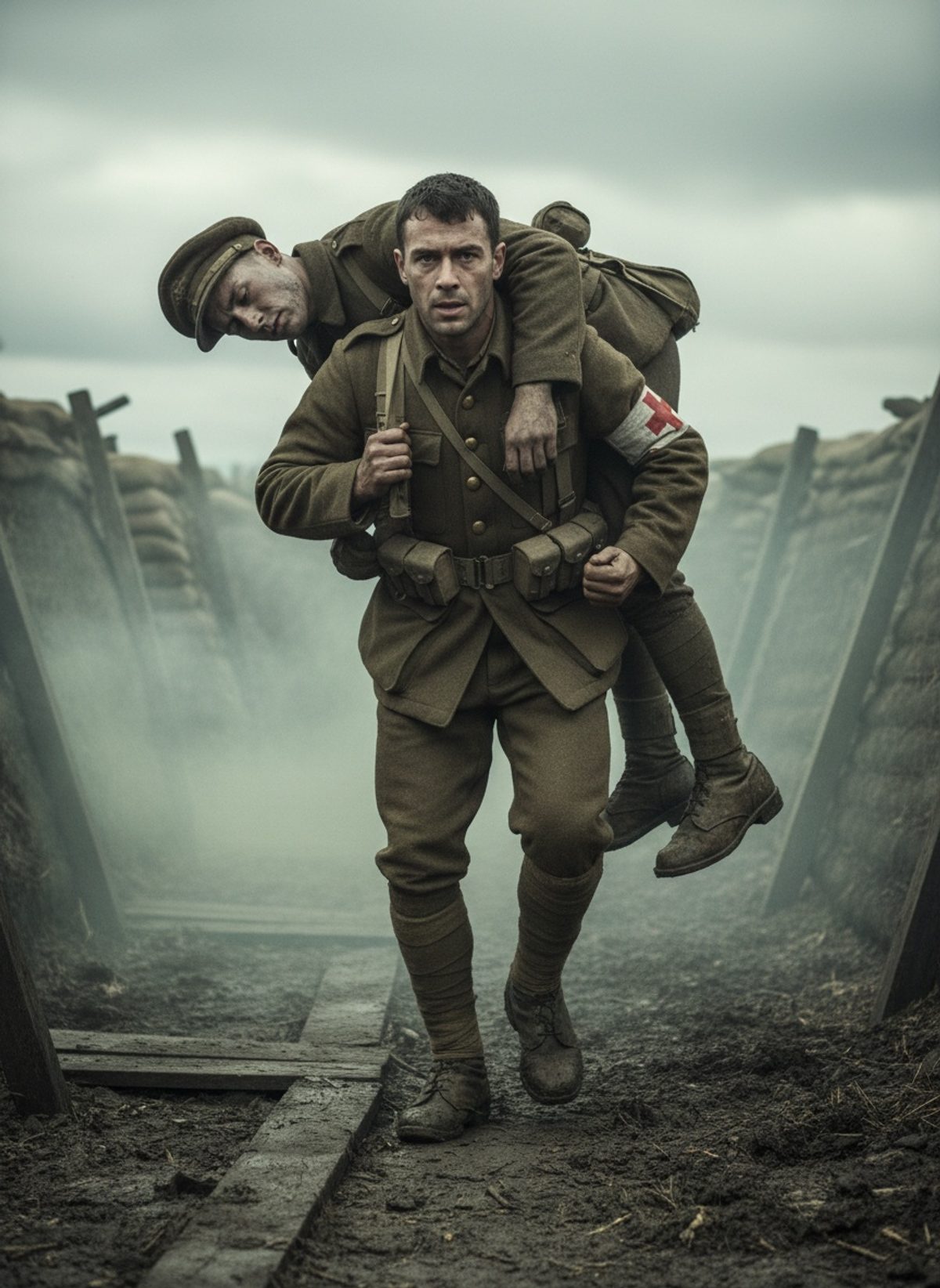
He carried no rifle. The gentle strength of his hands held only a stretcher. In the hellscape of World War One's Ypres, this absence of weaponry marked Private William Coltman as an anomaly amidst the thunder of artillery and crackle of gunfire. Yet, as the German gas attacks unfurled their deadly cloak of chlorine clouds over the Allied lines in April 1915, it was men like Coltman who embodied the quiet valor and moral courage that resisted the instinct of survival, choosing instead to walk towards danger they could hardly comprehend.
Coltman's entry into this perilous scene began deeply invested in the values of life preservation. Born and raised in the peaceful towns of Britain, Coltman had answered the call to serve not with a desire for bloodshed but to offer medical aid and spiritual solace as a stretcher-bearer. In the British Army, stretcher-bearers were lifelines, tasked with retrieving the wounded from the battlefield, often under conditions as deadly as those combat soldiers faced. What set Coltman apart, however, was his unyielding dedication to this mission, made starkly evident on that fateful spring day when Ypres was engulfed in chaos.
As the morning light struggled to pierce through the pall of war, the Germans unleashed one of their deadliest new weapons: chlorine gas, a veil of greenish-yellow death that drifted insidiously towards the Allied trenches. The reaction was immediate and visceral - panic gripped the soldiers as they clambered for escape from the advancing fog of poison. In those moments, fear was a tangible beast, driving men to flee. But where others sought refuge, Coltman moved forward, driven by an unbreakable bond to his fellow man, known or unknown.
Imagine the scene: a landscape scarred by warfare, trenches scarified with barbed wire and the relentless rain of artillery turning the earth to uncompromising mud. There, amidst the cries of the injured, the air burned by chlorine's caress, Coltman might have hesitated, yet he pressed onwards. Without a gas mask capable of genuine protection by modern standards, his only shield was the thinnest layer of rudimentary cloth, soaked with the scant hope it might ward off the invisible killer. His resolve was armored by conviction; he would not leave the wounded to suffer alone in that toxic purgatory.
Read next: The Soldier They Wounded Eleven Times and Could Not Stop
One by one, he found them — soldiers collapsed, gasping for breath, their eyes streaming from the fumes with a searing intensity. Each man was a burden he carried away from the front lines, retracing his steps through a nightmare landscape that none would wish to tread. Coltman's efforts were not driven by any grand aspirations of heroics but by an inherent empathy that refused to abandon those laid low by war's cruelty. His actions were both solitary and universal, reminiscent of figures in stories untold, whose courage existed in the whispers of history rather than the shouts of legend.
While Coltman's deeds on that April day would be sung of with pride in the years following the war, at the time, they were mere ripples in the vast ocean of the battle's brutality. The survival of one man meant scarcely a shift in the line, hardly an entry in the commanding general’s report. Yet, the impact on the lives he touched was personal and profound. Fellow soldiers recollected this unassuming man’s bravery with reverent awe, knowing well how proximity to death's grip could crystallize a moment into a lifetime's worth of stories.
The sights Coltman would have encountered are almost unimaginable: men choking in agony, unable to draw breath, their strength sapped by the malevolent agent of a new age of warfare. And yet, as he repeatedly weaved through the cloying devastation, Coltman exhibited a peculiar resilience, one less of the body than of spirit. Such fortitude was not standard-issue; it came from self-compulsion, driven by principles instilled far from any battlefield — a commitment to humanity above hostility.
In the weeks and years that followed, the stories trickled back home, pieced together by survivors and chroniclers who found themselves astonished by the ordinary man’s defiance of death. Accolades did come, for Coltman's theater of action was not only in Ypres but part of an extensive campaign where stretcher-bearers saved countless lives across the scarred French and Belgian lands. Yet it was this moment, in the gathering gloom of a gas attack, that crystallized what many already knew — sometimes, the greatest acts of courage come not from the barrel's end but from the heart's depths.
Coltman's actions spoke to a larger narrative buried within the war's clamor - the power of one individual to enact profound change, to stand defiantly against the annihilation that accompanies blind violence. In every successive war story, there are tales of men like him, less committed to the conflict as a whole and more to the humanity left battered and bleeding within it. Their stories often fall between the pages, their memories shuffled to the shadows in favor of generals and offensive maneuvers. But it is here, in the unsung voices, that we find the heartbeat of wars not fought over territory but for the preservation of souls.
Why should we remember William Coltman walking into a gas cloud for men he hardly knew? Because his tale is not merely one of uncommanded courage but a reflection of the undying human spirit to reach out and save, even when darkness beckons. In the simple choice not to turn away, Coltman reaffirmed a tenet of decency that all too often seems drowned out by the chaos around it. It reminds us that in every narrative of history, amidst decisions calculated on battle plans and maps, the true measure of our compassion lies in acts that abandon all logic of self-preservation in favor of an ancient, unspoken kinship of survival.