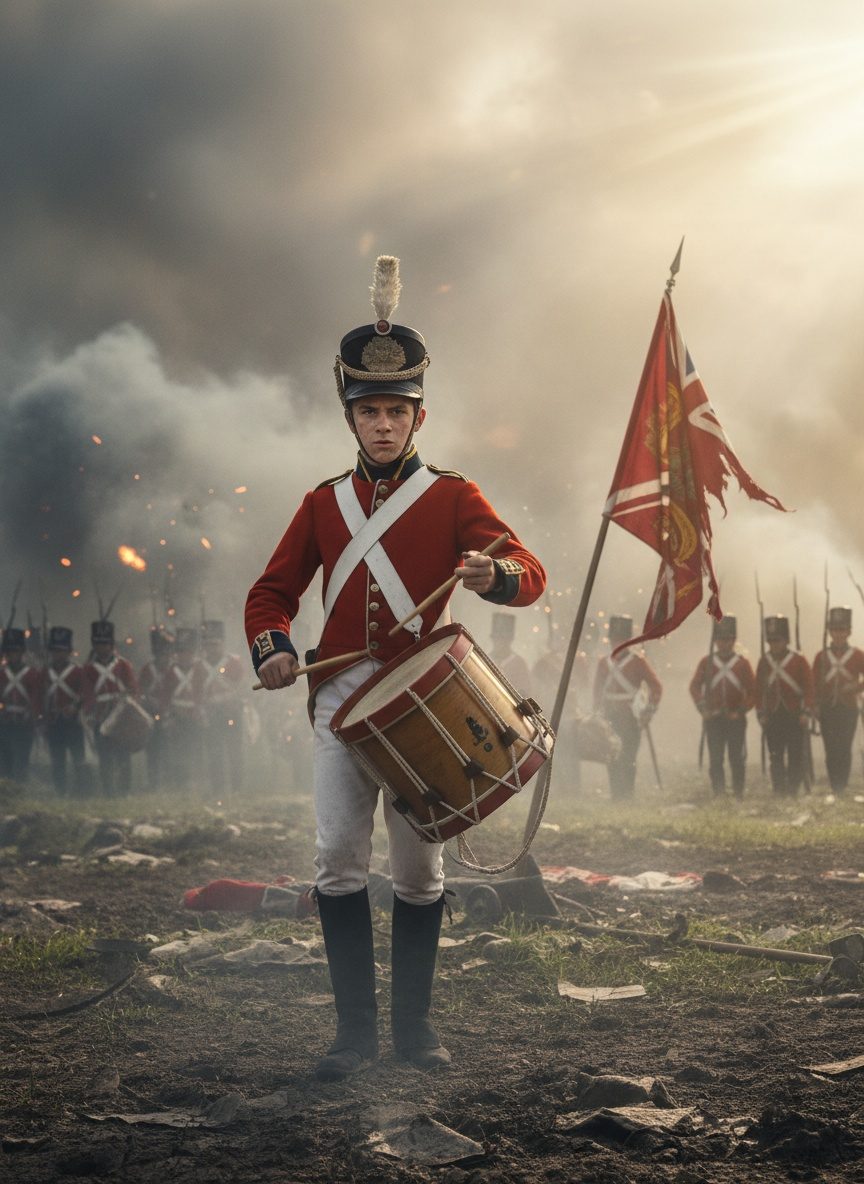
The fields outside Waterloo were a sea of emerald grass, their richness tempered by the heavy clouds that piled overhead like an unwelcome army itself. The sky was tense with the promise of rain, and cool winds whispered through the ranks of red-coated soldiers as they awaited the moment that would define them. In this charged atmosphere, a heartbeat could be heard—the measured, insistent drumming of a boy not yet old enough for whiskers, weaving between the footsteps of men whose lives depended on the rhythm he kept. In June 1815, as the Napoleonic Wars neared their bloody conclusion, the Battle of Waterloo was set to carve its place in history. Among the forces stood a fifteen-year-old drummer boy, woven into the fabric of an epic confrontation with only a drum for company.
The sight of him in this formidable tableau—so small against the vast backdrop of impending chaos and violence—was both touching and unnerving. This young boy, barely past childhood, was essential to the regiment. Despite the chaotic scramble of war, his task was vital. Amidst the explosions and gunfire, when commanders' commands could not be carried over the miles of desperate fighting, it was the cadence of his drum that signaled maneuvers, communicated orders, and maintained the regiment's cohesion. The beat dictated the pace of the battle, a substitute tongue that moved hundreds to action. It was these tattoos that shepherded courage through fear as death danced in the muddy expanses of Belgium.
With eyes scanning the horizon, the young drummer boy understood more than most would give him credit for. Waterloo was not just a battle of swords and bayonets but one of wills. The missteps that unraveled great empires hung in the air like so much gunpowder smoke. A beat issued wrong or missed could unravel a line, could send a formation spiraling into chaos. Yet to hear the deliberate tap of the drum against the clamor of clashing forces was to recognize the extraordinary, unerring trust soldiers placed in this boy and his peers, whose rhythms heralded both charge and retreat. Theirs were the voices of order against disorder, threading through a tapestry woven thick with human valor and despair.
This trust was tested by the very nature of warfare that Napoléon's forces and their adversaries had transformed. Tactics evolved alongside weapons, all conspiring to render battles like Waterloo unpredictable and savage. Yet across the battlefield, thousands of soldiers believed in the simplicity of a drum—a belief rooted as much in tradition as in necessity. Modern readers, often surprised by the significance of the role these boys played, might not know that these drummers were usually positioned at the heart of the brigade, the gravitational center around which men formed and reformed their ranks.
Read next: The Night a Teenage Gunner Held the Bridge at Arnhem
The sun, obscured by clouds, rarely pierced the gloom above, but when it broke through, it bathed the fields in an ethereal glow, spotlighting moments of incredible bravery and vulnerability. Despite the primal fear thrumming in his chest, the drummer boy’s rhythm never faltered. As the battle lines surged and receded like the tide, the wails of those caught in its drag echoed through the chaos. The drumming became not just a command but a comfort; a familiar, steady companion amid the noise of artillery cratering the landscape. There was a peculiar bravery in this simplicity—bravery not born of ignorance, but of determination.
Through the course of that terrible day, the history of Europe trembled at the edge of a knife. The effective rhythm of these drummer boys—woven seamlessly with the pounding hoofbeats of cavalry, the marching of infantry, the blasts of musketry and cannon—created a discordant symphony that signaled both triumph and tragedy. Each sonorous beat held among its echoes the outcome of an indeterminable future afflicted by Napoléon's dreams of empire, entwining their destiny with his. The rhythms their sticks composed were critical to managing the living chaos that defined Waterloo.
Amidst this tableau of tumult and resolution, many drummer boys like him would not see the close of that fateful June day. They marched fearlessly forward despite knowing that peril lingered at their heels, aware that survival was as much about fortune as it was about skill. Others, however, did return, scarred by what they witnessed, older than their years would suggest. Those who found themselves on the battlefield’s fringes, protected only by the flimsy reassurance of their drums, understood that history would remember Waterloo for empires and generals. Yet within their beats lay the rhythm of history itself, the soul and testament to the courage of boys who became men amidst the firestorm.
The story of the drummer boy from Waterloo whispers through the annals of time, urging us to remember the overlooked courage of those who fought with rhythm rather than rifles. They remind us of a world in which music was martial; a world where victory and defeat hung in the balance of a cadence. They leave us to ponder the sounds of war—how the silence that follows can speak just as loudly, serving as an eternal echo of those whose sacrifices we must never forget. Through their beats, we hear more than a sound—we hear the enduring legacy of youth, courage, and conflict.