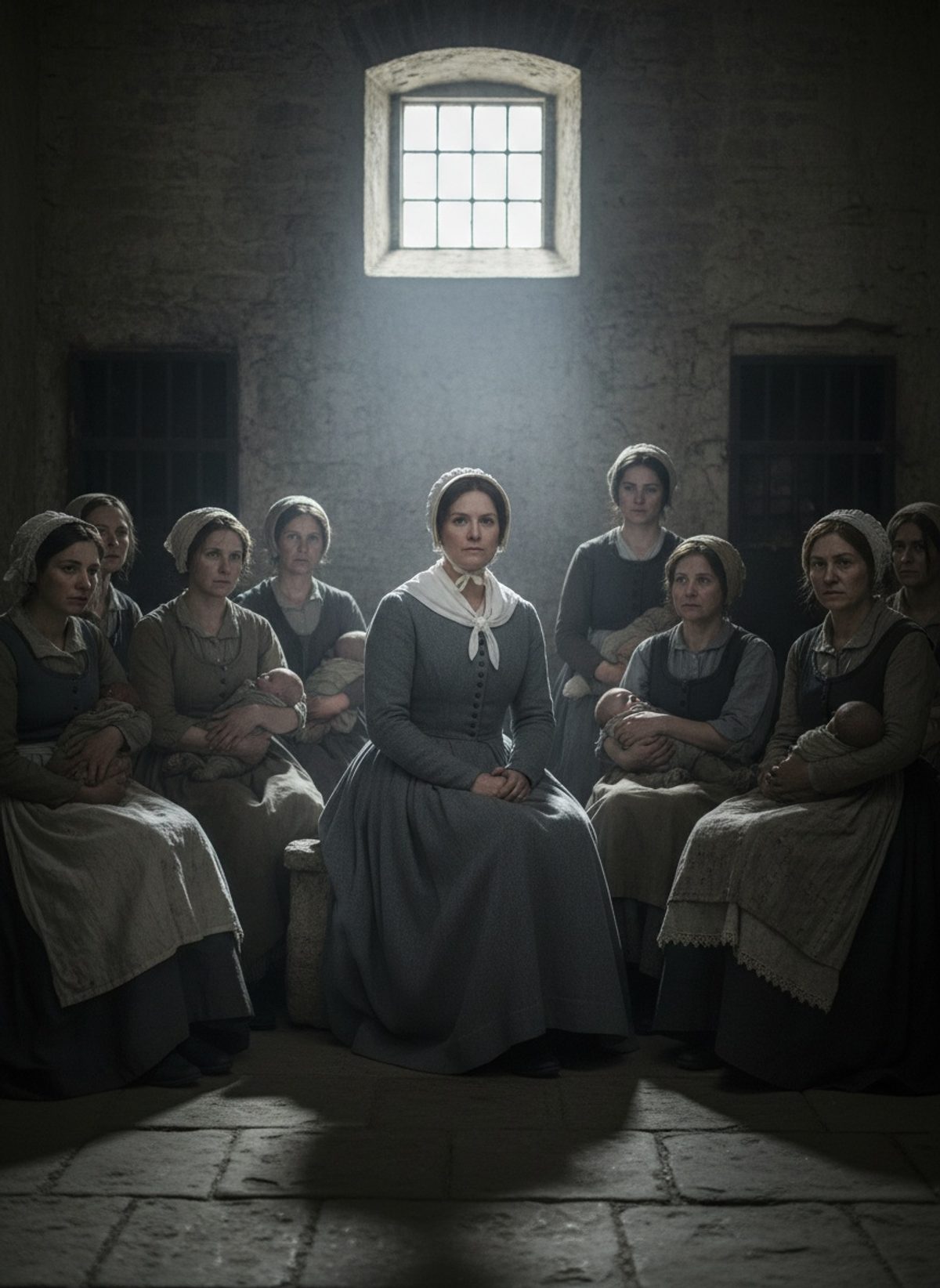
She was a banker's wife who had never held public office. Yet, Elizabeth Fry transformed the lives of forgotten souls in the most notorious prison in England.
The Shocking Reality Inside Newgate
In 1827, London's Newgate Prison was a squalid chamber of despair, filled with the cries of desperate women and children. The stench of neglect pervaded the air, mingling with the echoes of sorrow. It was here that Elizabeth Fry, armed with the strength of her convictions rather than any official title, made her way into the heart of human misery.
Fry entered the prison not with the aloof distance of an observer but with the sincere curiosity of a fellow human. What she encountered was beyond grim: inmates crowded in dark, unventilated spaces, with little more than their tattered dignity to call their own. The women and children, residing in filth, were tangled up in an endless nightmare from which escape seemed impossible.
Fry refused to be a mere witness to their plight. She sat amongst these forgotten souls and began the slow, arduous work of lighting a spark in a place shrouded in despair. With each visit, her proximity to these inmates seemed to lighten their grim shadows, offering the gentle illumination of hope.
Read next: The Day 500 Highlanders Stood and Refused to Die
Reading Hope Into Existence
Though she was not wielding power like a politician or a monarch, Elizabeth Fry's influence was profound. Each week, she returned to Newgate, her presence a comforting constant in a world defined by uncertainty and fear. Her weapon of choice was neither a sword nor a pen, but rather the soothing cadence of her voice as she read aloud to the prisoners.
Through books, Fry unlocked the possibility of a world outside their dark cells. The scriptures she shared offered solace, a compassionate balm for wounded spirits. With every word she shared, Fry inspired in these women a belief in their own worth — an essential step toward reclaiming their humanity.
It was a radical movement in its quiet defiance, an unspoken challenge to the systemic brutality that treated these individuals as less than human. Her dedication was more than an act of charity; it was a vision of change at a time when even the whisper of reform seemed audacious.
Organizing Beyond the Walls
Elizabeth Fry's mission extended beyond reading sessions. The determined Quaker transformed Newgate into more than a fortress of misery — it became a workshop of redemption. Understanding the necessity for skills and structure, Fry initiated programs within the prison to provide education and employment for the women.
By organizing classes in sewing, knitting, and other practical crafts, she instilled in them the tools necessary for self-sufficiency. Many inmates, previously languishing in idleness born of neglect, now found themselves contributing to society through their work.
Fry's vision extended to hygiene and health. She set out to improve the living conditions within these oppressive walls, introducing clean clothing and encouraging basic sanitary practices. Over time, order began to replace chaos, and the seeds of dignity flourished even in such inhospitable soil.
The Reluctant Advocate Meets Parliament
Despite her aversion to public life, Elizabeth Fry's efforts at Newgate increasingly caught the attention of the wider world. Her unyielding commitment and the transformations wrought within the prison could no longer be ignored. Summoned before Parliament, Fry became the voice for those who had been systematically silenced.
Her testimony was delivered with the quiet fortitude and moral clarity that had defined her work. Fry articulated not just the deplorable state of the prisons but presented a convincing case for the humane treatment of inmates. Her appeal was not merely emotional but rational; she argued for reforms that recognized the potential within every human being.
The echo of her words reverberated within the hallowed halls of power, challenging the status quo and paving the way for legislative changes. Slowly, the public began to see the incarcerated not as irredeemable outcasts but as individuals capable of change.
A Legacy Forged in Empathy
Elizabeth Fry's journey into Newgate was not merely an act of charity but a radical re-imagining of what could be. Her legacy is not only in the lives she touched or the reforms she inspired but in the profound truth she revealed: empathy knows no bounds, and dignity is not the privilege of the few but the right of all.
Her story goes beyond the confines of the Victorian era, serving as a timeless reminder that change often begins with a single resolute step into the darkness. In an age where numbers and statistics often overshadow human stories, Fry's example is a powerful reaffirmation of the impact one person can have upon systems seemingly set in stone. Her life is a testament to the enduring power of compassion to illuminate even the darkest corners of our world.