March 1944. A sharp wind cut across Salisbury Plain, carrying with it the scent of damp earth and anticipation.
Gathering of Titans
Amidst the rolling hills of Salisbury Plain, a patchwork of kaki spread across the English countryside—an army at rest yet bristling with readiness. This was no ordinary day, for amidst the bustling activity of the American troops stationed there, a figure renowned across the world moved purposefully, as if he were surveying his realm. Winston Churchill, Britain's indomitable Prime Minister, was not merely visiting; he was solidifying bonds that fatefully would tilt the balance of a world at war.
The alliance between the United Kingdom and the United States during World War II was as much about personal diplomacy as it was strategic necessity. Churchill understood this perhaps better than most. His visit to the American troops in March 1944 was more than ceremonial; it was theatrical diplomacy at its finest, aimed to inspire, cement ties and remind the soldiers why they were far from home, living under grey English skies in preparation for a confrontation that would decide the fate of nations.
Ahead lay the crucible of D-Day, and these men were the tip of the lance. As he mingled with the soldiers, Churchill's presence—a galvanising force—brought a semblance of assurance and familiarity to a foreign land. Known for his charisma and sharp wit, Churchill's interaction with the American servicemen was as much about boosting morale as it was about exemplifying the trans-Atlantic spirit forged in the fiery trials of World War II.
Read next: The Night a Teenage Gunner Held the Bridge at Arnhem
A Prime Minister's Trigger Finger
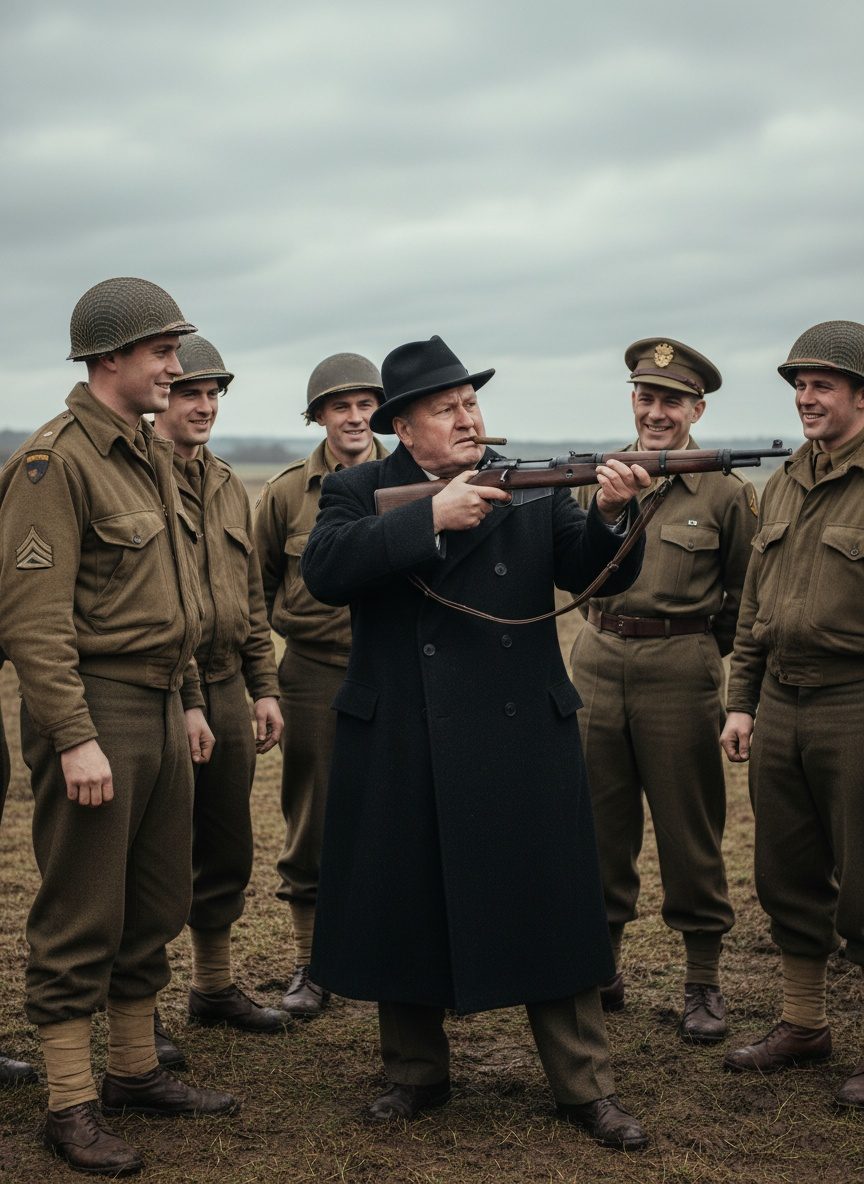
The morning was punctuated by a startling and emblematic moment—a snapshot in history, embodied not in written speeches or broadcast addresses, but in a gesture rather unexpected for a Prime Minister. During his tour, Churchill came across the soldiers' armory, and like a seasoned performer seizing the climactic moment, he picked up a US Army .30 carbine, compact yet deadly, used widely among the American troops.
The diminutive weapon was known for its reliability and effectiveness in the hands of paratroopers and other American soldiers racing toward liberation. To see Britain’s steadfast leader aim this iconic piece of American ordnance was to witness the very embodiment of the Allied partnership—a melding of purpose and power. Crack! The sound of the shot echoed across the plain, piercing the quiet; a singular report that was immediately absorbed into the evolving narrative of Allied victory.
The image of Churchill firing the carbine captured both symbolically and literally the unity between the two nations. In that brief moment on Salisbury Plain, all that rhetoric about unity, shared sacrifice, and common cause was galvanised into action, one definitive action that resonated with those there and rippled outwards beyond the military ranks to the civilians who also found themselves inextricably part of this global conflict.
An Alliance Forged in Gunpowder
Churchill firing an American weapon might have seemed an odd, almost anachronistic sight. However, it encapsulated the earnestness of the bond that was, by that stage of World War II, robust and critical to the impending triumph over tyranny. Here was the British Bulldog with the tool of the American soldier—a juxtaposition leading to a symphony of cooperation. Diplomats, generals, and politicians built this alliance in meetings and strategy sessions, but in the mud and grass of Salisbury Plain, it was something tangible and powerful.
History would show that the gathering of these allied powers on English soil was essential to securing the liberation of Europe from Nazi occupation. Months later, when the beaches of Normandy bore the weight of advancing liberators, the ties forged through shared gestures and common pursuits bore fruit. The .30 carbine, compact and fierce, symbolised agility and determination; qualities allies needed more than ever on the precipice of Operation Overlord.
As the echoes of that gunshot faded into history, what remained was the realisation that this partnership went far beyond mere political alliance—it was the blend of will and weaponry, geographical boundaries notwithstanding, that culminated in the eventual path to peace. The weight of the moment spoke to the idea that unity can manifest in the simplest acts, searing into the collective memory a reminder of what can be achieved when disparate hands shoulder the same gun in pursuit of a common goal.
Today, the story of Churchill and the American rifle is more than a footnote in the history of the great war; it reflects an understanding that the ties that bind can often find expression in the most unexpected way. For those on Salisbury Plain that day, the image of a Prime Minister wielding a foreign weapon underscored the deep, interwoven strands of a partnership that helped shape the modern world's destiny. It is a story that, while left out of many textbooks, resides firmly in the heart of the shared Allied legacy—a poignant reminder of unity in adversity.