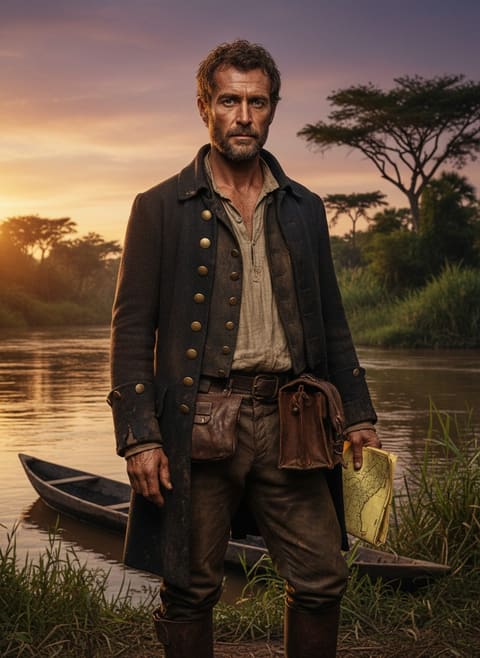
July 17, 1804. The grated window allowed just a sliver of the Indian Ocean's salty breeze to penetrate the stifling cell.
The Seafarer’s Ambition
Long before the era of air travel, the Earth was a map waiting to be drawn, and Matthew Flinders was one of its eager auteurs. Born in England, Flinders fell in love with the sea, inspired by Daniel Defoe’s "Robinson Crusoe." Fascinated by the promise of uncharted territories, he honed his skills as a navigator, eventually leading him to the brink of monumental discovery.
Though many had speculated about a vast southern land, it was Flinders, with a sharp mind and an unwavering spirit, who would traverse the daunting coastlines of what was then known as New Holland. His voyage with the ship Investigator was nothing short of legendary, charting the serpentine contours of a single, sprawling continent. Through meticulous exploration, he stitched together the jagged coastline, proving once and for all that Australia was an island distinct from its northern landmass neighbors.
A Stall in Mauritian Waters
However, the winds of fortune are as fickle as the sea. As Flinders completed his circumnavigation, political storms brewed. The temporal ripples of the Napoleonic Wars reached across oceans. En route back to England to share his groundbreaking findings with the world, Flinders made a fateful stop at Mauritius, then a French-controlled island.
Read next: The Day a Devon Captain Charted the Pacific and Changed the World
Bearing the scars of his grueling journey, the ship required urgent repairs. But Peron, the French governor, eyed the British navigator with suspicion. Amidst escalating tensions between France and Britain, Flinders found himself unexpectedly under arrest, the victim of imperial entanglements and mistrust. Inside the chafing confines of the colonial prison, his mission was stalled indefinitely. A world-shaping revelation, locked away like some arcane secret.
Writings Behind Bars
Yet, Flinders was not a man easily quelled. His anticipation turned into resilience, his enclosure, an unplanned study. In the dim confines of his cell, confronted by the persistently waving palm leaves, he set his mind adrift on paper. With painstaking precision, he began crafting the narrative of his epic voyage, detailing every discovery and insight. His charts sat idle, but they lived within his words.
It was during these interminable days of captivity that he first penned the name Australia—a nod to the Latin word Australis, meaning 'southern'. He reasoned it captured the essence of a land defined by its southern latitude, far removed from other more familiar continents. This nomenclature gave the region an identity distinct from the Dutch appellation of New Holland, a vision of unity tailored for a common discourse.
The Endurance of a Name
Six years ambled by, years when the world scarcely knew the struggles of a man far from his homeland, victim to the time's geopolitical paranoia. External correspondences were scant, but Flinders’ relentless spirit endured—his loyalty to accuracy, his devotion to nomenclature, and sheer belief in the providence of science over politics.
Read next: The Day a Devon Sailor Mapped the Roof of the World Alone
Upon his eventual release, weary but undeterred, Flinders returned to Britain. There, he found his reports awaiting attention, eager to breathe life into endless sheets of dotted lines and coastal silhouettes. By the time of their publication, public intrigue had transformed into acceptance. The name Australia began to permeate, validating Flinders’ contribution and fundamentally reshaping our mental maps of that southern land.
Beyond the Horizon
The naming of Australia was more than a cartographer's cursory decision; it was a reflection of an indomitable desire for knowledge and coherence. Flinders’ story matters because it reminds us that exploration is not just about discovery, but about overcoming the terrestrial and philosophical limits. It tells of a man who chased clarity amidst chaos, leaving behind a narrative stitched together inside a cell—a reminder of the enduring struggle to enlighten and define our world.
In the end, the void between what is unknown and known has always beckoned humanity forward. It is on edges like these that we define horizons, not just geographically, but within the expansive landscapes of the human spirit.