He was a master of oratory, yet for once, he was forced into silence. Winston Churchill, the man whose speeches became the battle cries of a nation, found himself in a moment where words might not suffice.
The Gathering Storm
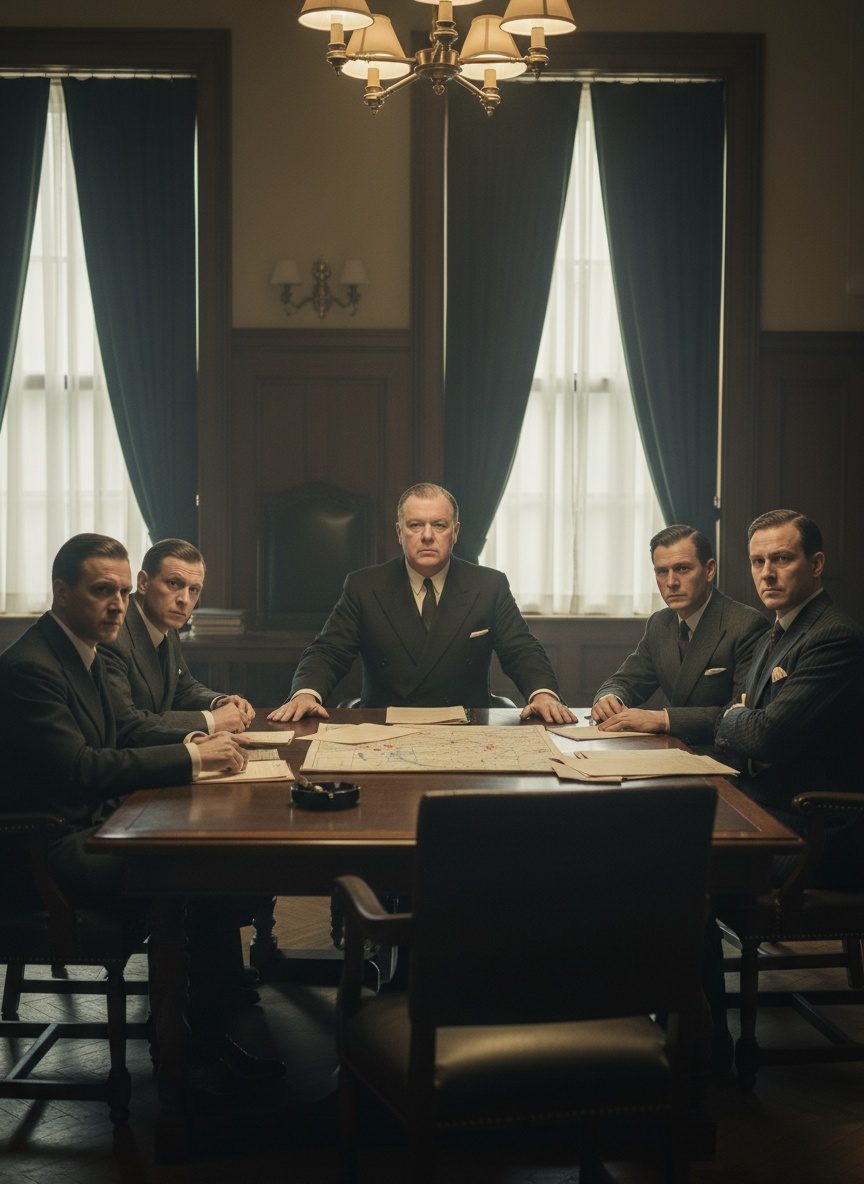
In May 1940, Britain teetered on the brink of disaster. The German Blitzkrieg had torn through Western Europe with alarming speed, leaving Dunkirk in flames and nations crumbling. Britain stood alone, its allies subdued and beaten. As news of the calamity unfolded, a small locked room at 10 Downing Street became the setting for a battle that could have changed the course of history. The War Cabinet, a nucleus of five men, faced a decision of staggering consequence: should Britain negotiate with Hitler, or fight on against seemingly insurmountable odds?
Churchill's defiance in public was unwavering, but behind closed doors, his Cabinet was fracturing. Lord Halifax, the Foreign Secretary, was not a man to be easily swayed by the fervor of Churchill's rhetoric. To him, pragmatism dictated consideration of a softer line—a negotiation with Hitler to preserve what remained of Britain's empire and stave off total destruction. But for Churchill, compromise with tyranny was unthinkable. The stakes were titanic; the atmosphere electric.
Halifax and the Path of Compromise
Known for his aristocratic stoicism, Lord Halifax was no stranger to diplomatic intricacies. He believed that considering peace terms through Italy, which was then still a neutral power, could preserve Britain's dignity and its global dominion. Halifax envisioned a Britain that might bow its head momentarily but remain standing when the storm passed. What he did not foresee was the tidal wave of consequences such a path might unleash—a Europe forever shadowed by fascism, its own sovereignty compromised.
Read next: The Night a Teenage Gunner Held the Bridge at Arnhem
Halifax's proposal was not born out of cowardice but from a deep sense of responsibility. He feared the unimaginable cost of continuing the fight: cities reduced to rubble, thousands more lives lost. Yet, against this backdrop of worry and pragmatism, Churchill's spirit burned incandescently with a conviction that faltering at this moment would lead to a future far darker than the present menace.
The Silence of Determination
In those tense cabinet meetings, Churchill fought not with his infamous bombast, but with a simmering resolve. While others spoke, he sat quietly, absorbing, calculating. He knew that his decision needed not just to be right but to resonate with an undying spirit. The Prime Minister's instinct was to channel the tenacity of Britain's storied past—the resilience of Caesar-defying Celts, the stoicism of islanders weathered by centuries of invasion attempts. He knew the gravity of the moment transcended his own political career; it encapsulated the moral soul of his nation.
Four days past this silent trial, he would stand before the House of Commons and declare that they would "fight them on the beaches," but in that silent room, his battlefield was the hearts and minds of five very different men. Churchil’s conviction, though unspoken in leaps, had to pierce through private doubts and public fears.
The Weight of History on Their Shoulders
Each man's choice in that room carried the weight of history. Churchill’s eyes, heavy with the burden of leadership, met those of Halifax and the rest. He understood the temptation to seek a peace that might safeguard immediate safety, but he envisioned a future unshackled from the tyranny of Nazi domination. He also knew that history would judge them not merely for their choices, but for their faith in the resilience of the British spirit.
As the discussions floored, it became clear that Churchill’s influence was not just intellectual but inspirational. He spoke less, but when he did, the words curdled with urgency and the call to valor. The Prime Minister, aware that no document could capture the ethos of a fighting spirit or the value of freedom, relied on the gravity of the moment to speak for his taciturn refusal to bend.
A Turning Point Unseen
Though the room was void of a formal vote, the atmosphere congealed with the realization—there could be no compromise. Churchill had faced his Cabinet and refused to yield, his resolve silent but unshakeable. Very few outside those walls knew just how close England came to brokering peace with Hitler's regime. It took decades for the public to learn the fragile nature of those days, and the audacious gamble taken to reject surrender when it was most tempting.
In the grand symphony of history, sometimes the quiet struggles, fought away from the public eye, prove most pivotal. Churchill’s stand that night on Downing Street, cloaked in silence, was a testament to his understanding that sometimes the fiercest battles require no words at all. Britain emerged from that room poised not just to survive, but to prevail, leaving an indelible mark on the pages of time—one that proved freedom is not freely given, nor ever lightly surrendered.