April 21, 1982. The icy winds howled with unyielding fury across the barren expanses of South Georgia Island.
Whipping through the glacial basin, the ferocious gales reached speeds of over a hundred miles an hour, plunging temperatures to life-threatening lows. This was not a place for mere mortals, and certainly not a place for rescue operations. Yet, it was here, amidst the blizzard's wrath, that fifteen men from the Special Air Service (SAS) found themselves locked in a deadly struggle for survival.
The mission had begun with high hopes and strategic military objectives. South Georgia, a remote outpost closer to Antarctica than Argentina, had become an unexpectedly pivotal location during the unfolding Falklands War. For the SAS, the stakes were high: a successful operation could tip the delicate balance of power in favor of British forces. But neither strategy nor valor can conquer the forces of nature, and the tempest turned ambition into a deadly dilemma.
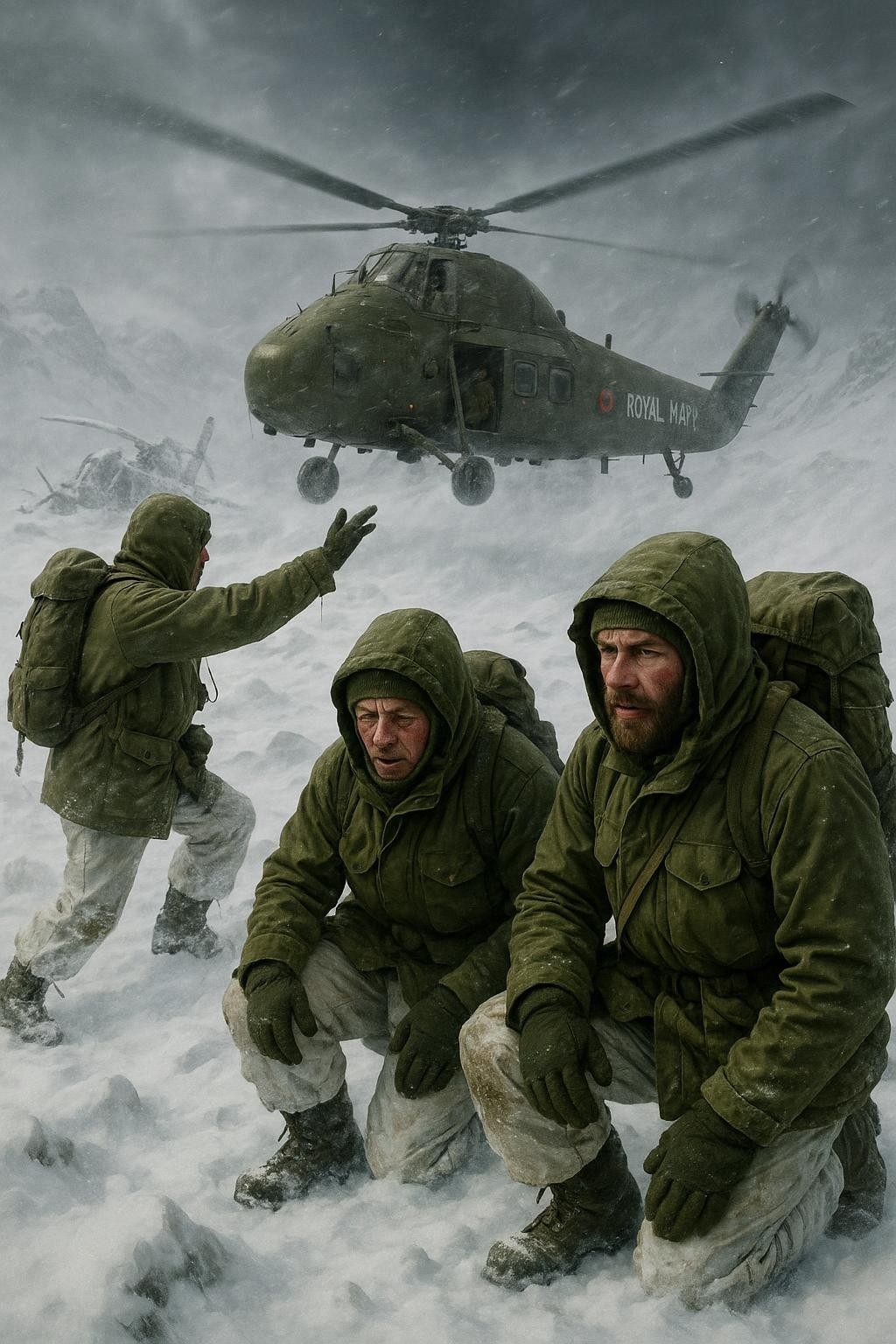
The initial plan had been clear: insert the SAS team onto the glacier to conduct reconnaissance and secure a foothold. However, the unpredictable and volatile weather rapidly escalated into a nightmare scenario. With the storm raging, two helicopters tasked with the extraction had already succumbed to the icy grip of the mountain, their fractured remains etched into the glacier like grim souvenirs of man's overreach.
Read next: The Night the British Ate the President's Dinner
Amidst the chaos, Lieutenant Commander Ian Stanley faced an unenviable decision. A seasoned pilot with long years of service beneath his wings, Stanley knew the precarious nature of flying at high altitudes in adverse weather. He was not a man to tempt fate lightly. Yet the sight of his comrades stranded, against the unrelenting backdrop of white, left him with no choice. Turning his British Wessex helicopter back into the heart of the storm was an action born not of recklessness, but of resolve.
The first attempt at rescue was fraught with peril. The blustery winds wreaked havoc on the aircraft's controls, testing not only the limits of technology but also the endurance of the human spirit. With visibility reduced to nearly zero, Stanley navigated not by sight, but by instinct, a mental map etched into his consciousness through years of rigorous training. He descended into the eye of chaos and managed to land—a feat inspired by necessity as much as skill.
The helicopter was not designed to hold fifteen men in addition to its crew. Yet as the frozen soldiers clambered aboard, their frostbitten faces a stark reminder of the urgency, practicality gave way to ingenuity. Packed like sardines, with survival instincts overriding discomfort, the men huddled together as Stanley attempted the impossible—a vertical evacuation through roaring elements that conspired at every moment to ground them permanently.
With the first precious group secured aboard, Stanley's helicopter ascended from the glacier, battling every gust as if engaging in a high-stakes combat with the mountain itself. Any respite was fleeting. As soon as this group was safely delivered to a nearby support ship, the HMS Tidespring, a solitary question loomed: could he do it again?
Most would have called it a day, praised the heavens for a successful extraction, and doubled their prayers for those left behind. But within Stanley dwelled a courage that transcended the ordinary. Resolute in his commitment, he made the decision to face the elements anew. Perhaps it was the camaraderie, the unspoken bond forged in the face of danger, or perhaps it was the haunting weight of responsibility that pulled Stanley back into the storm. Whatever the motivation, there was no hesitation—the decision was singular, driven by honor and necessity.
Read next: The Day a One-Eyed Admiral Sailed Into the Line of Fire
Returning through the storm, the helicopter blades bit into the wind as Stanley retraced the treacherous path to the glacier. The second and final rescue was as harrowing as the first, if not more. The helicopter's interior rang with the freezing cacophony of wind and metal, a symphony of nature's ire clashing with mechanical resolve. Positioning the aircraft upon the ice once more, Stanley awaited the remaining soldiers who relied on his skill and determination for their salvation.
With every fleeting moment spent on the glacier, the situation grew progressively dire. Yet, inch by painstaking inch, the final men clambered aboard the Wessex. Their frostbitten extremities told tales of their ordeal more eloquently than any words. Once all were secured, Stanley steered the helicopter into the storm, executing an ascent underscored by sheer tenacity.
The return was fraught with tension and tentative silence, punctuated only by the rhythm of the rotors and the haunting memories of how close they had come to oblivion. But as Stanley finally sighted the HMS Tidespring and descended towards safety, the cabin erupted in a shared realization—the insurmountable had been conquered, a full evacuation achieved against incalculable odds.
In an age defined by technological prowess and military might, it is easy to overlook the enduring power of individual initiative and courage in the face of adversity. Stanley's daring rescue serves as a poignant reminder that heroism transcends circumstance, anchored instead in the unwavering commitment of one person to another. In the isolated reaches of the South Georgia glacier, the intertwining of human spirit and mechanical ingenuity made history. It's a narrative of resilience, both vivid and untold, that underscores the timeless capacity of determination to triumph—even in the storm's eye.